Clear Sky Science · en
Rigorous construction and classification of solitary-waves and exact soliton configurations in the nonlinear coupled Maccari system
Why waves can travel alone
From ocean swells to light pulses in fiber-optic cables, many important signals move through nature as waves. Sometimes, these waves behave in a surprisingly orderly way: instead of spreading out and fading, they lock into self-sustaining “packets” that travel long distances without changing shape. These packets, called solitary waves or solitons, help explain extreme events like rogue waves at sea and underlie technologies such as high-speed internet. This paper explores a mathematical model that captures such behavior in complex media and shows how to build a rich catalog of these solitary wave patterns exactly, using pencil-and-paper mathematics rather than brute-force computation.
A mathematical playground for real waves
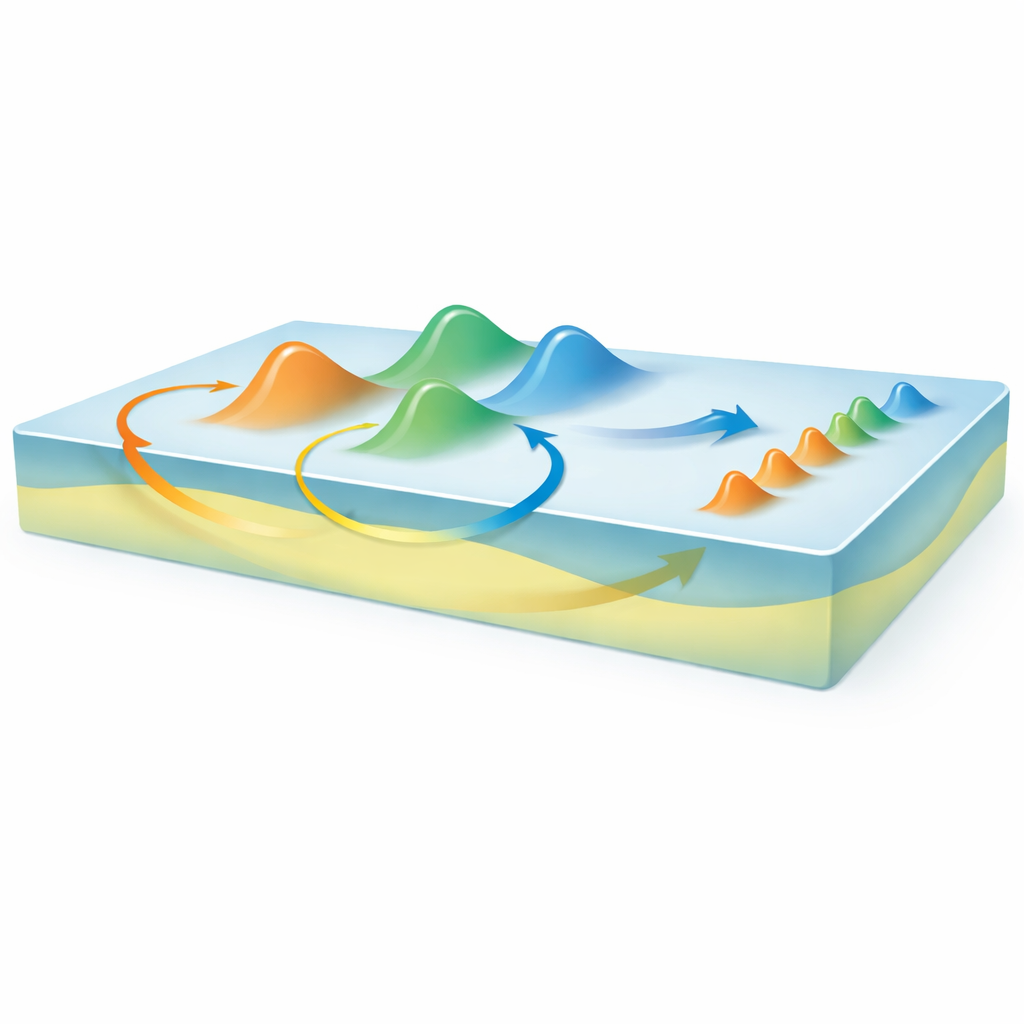
The study focuses on the nonlinear coupled Maccari system, a set of equations closely related to the Schrödinger equation of quantum mechanics. Instead of describing a single wave, this system tracks three interacting short-wave components together with a slower, long-wave background. That makes it useful for a variety of real-world settings. In plasma physics, it can represent how high-frequency electromagnetic or electrostatic waves interact with slower changes in charged-particle density. In water-wave theory, the same framework captures how short, choppy waves ride on top of large-scale currents or swells. Environmental flows, such as those in stratified oceans and the atmosphere, can also be viewed through this lens, where several kinds of waves exchange energy as they travel.
A new way to tame nonlinear equations
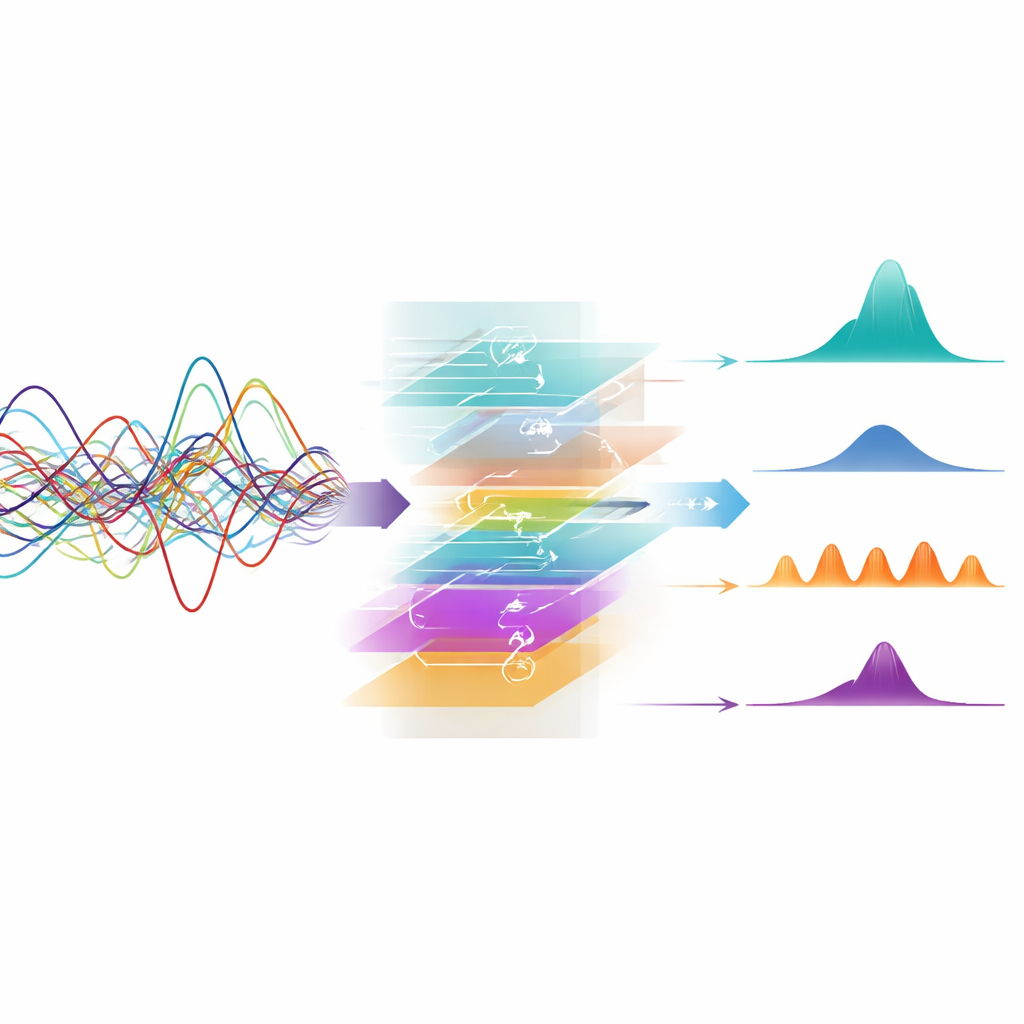
Nonlinear wave equations are notoriously hard to solve exactly. The authors adopt and extend a relatively new analytical tool called the generalized exponential rational function (GERF) method. The idea is to first convert the original equations into simpler ones by looking for traveling waves—patterns that keep their shape while moving. This reduces the model from partial differential equations, which depend on space and time, to ordinary differential equations in a single combined variable. The GERF method then assumes that the wave profile can be written as a carefully chosen combination of exponential terms arranged as a rational (numerator-over-denominator) expression. By substituting this flexible guess into the reduced equations and matching coefficients, the messy nonlinear problem collapses into an algebraic system that can be solved symbolically, here with computer algebra software.
Many shapes for solitary waves
Using this strategy, the authors systematically construct and classify a wide array of exact solutions for the Maccari system. These include bright solitons, where wave energy is concentrated into a localized hump, and dark solitons, where a localized dip travels on an otherwise uniform background. They also uncover kink-like structures that connect different background levels, periodic waves that repeat regularly in space, and singular solutions where the mathematical profile becomes very steep or even unbounded at isolated points. The solutions appear in many familiar mathematical guises—hyperbolic, trigonometric, exponential, rational, and polynomial forms—each corresponding to a distinct type of wave behavior. By varying the parameters that set wave speed and coupling strength, the same framework yields single pulses, trains of multiple waves, and more intricate multiwave configurations.
From formulas to physical insight
To connect the algebra with physical intuition, the paper visualizes selected solutions as three-dimensional surfaces, showing how wave amplitude changes in space and time. These plots highlight how the derived solitons move without distorting, how different components of the system share similar shapes, and how the long-wave background responds to the clustered short waves riding on it. The authors compare their families of solutions with earlier results obtained by other techniques and show that the GERF method not only recovers known patterns but also produces new ones, enriching the known solution space of the Maccari model. This expanded catalog offers ready-made test cases for numerical simulations and a toolkit for exploring phenomena such as modulational instability, energy localization, and wave–current interaction.
What this means for understanding waves
In essence, the study demonstrates that a relatively compact mathematical recipe can generate a large variety of solitary and periodic waves in a model relevant to plasmas, water waves, and environmental flows. By providing explicit formulas rather than purely numerical snapshots, the GERF method makes it easier to probe how parameters control wave speed, shape, and interaction, and to design scenarios that mimic real physical conditions. The authors note that the method has limits—it works best when equations can be cast into a form compatible with their assumed expression and may not capture chaotic or highly irregular behavior. Still, by turning a challenging nonlinear system into a catalog of solvable wave patterns, the work advances both the theory of solitons and practical tools for studying complex wave dynamics in nature and technology.
Citation: Hussain, A., Khalel, N.J., Oğul, B. et al. Rigorous construction and classification of solitary-waves and exact soliton configurations in the nonlinear coupled Maccari system. Sci Rep 16, 10746 (2026). https://doi.org/10.1038/s41598-026-46019-6
Keywords: solitons, nonlinear waves, plasma physics, water waves, analytical methods