Clear Sky Science · en
Perceiving material qualities from moving contours
Seeing What Things Are Made Of
Imagine watching a balloon, a splash of water, or a drifting cloud of smoke, but instead of a full-color movie you see only their outlines, drawn like a simple cartoon. Could you still tell what each thing is made of—whether it’s jelly, liquid, fabric, smoke, or solid glass? This study asks how much our sense of material comes not from color and texture, but from the way an object’s outline moves and changes over time.
From Cave Lines to Moving Sketches
Humans have relied on line drawings for tens of thousands of years, from ancient cave art to modern comics. A few well-placed lines can describe a face, an animal, or a landscape, even without shading or color. That works because lines trace the important edges of objects: their contours and folds. Earlier work showed that even a single still outline can hint at what something is made of—for example, smooth straight edges may suggest plastic, while jagged spikes can feel like metal. But real materials rarely sit still. Fabrics ripple, liquids flow, smoke billows, and brittle objects shatter. As they move, their contours stretch, wobble, and break apart. The authors asked whether these moving outlines alone are enough for our eyes and brains to recover a rich sense of material qualities.
Building Movies Out of Edges and Dots
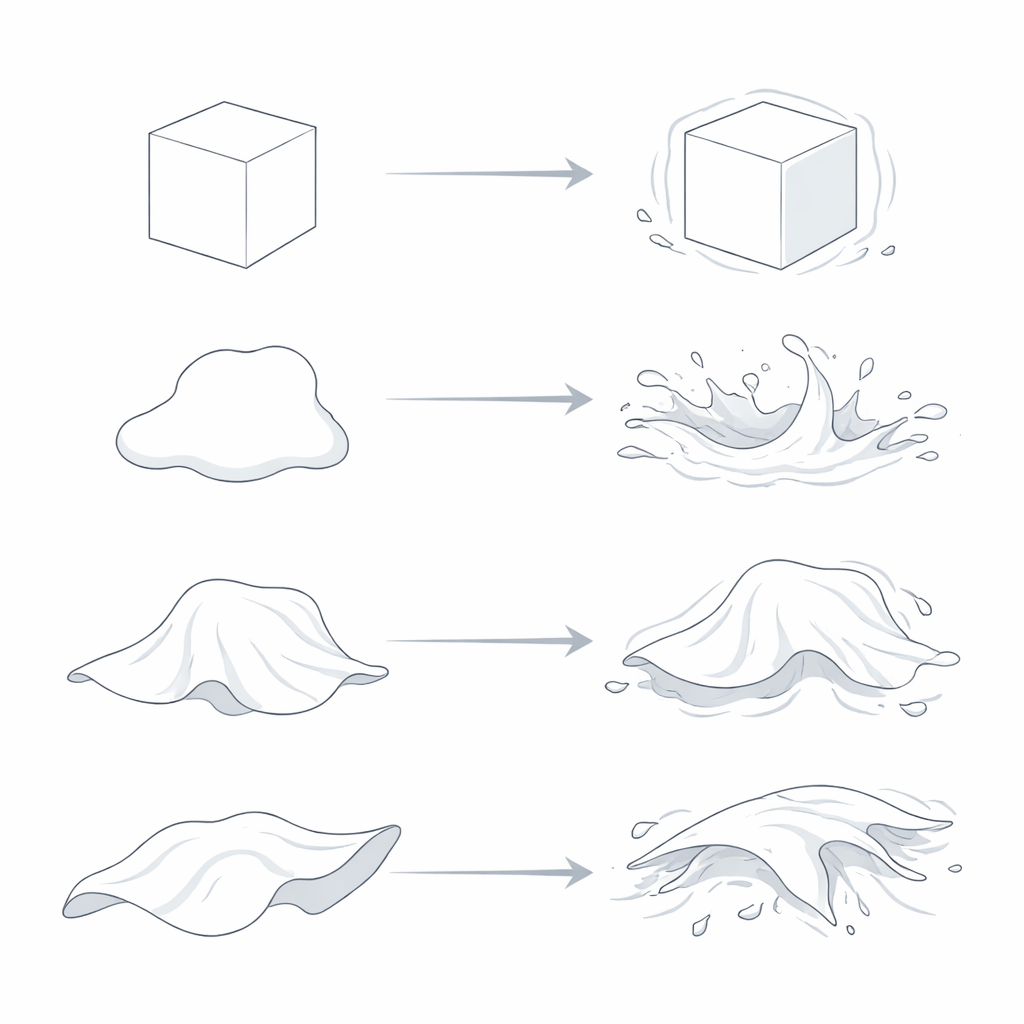
To explore this, the researchers created short computer animations of five broad material types: jelly-like objects, liquids, smoke, pieces of fabric, and rigid breakable solids. Each little movie showed a simple shape—a cube, blob, or sheet—undergoing some event, such as falling, splashing, fluttering, or shattering. Every animation was rendered in three ways. In the “full” version, viewers saw realistic, textured materials with all the usual visual cues. In the “line” version, everything but the contours was stripped away; only moving outlines and creases remained, like an animated white sketch on black. In the “dot” version, the object was replaced by a cloud of bright points that moved with the material, hinting at its internal motion but leaving its exact outline fuzzy. These versions let the team tease apart what comes from contour motion, internal motion, and rich surface appearance.
Judging Feel From Motion Alone
Volunteers watched these movies and judged how each material “felt” along five everyday qualities: how dense, flexible, wobbly, fluid, and airy its motion seemed. In a second task, people saw three animations at a time and chose which of two looked more similar to a reference one, based purely on overall material impression. The key question was whether the pattern of judgments made from line and dot movies would match the pattern from the fully rendered movies. Across both tasks, the answer was largely yes. Even when people saw only moving outlines or moving dots, they still grouped jellies with other jellies, liquids with liquids, and so on, in much the same way as when they saw the richly shaded films. This means that the way contours change shape over time—their stretches, ripples, and breakups—carries strong clues about what kind of stuff we are looking at.
Why Motion Adds More Than a Snapshot
The team also ran a control experiment using single still frames from the line drawings. Here, people’s impressions of material were noticeably less aligned with judgments from the full movies. A static outline could still hint at a category, but it did not organize perceptions as cleanly as moving outlines did. In other words, the extra information that appears only when contours move—how fast they bend, how far they wobble, whether they snap, smear, or drift apart—adds crucial detail that a frozen snapshot cannot provide. The researchers further analyzed simple measures of motion and shape in the movies and found that these could explain some, but not all, of the differences in how people saw the materials, suggesting that our visual system is picking up on richer patterns than basic statistics alone.

What This Means for How We See the World
For a general reader, the takeaway is that our brains are remarkably good at “reading” materials from motion, even when color and texture are gone. A few moving lines are enough to tell jelly from rock, cloth from smoke, or water from a solid object. This work shows that material perception depends not just on what an object looks like in a single image, but on how its outline reshapes itself over time. That insight helps explain the power of simple animations and sketches, and it may guide future technologies—from more efficient visual effects to machine vision systems—that need to understand the physical world from sparse visual cues.
Citation: Malik, A., Yu, Y., Boyaci, H. et al. Perceiving material qualities from moving contours. Sci Rep 16, 12347 (2026). https://doi.org/10.1038/s41598-026-46015-w
Keywords: material perception, contour motion, dynamic line drawings, visual motion, shape and motion cues