Clear Sky Science · en
Wireless sensor network design with reliable and long network lifetime
Why this matters for everyday sensing
From farms and forests to smart cities and hospitals, invisible networks of tiny wireless sensors quietly watch over our world. They track temperature, pollution, motion, and more, often in places where no person could stay for long. But these sensors run on small batteries that are hard or impossible to replace. This paper asks a deceptively simple question with big real‑world consequences: how can we design these networks so they run for a long time and still deliver trustworthy data, even when parts of the system fail?

How sensor networks keep watch
A wireless sensor network is like a nervous system spread across a landscape. Dozens or hundreds of low‑power devices measure their surroundings and pass their readings along from sensor to sensor until they reach special collection points called sinks. Designers must decide where to place sensors, where to put sinks, which sensors should be awake at any moment, and how data should flow through the network. These choices matter: if a few sensors near a sink are overworked, their batteries die early, cutting off the rest of the network. If too many sensors sleep to save energy, blind spots appear and important events go unnoticed.
The puzzle of life versus safety
Designing these networks means juggling two goals that pull in opposite directions. On one hand, we want the network to last as long as possible on its fixed supply of battery energy. That favors minimalist data paths: each reading should take the cheapest route to a sink. On the other hand, we also want reliability. In harsh or hostile environments, a sensor can fail or a radio link can be disrupted by an attack, a storm, or simple wear and tear. If each piece of data follows only one path, any broken link can turn into permanent information loss. Many researchers have studied energy use, coverage, and routing separately, but few have treated all these design problems together while also tackling reliability.
Three ways to move the data
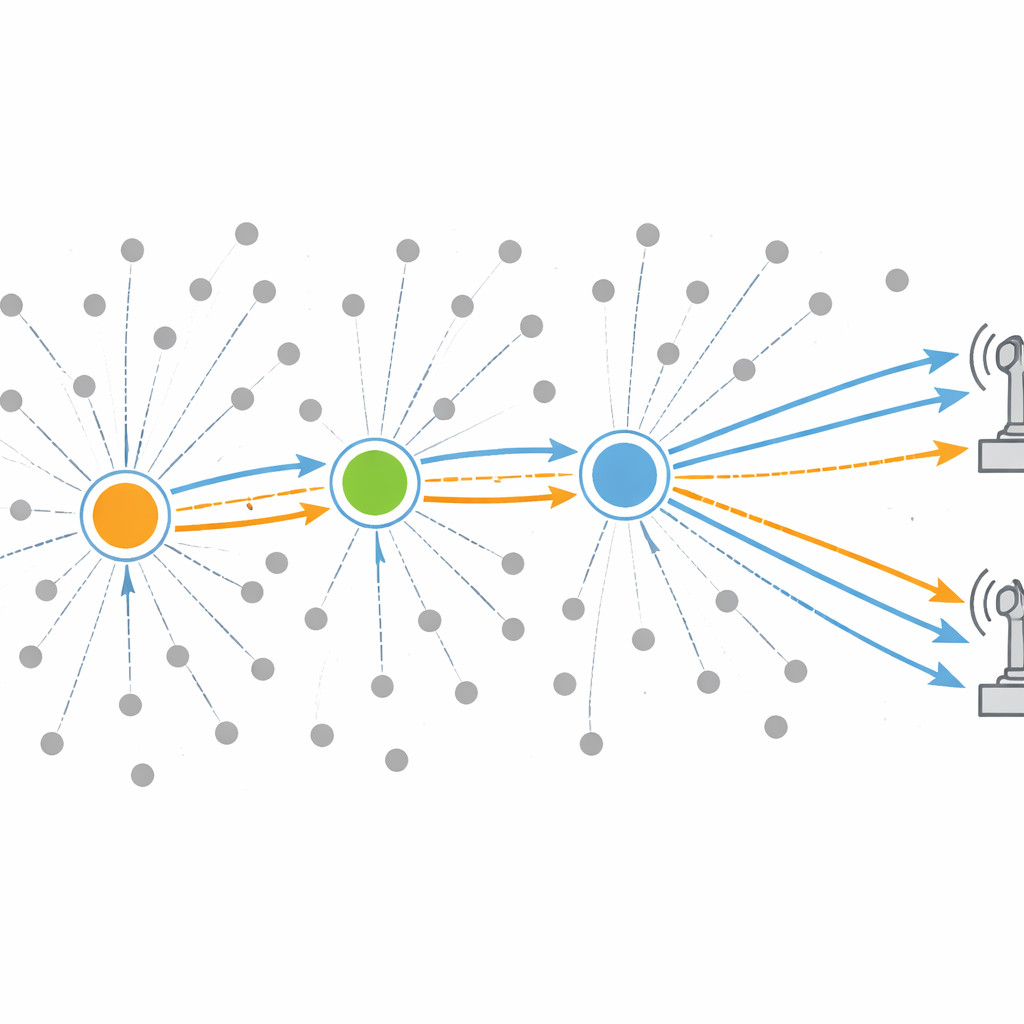
The authors propose and compare three strategies that differ in how many copies of each reading they send. In the Single Copy strategy, every reading travels along a single, cheapest route to a sink. This squeezes the most lifetime out of the batteries, but offers no backup if a key sensor or link fails. The Double Copy strategy sends the same reading along two completely separate routes, like mailing two letters by different couriers. This greatly improves the chance that at least one copy arrives, but it doubles the radio work and quickly drains batteries. To strike a middle ground, the Hybrid strategy copies data only when it passes through especially busy “central” sensors whose failure would hurt the network most. Ordinary sensors send readings once; near these central points, the flow is duplicated to provide insurance.
Testing designs on virtual networks
To see how these ideas perform, the team built detailed mathematical models that capture sensor placement, sink placement, activity scheduling, routing, and copying behavior all at once. They then ran large sets of computer experiments on networks of different sizes and layouts. For each strategy, they measured total operating time before batteries ran out and how much data still reached the sinks when they simulated damage to random sensors or connections. Because solving the full problem exactly becomes extremely time‑consuming for big networks, they also developed a specialized heuristic method based on a technique called Lagrangian relaxation. This approach breaks the huge problem into smaller pieces, solves them iteratively, and stitches their solutions together, allowing the Hybrid strategy to be used on much larger examples than a standard solver could handle.
What the results reveal
The experiments show a clear trade‑off. Networks using the Single Copy strategy live the longest but are fragile: when sensors or links are knocked out, reliability drops sharply. Double Copy networks are the most robust, maintaining high data delivery even when a large fraction of the system is damaged, but they burn through energy and die much sooner. The Hybrid design comes close to the long lifetimes of Single Copy while gaining much of the reliability of Double Copy, especially when damage is moderate. The new heuristic method often finds even longer‑lived Hybrid designs than a leading commercial optimization package, particularly for medium and large networks.
Take‑home message for non‑experts
The key lesson is that smart backup beats brute‑force redundancy. Simply duplicating every message keeps data safe but quickly exhausts batteries, while relying on a single path makes networks too brittle for real‑world use. By identifying and protecting only the most critical points in the network, the Hybrid strategy delivers a practical balance: long‑running sensor systems that still keep working when parts of them break. This kind of careful planning will be essential as we lean more and more on hidden sensor webs to monitor crops, cities, power grids, and the natural environment over years rather than months.
Citation: Çelik, E., Keskin, M.E. Wireless sensor network design with reliable and long network lifetime. Sci Rep 16, 12458 (2026). https://doi.org/10.1038/s41598-026-46014-x
Keywords: wireless sensor networks, network lifetime, reliable data routing, optimization heuristics, energy efficiency