Clear Sky Science · en
Comparative susceptibility of various pulses and their impact on the biological traits of pulse beetle, Callosobruchus chinensis (Linn.) (Coleoptera: Chrysomelidae)
Why tiny beetles matter for your pantry
In many kitchens across India and around the world, bags of lentils and beans sit quietly in cupboards, often for months. Yet inside those grains, tiny beetles can be eating away unseen, turning nutritious pulses into dust and leaving seeds unable to sprout. This study explores how a common storage pest, the pulse beetle Callosobruchus chinensis, fares on different types of pulses and how badly it harms them. Understanding which beans are most at risk helps farmers, traders, and households protect both food quality and seed for the next planting season.
The hidden life inside a single seed
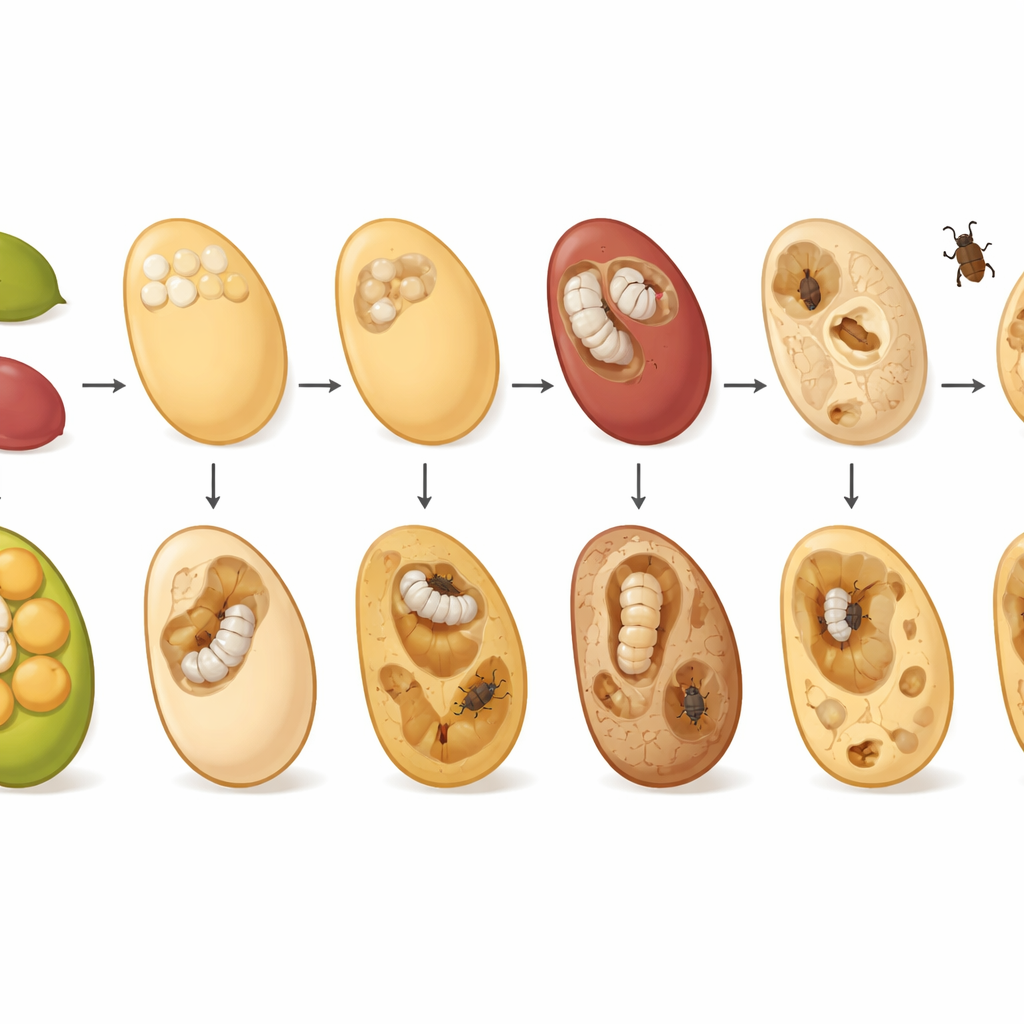
Pulse beetles have a remarkably compact life cycle: an entire generation can develop inside a single seed. Adult beetles lay eggs on the surface of stored pulses; the tiny larvae hatch, burrow straight into the grain, and quietly feed and grow, out of sight. They pass through larval and pupal stages within the seed, eventually chewing a neat round exit hole as adults. Because they do not need food or water as adults and can reproduce quickly, populations can build up fast in storage. The damage they cause reduces grain weight, lowers the market value, and—crucially for farmers—destroys the seed’s ability to germinate.
Putting eight common pulses to the test
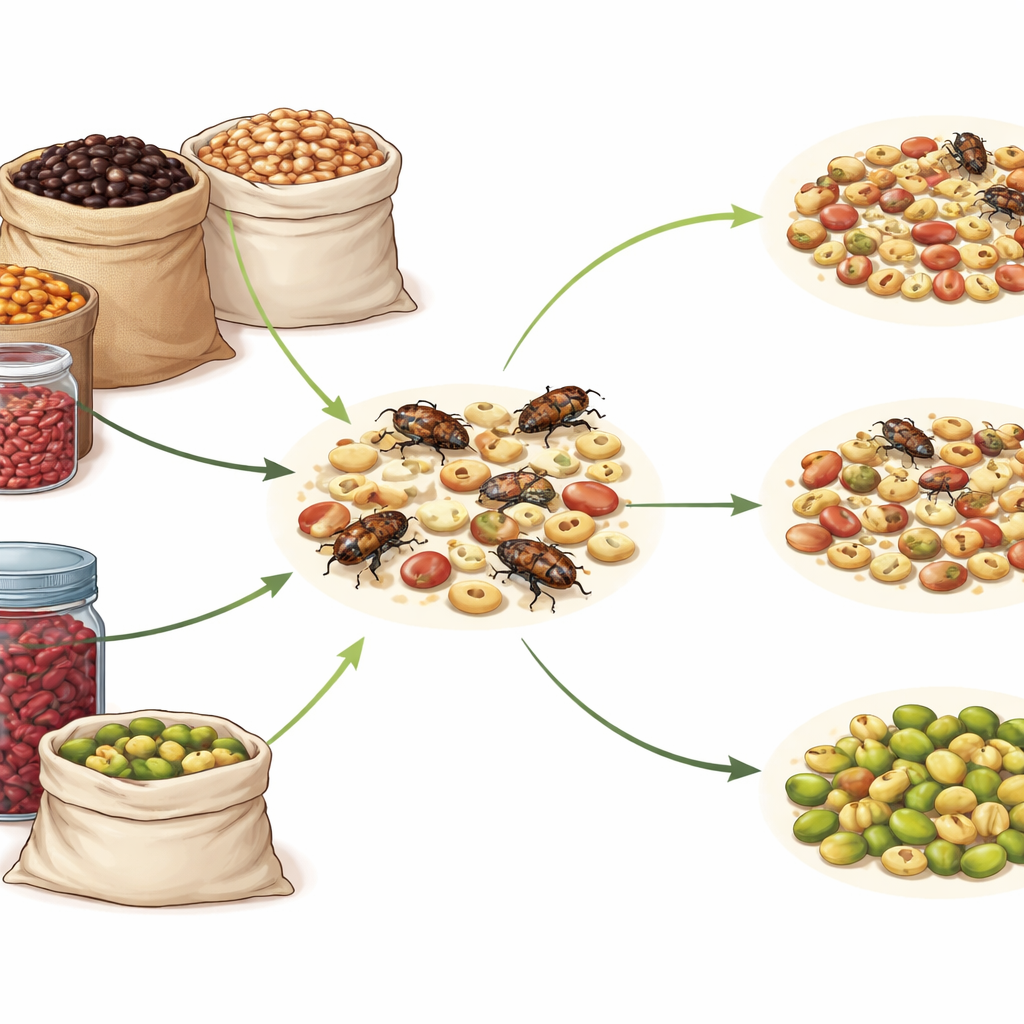
The researchers compared eight popular pulses: green gram, black gram, soybean, cowpea, chickpea, kabuli chickpea, lentil, horse gram, and kidney bean. Under controlled laboratory conditions, they allowed a set number of pulse beetles to lay eggs on each type of grain and then tracked how the insects developed. They counted eggs, timed how long each life stage took, measured how many adults emerged, and recorded how long those adults lived. They also studied how strongly adult beetles were drawn to each pulse when given a choice, and they monitored grain damage, weight loss, and seed germination over four months of simulated storage.
Which beans the beetles like best—and least
The clear “favorite” of the beetle was green gram. On this pulse, females laid the most eggs, the young developed fastest, and the highest number of adults emerged, which in turn lived the longest. A combined susceptibility index—based on development speed and adult numbers—was also highest for green gram. Chickpea and kabuli chickpea followed closely behind in terms of beetle success. Orientation tests, where beetles were free to roam among different grains, showed they consistently walked toward and settled on green gram first, then chickpea and cowpea. At the other end of the scale, kidney bean and horse gram attracted fewer beetles, supported slower development, and produced fewer adults, marking them as relatively resistant hosts.
Damage, weight loss, and seed death over time
As weeks of storage passed, differences among pulses became stark. After only one month, all grains showed some injury, but by four months, green gram had suffered about two-thirds of its grains damaged and the greatest weight loss, with chickpea and soybean not far behind. Kabuli chickpea, black gram, and cowpea experienced moderate damage, while kidney bean and horse gram lost the least, though still not negligible amounts. Seed germination told a similar story: the more the beetles tunneled through the grains, the fewer seeds could sprout. Green gram again fared worst, with germination collapsing, whereas kidney bean and horse gram maintained much higher sprouting rates even after prolonged infestation.
What this means for food and seed security
For a non-specialist, the key message is that not all beans are equally vulnerable once they enter storage. Green gram and chickpea, staples in many diets, turn out to be especially easy targets for pulse beetles, rapidly losing both weight and germination capacity. Kidney bean and horse gram, in contrast, naturally slow the beetle’s progress, likely thanks to tougher seed coats and less inviting internal chemistry. These findings suggest that highly susceptible pulses need better storage protection—such as improved containers or safe treatments—if they are to remain edible and viable as seed. More resistant pulses, meanwhile, could be used as parents in breeding programs to develop new varieties that keep the beetles at bay, helping safeguard both household pantries and future harvests.
Citation: Mehta, V., Chandel, R.S. & CS, J. Comparative susceptibility of various pulses and their impact on the biological traits of pulse beetle, Callosobruchus chinensis (Linn.) (Coleoptera: Chrysomelidae). Sci Rep 16, 10561 (2026). https://doi.org/10.1038/s41598-026-46013-y
Keywords: stored grain pests, pulse beetle, mung bean storage, seed germination loss, legume resistance