Clear Sky Science · en
Towards a more reliable assessment of aortic diameters using a Bayesian Z-score
Why measuring the body’s main artery is tricky
The aorta, the body’s main blood vessel, can quietly widen over time. If this stretching goes too far, it raises the risk of dangerous events such as a tear or rupture. Doctors use heart ultrasound scans to measure the aorta and often rely on a simple number, the Z-score, to decide whether a person’s aorta is unusually large for their age and body size. This study asks a deceptively simple question: how sure are we about that number? The authors show that today’s tools can be overconfident, especially for people whose body shape or age is under‑represented in the reference data, and they propose a new, more honest way to report both the measurement and its uncertainty.
A common number with hidden blind spots
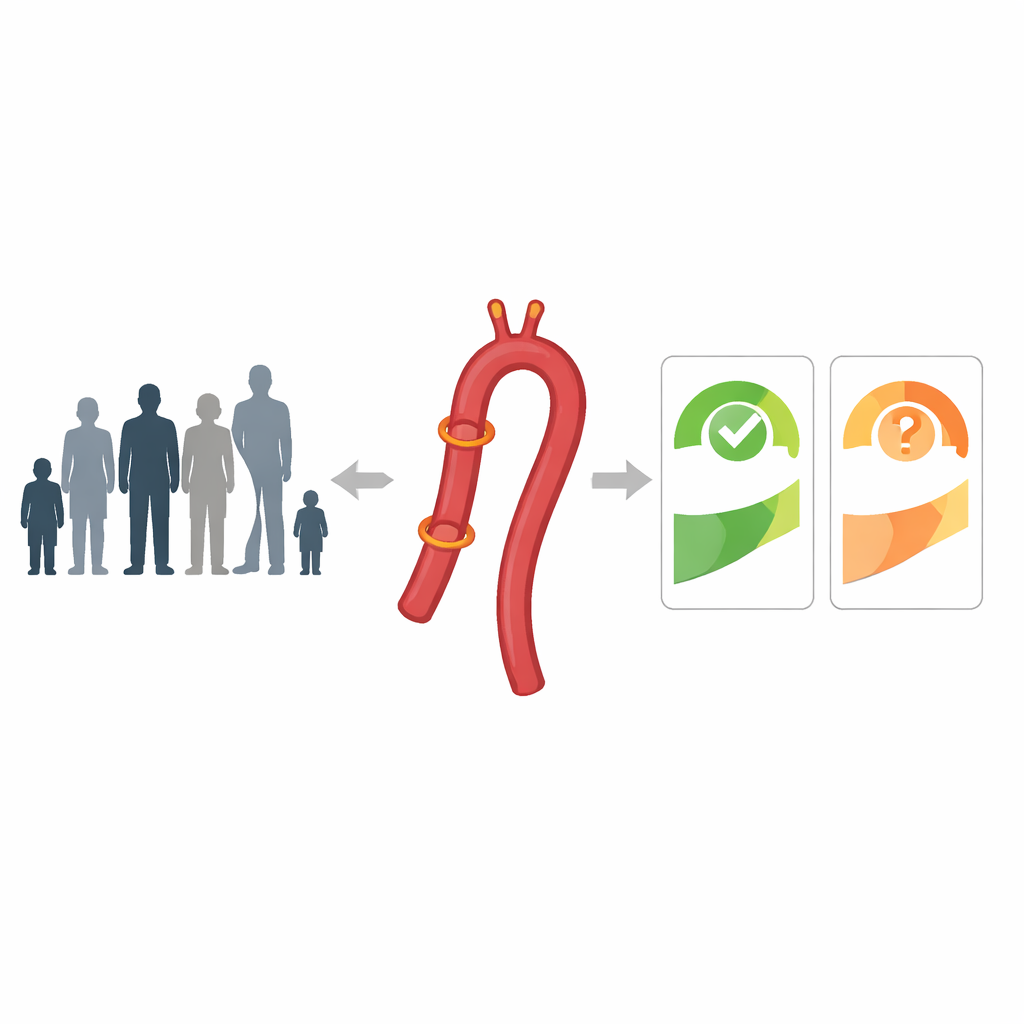
The conventional Z-score compares a person’s measured aortic diameter with an expected “normal” value for someone of the same age, sex, height, and weight, then expresses the difference in units of standard deviation. If the Z-score is above 2, many clinicians treat the aorta as dilated. This approach assumes that we know normal aortic size well across all body types, that the relationship between body size and aortic diameter is smooth and mostly linear, and that the spread of normal values is the same everywhere. In reality, aortic growth with age is strongly curved—rapid in childhood, then flattening in adulthood—and the variability of normal diameters itself changes with age and body size. More subtly, many reference datasets exclude people at the extremes, such as those who are very small, very large, or obese. As a result, classic Z-scores can be misleading for exactly the patients where decisions are most difficult.
Two kinds of uncertainty, not just one
The authors distinguish between two sources of uncertainty in aortic measurements. One is natural randomness: even people with identical age, sex, height and weight do not all share the same aortic diameter. This “built‑in” variability, known as aleatoric uncertainty, cannot be eliminated, no matter how much data are collected. The other, more problematic kind is epistemic uncertainty, which arises when the model is forced to extrapolate beyond the types of people it has seen in the training data. For example, if very tall, heavy individuals were excluded from the reference population, predictions for such patients rest on thin evidence. Classic Z-scores silently mix these two types of uncertainty and never signal when they are guessing in poorly charted territory.
A Bayesian makeover for the Z-score
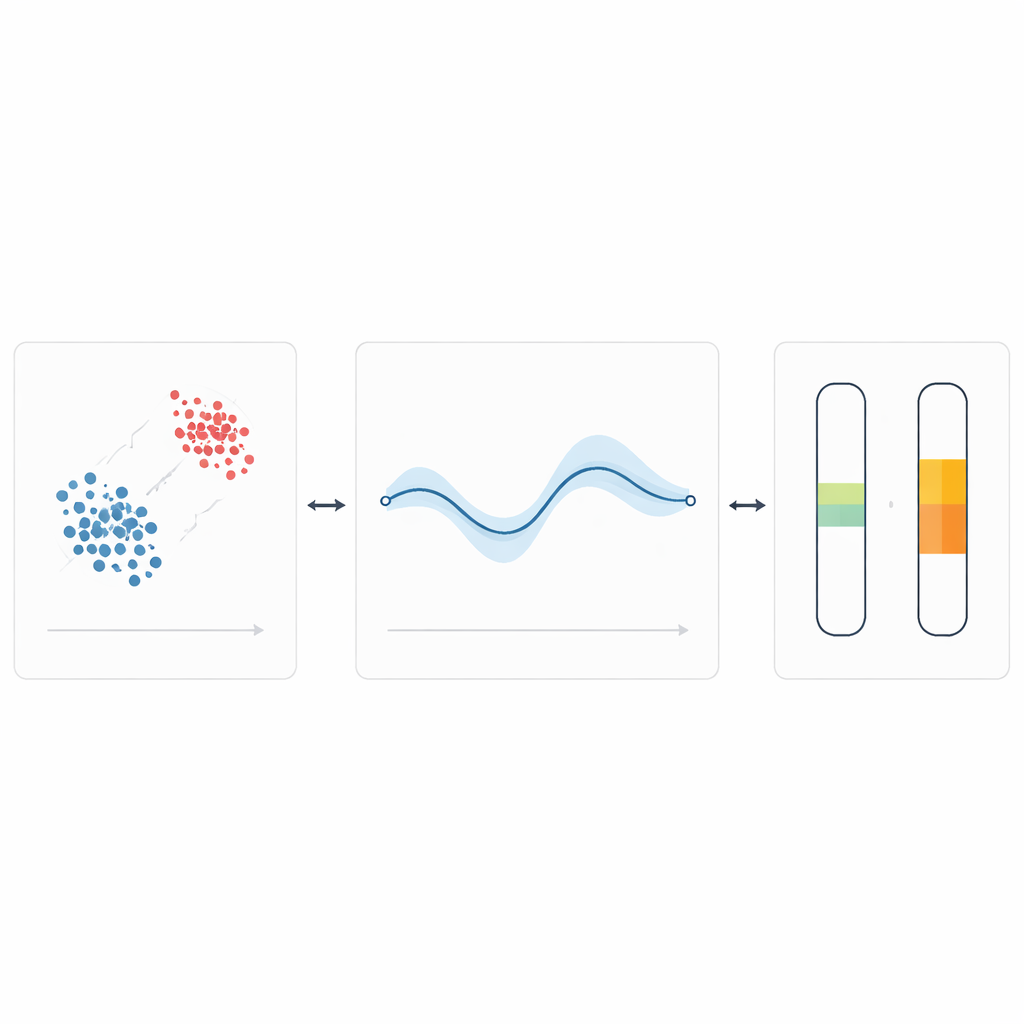
To make model uncertainty explicit, the team reformulates the Z-score within a Bayesian framework. Instead of treating the “normal” aortic size and its spread as fixed curves, they model them as flexible functions learned from data using a heteroscedastic Gaussian process—a method well suited to capture both curved growth patterns and context‑dependent variability. In this setup, the Z-score itself becomes a random quantity rather than a single number. For each patient, the method produces an expected Z-score and a “highest‑density interval,” which can be thought of as a range of Z values that are most compatible with the data and model. A narrow interval means the model is confident; a wide one warns that the result depends heavily on uncertain assumptions about under‑sampled regions of the population.
Testing the new approach in real patients
The authors trained their Bayesian model on a merged reference set of 1,947 healthy individuals spanning ages from early childhood to old age, collected in Italy and Belgium under compatible scanning protocols. They then evaluated two groups of patients at higher risk for aortic disease: people with Marfan syndrome and those with bicuspid aortic valve. Compared with a widely used traditional Z-score calculator, the Bayesian method identified a slightly higher proportion of patients as having dilated aortas, particularly among those with extreme body types. At the same time, it highlighted “borderline” cases where the interval around the Z-score straddled the usual clinical cut‑off of 2, indicating that the available reference data do not justify a firm normal‑versus‑abnormal verdict.
What this means for patient care
For clinicians, the key advance is that the proposed Bayesian Z-score reports not only how abnormal an aortic diameter appears, but also how much trust to place in that judgment. The model reproduces or slightly improves on the accuracy of existing methods while flagging cases where limited reference data make the classification uncertain. Maps of uncertainty across age and body size further show where current reference standards are most fragile, underscoring the value of collecting more data in children, the elderly, and people at the extremes of body size. In practical terms, this work suggests that a single Z-score should not always be treated as a hard line between health and disease; instead, doctors can use both the value and its uncertainty to tailor follow‑up and treatment, moving toward more cautious and personalized management of aortic conditions.
Citation: Bindini, L., Campens, L., Davis, J. et al. Towards a more reliable assessment of aortic diameters using a Bayesian Z-score. Sci Rep 16, 10848 (2026). https://doi.org/10.1038/s41598-026-46006-x
Keywords: aortic dilation, echocardiography, Bayesian modeling, medical risk stratification, uncertainty in diagnosis