Clear Sky Science · en
Spatiotemporal changes and degradation early-warning of key ecosystem services in China from 2015 to 2020
Why this matters to everyday life
Clean water, fertile soil, and protection from sandstorms may sound like issues for scientists and policymakers, but they touch daily life for hundreds of millions of people. This study looks at how well China’s landscapes are performing these vital jobs, county by county, and asks a simple but crucial question: where are nature’s life-support systems holding steady, and where are they starting to fail in ways that call for early action?
Taking the pulse of nature’s services
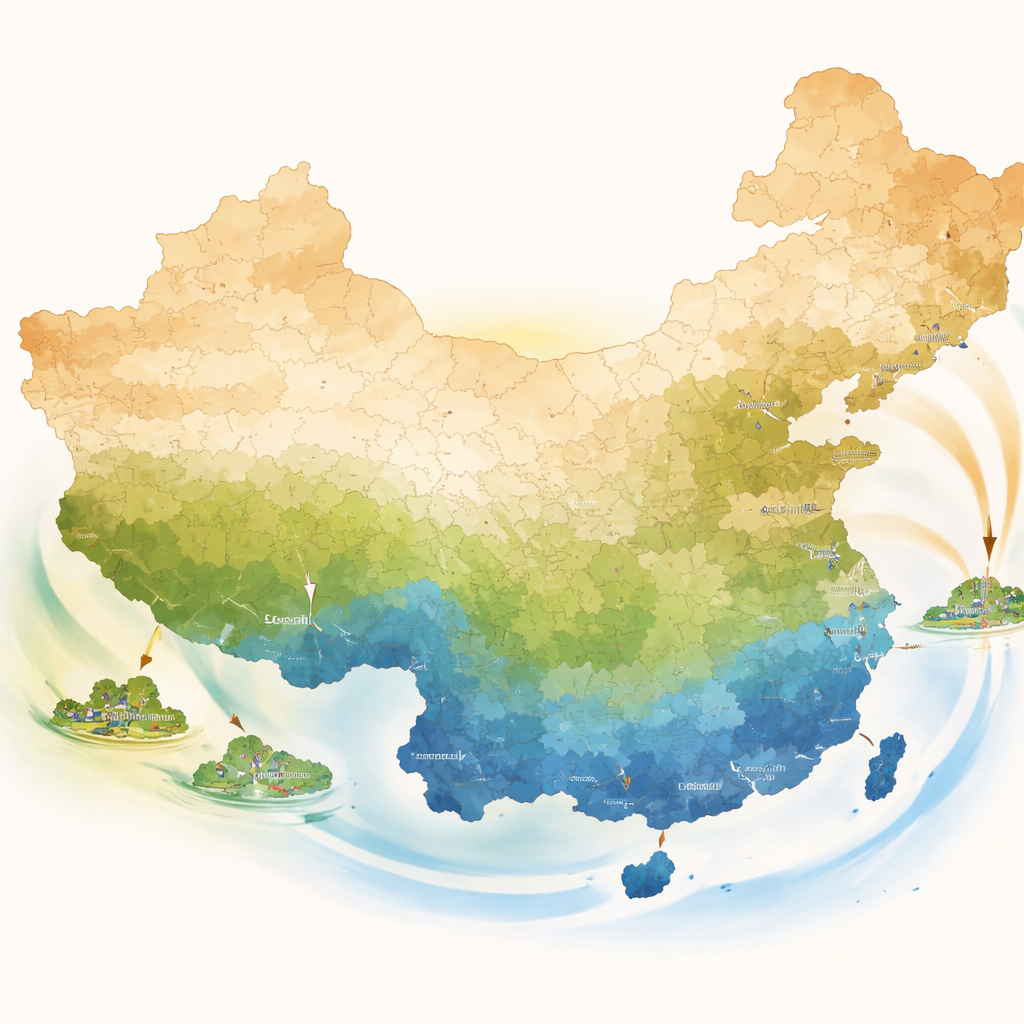
The researchers focused on three “key ecosystem services” that are especially important for China’s security and development. Water conservation reflects how well ecosystems soak up and slowly release rainfall, buffering both floods and droughts. Soil conservation captures how vegetation and roots hold earth in place, preventing erosion and landslides. Windbreak and sand fixation measure how landscapes in dry regions keep sand and dust from being stripped away by strong winds. Together, these three services form a quiet but powerful shield that supports drinking water, farming, and livable climates across the country.
A nationwide checkup from 2015 to 2020
To see how this shield has changed, the team assembled high-resolution data for all three services for the years 2015 and 2020, covering 2,847 counties across mainland China. Using geographic information systems, they summed up the strength of each service in each county, then mapped where values were high or low and how they shifted over the five-year period. Rather than averaging per square kilometer, they looked at total service volume per county, emphasizing each county’s absolute contribution to national ecological security, even in vast regions where nature may be sparse but area is enormous.
Where nature is strongest
The maps reveal clear geographic patterns. Counties with strong water conservation are clustered on the Qinghai–Tibet Plateau, in the humid southern mountains, and in major forest belts of Northeast China. Soil conservation is strongest on the Loess Plateau, the Qinghai–Tibet Plateau, the Yunnan–Guizhou Plateau, and the hilly southeast—areas long recognized as crucial for holding fragile soils in place. Protection from wind and sand is concentrated in the dry and semi-dry north and northwest and again on the high plateau, where vegetation and engineered shelterbelts blunt the force of erosive winds. Nationally, the overall capacity of all three services stayed broadly stable from 2015 to 2020, with water conservation showing a modest rise and the other two services barely changing, suggesting that large ecological restoration programs have, on balance, worked.
Turning trends into early warnings
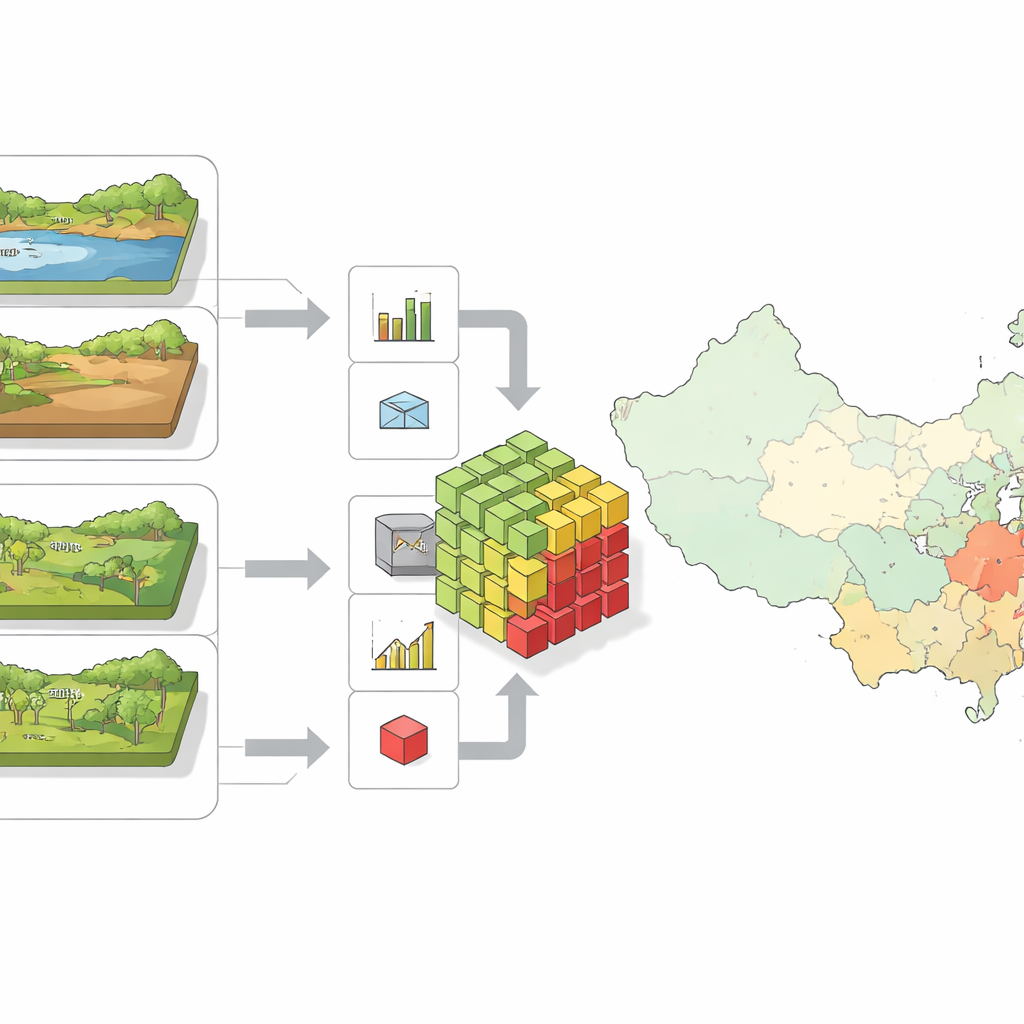
Stability at the national scale, however, can hide trouble spots. To uncover these, the authors built a simple early-warning system that compares each county’s performance in 2020 to 2015. Changes larger than a narrow band of natural year-to-year fluctuation are treated as meaningful: declines are sorted into light, moderate, or severe, and each county receives a three-part code summarizing how its water, soil, and sand-related services have changed. From these codes, the team assigns one of four alert levels: no alert, light, moderate, or severe. Nearly half of China’s counties fall into the no-alert category, with stable or improving services. Around one-third show light alerts, and about one-eighth show moderate alerts, usually due to declines in either water conservation or soil conservation. Only about 2 percent of counties are in the severe-alert category, but these are tightly clustered in extremely dry parts of the northwest and in fragile karst mountains of the southwest.
What the findings mean for people and policy
For a lay reader, the bottom line is reassuring but cautionary. China’s major ecological investments appear to have stopped broad, nationwide declines in key services that underpin safe water, healthy soils, and protection from dust and sand. Yet more than half of counties show some level of weakening in at least one service, and a small but critical group is already in serious trouble, especially where loose soils meet harsh climates and intensive land use. The study’s early-warning system offers a practical way for decision-makers to spot these weak links early, rank where to act first, and tailor responses—from gentle maintenance in low-risk areas to urgent, large-scale restoration where nature’s protective functions are failing. In short, it is a diagnostic tool designed to keep the country’s ecological safety net from fraying before the damage becomes too costly or irreversible.
Citation: Dong, S., Hu, H., Jia, G. et al. Spatiotemporal changes and degradation early-warning of key ecosystem services in China from 2015 to 2020. Sci Rep 16, 10861 (2026). https://doi.org/10.1038/s41598-026-46005-y
Keywords: ecosystem services, China environment, early warning, soil and water conservation, desertification