Clear Sky Science · en
Seasonal outdoor thermal comfort and neutral PET thresholds in a severe cold Dwa climate city of Shenyang China
Why city comfort in the cold matters
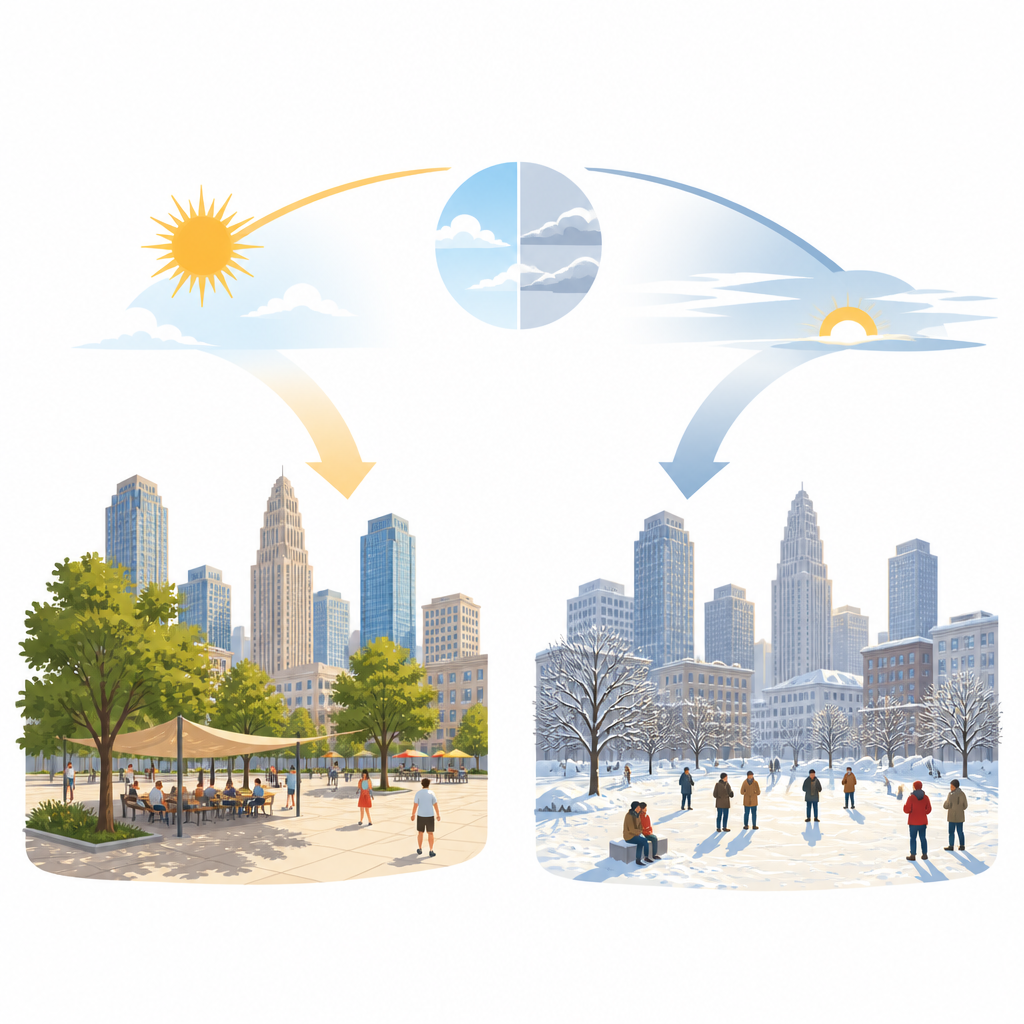
For anyone who has shivered through a long winter or wilted in a summer heatwave, this study from Shenyang in Northeast China asks a simple question: how can cities be shaped so that streets and squares feel comfortable in both seasons? The researchers show that people living in very cold places adapt strongly to the climate, and that the way buildings and trees frame the sky can either help or hurt comfort depending on the time of year.
Taking the pulse of a cold city
To explore this, the team monitored five common public spaces in Shenyang, including open plazas, tree lined squares, and a pavilion. Over one winter and one summer, they carried portable weather instruments while asking 1,009 passersby how they felt. At each point they recorded air and globe temperature, humidity, wind, sunshine and how much of the sky was visible, a measure called the sky view factor. At the same time, people rated how hot or cold they felt, how comfortable they were, and whether they would prefer it warmer or cooler. This pairing of physical measurements and personal reactions allowed the authors to link numbers to lived experience.
Finding the comfort sweet spot
Instead of using a single comfort target for the whole year, the study calculated separate “neutral” conditions for winter and summer using a body based index called Physiological Equivalent Temperature. In Shenyang, people felt thermally neutral at about 12.5 degrees Celsius in winter and 22.5 degrees in summer. The comfortable range was also different by season, roughly 8.4 to 16.6 degrees in winter and 19.1 to 26 degrees in summer. Compared with similar cities, Shenyang residents showed stronger tolerance for cold and reasonably high tolerance for summer heat, especially among long term residents, supporting the idea that people gradually adapt their expectations and habits to local climate.
How the sky above shapes comfort
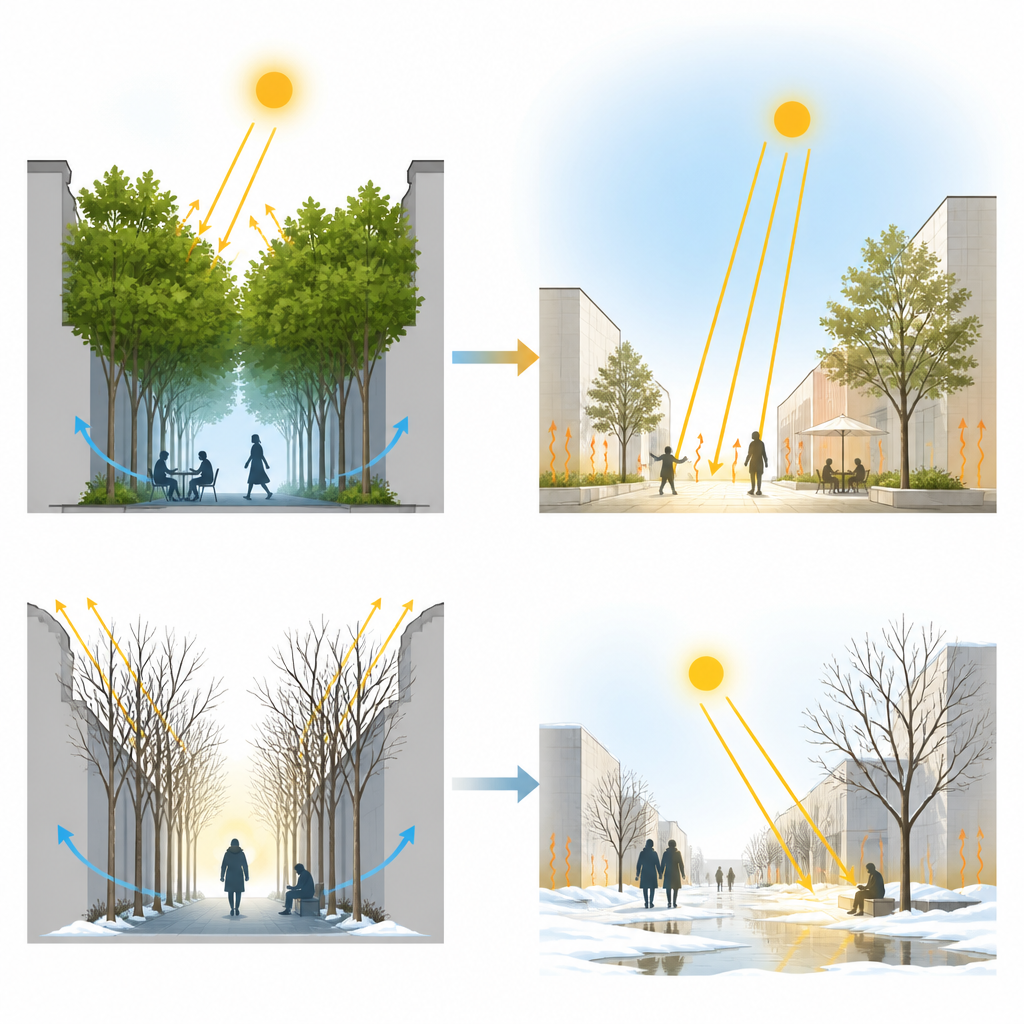
A key focus was how much sky a person sees when standing in a space. Wide open plazas with a clear view of the sky warm up quickly in winter sun but can be harsh in summer. Enclosed spaces under trees or pavilions stay cooler in hot months but deny welcome sun in the cold season. By grouping the data into bands of sky view, the researchers showed that this openness shifted both the typical thermal load and how tightly temperatures clustered. In winter, higher sky openness tended to raise perceived warmth, while in summer very low openness and heavy shade moderated extreme heat. The relationship was not a simple straight line, but the overall pattern revealed a seasonal “inversion” in the effect of sky exposure.
What people actually prefer
The survey results revealed that what feels “best” is not the same in January as in July. In winter, people were most likely to report feeling comfortable when they were slightly warm rather than exactly neutral, reflecting a strong desire to escape the cold. In summer, comfort peaked when people felt cool or slightly cool. Many also reported that wind and humidity shaped their experience: dry air and weak sun bothered people in winter, while strong light and muggy air drove discomfort in summer. These patterns underline that comfort depends on psychology and behavior as much as on raw temperature.
Design ideas for livable cold cities
Putting these pieces together, the authors argue that severe cold cities should not rely on one fixed design recipe. Instead they propose “dynamic morphology” using elements that change with the seasons. Deciduous trees can block high summer sun while letting in low winter light. Retractable awnings and varied street widths can adjust how much sky is visible at different times of year. By aiming for the season specific comfort ranges found in this study, planners can choose building forms, plantings, and shading systems that reduce both heat stress in summer and cold stress in winter, making outdoor life in high latitude cities more pleasant and resilient as the climate warms.
Citation: Fan, L., Li, Z. & zhou, Y. Seasonal outdoor thermal comfort and neutral PET thresholds in a severe cold Dwa climate city of Shenyang China. Sci Rep 16, 15265 (2026). https://doi.org/10.1038/s41598-026-46003-0
Keywords: outdoor thermal comfort, cold climate cities, sky view factor, urban design, seasonal adaptation