Clear Sky Science · en
Preferential crosstalk between perifollicular capillary vessels and dermal papilla cells during hair cycling homeostasis
Why the blood around hair roots matters
Many people worry about thinning hair, but we often focus only on the strands we see and forget the tiny world beneath the skin. This study looks at how small blood vessels talk with a group of cells at the base of each hair, called the dermal papilla, and shows that this hidden conversation helps decide whether hair stays full or becomes thin with age or hormone changes.
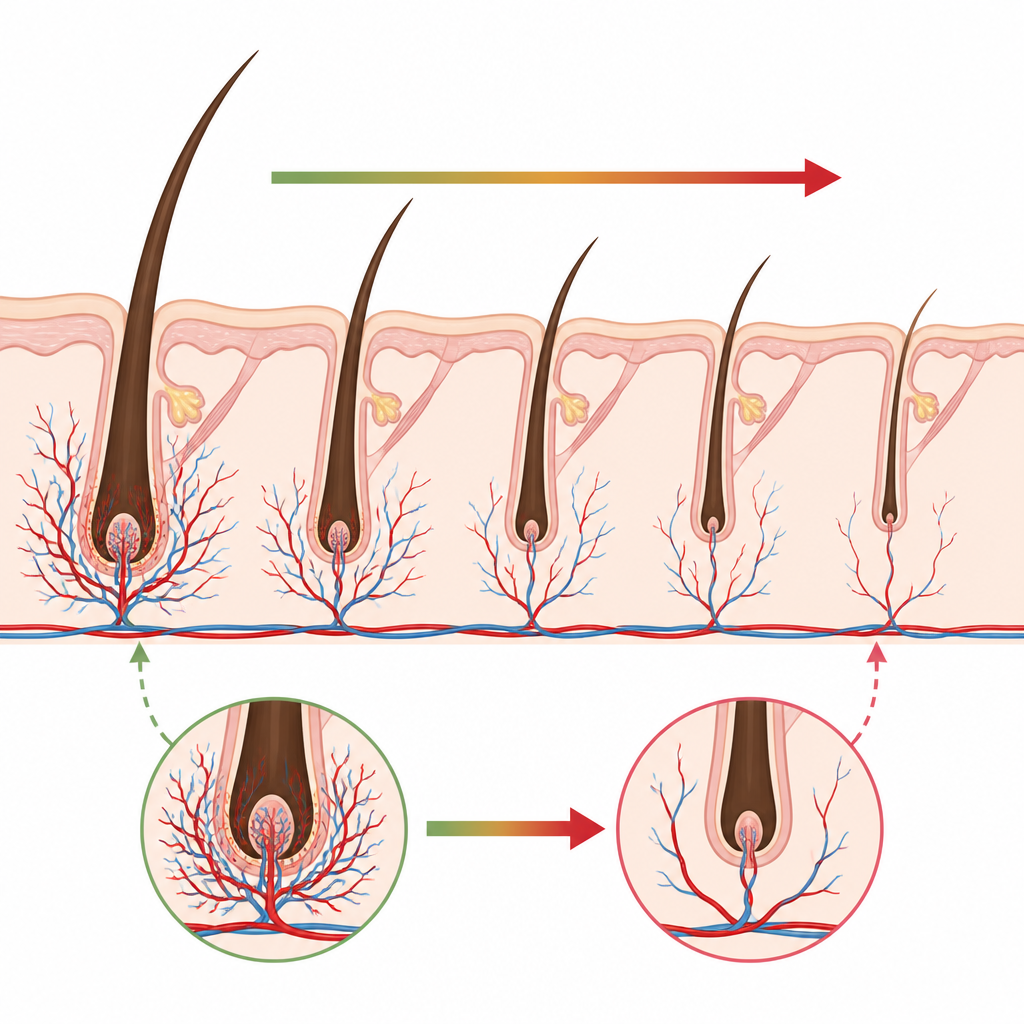
Hidden teamwork under each hair
Every hair grows from a follicle that cycles through growth, regression, and rest. At the bottom of the follicle sits the dermal papilla, a cluster of specialized cells that tell nearby stem cells when to start a new growth phase. These cells do not act alone. They sit in a “neighborhood” of fine capillary vessels that deliver oxygen and nutrients and release signals. The researchers asked whether changes in this tiny blood network are random or carefully tuned to support the dermal papilla during the hair cycle and over the course of aging.
Capillaries that favor the hair bulb
Using mice in which blood vessel cells glow under the microscope, the team mapped where capillaries sit around hair follicles at different stages. They found that during active growth, capillaries crowd around the dermal papilla, while during the resting phase vessels near the bulb thin out but remain around upper parts of the follicle. In older skin, the total number of capillaries did not drop sharply, but the pattern changed. Vessels near the dermal papilla became sparser, and this region of the skin also became thinner. This suggests that a special, responsive subset of capillaries near the hair bulb is especially important for keeping follicles healthy over time.
Drugs, hormones, and vessel reshaping
The scientists then tested how common hair related treatments affect these vessels. When they blocked VEGF, a key blood vessel growth signal, capillaries shrank mainly near the dermal papilla, and nearby follicle cells divided less often. In contrast, topical minoxidil, a widely used hair growth agent, pulled more capillaries toward the follicle tip and boosted dividing cells around these vessels, especially near the dermal papilla. Testosterone, a male hormone linked to pattern baldness, had the opposite effect, reducing capillary density near the bulb and shrinking the dermal papilla, while minoxidil partly rescued these changes. Lab tests with human vessel and dermal papilla cells confirmed that minoxidil enhances vessel growth and that testosterone dampens it.
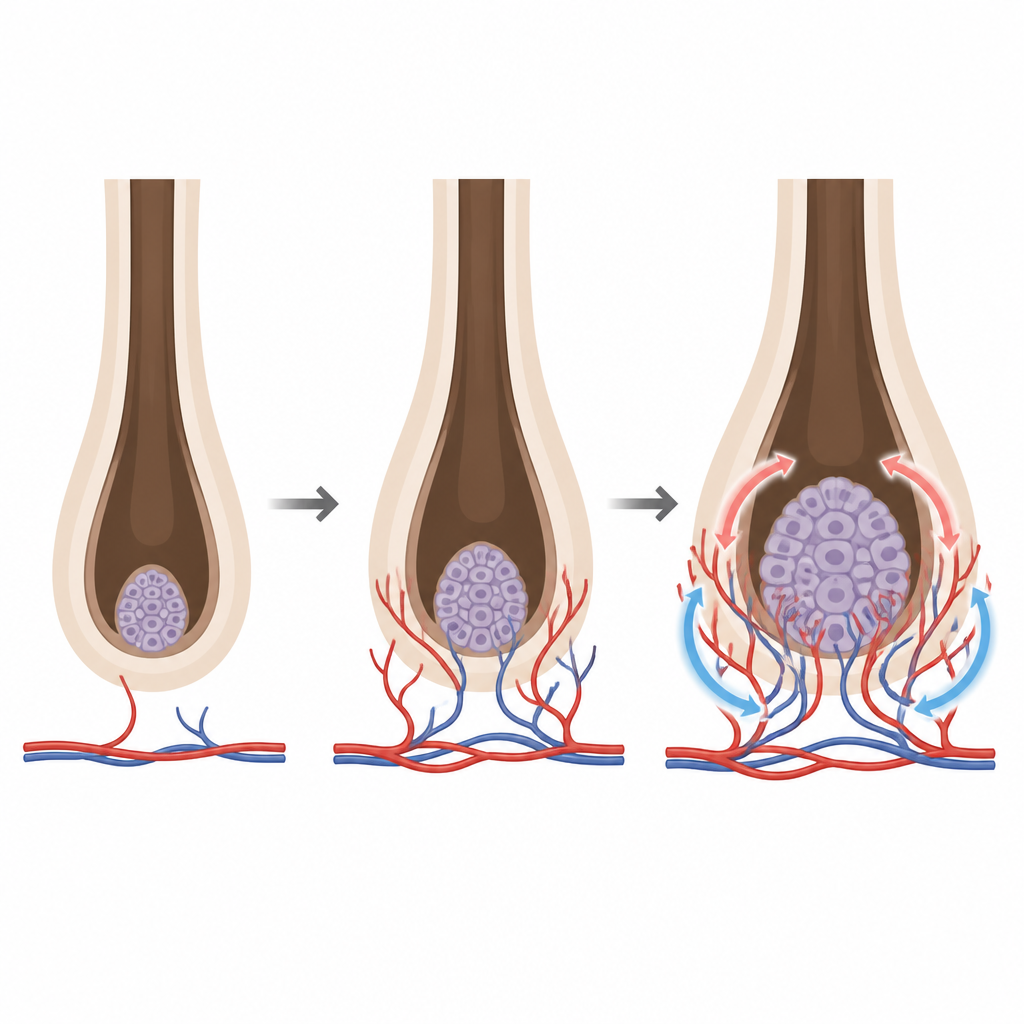
Chemical messages that keep the loop going
To understand how blood vessels and dermal papilla cells talk, the team bathed human dermal papilla cells in liquid taken from cultured blood vessel cells. The papilla cells responded by turning on several chemokines, small signaling proteins, with one called CCL2 standing out. CCL2 boosted papilla cell growth and increased markers linked to hair supporting activity, and it also helped blood vessel cells form new tube like structures, even when testosterone tried to block them. In mouse skin, CCL2 levels rose near the dermal papilla during growth, fell during rest, and dropped with age or VEGF blockade. When the researchers neutralized CCL2 in live mice, capillaries around the hair bulb thinned and the dermal papilla became smaller, showing that CCL2 is a key part of this two way signal loop.
What this means for hair and skin health
Overall, the study reveals that hair follicles rely on a preferred partnership between the dermal papilla and nearby capillaries that strengthen each other with signals like VEGF and CCL2. When this partnership is robust, vessels cluster around the hair bulb, papilla cells stay active, and hair growth cycles proceed smoothly. Aging, hormone shifts, or blocking vessel growth can weaken the loop, leading to fewer vessels near the bulb, a shrunken dermal papilla, and delayed or reduced hair growth. By showing how drugs such as minoxidil reinforce this local conversation, the work points to new ways to design treatments that target the tiny vascular niche to help manage hair loss and related skin problems.
Citation: Zeng, Y., Abe, A., Takashima, S. et al. Preferential crosstalk between perifollicular capillary vessels and dermal papilla cells during hair cycling homeostasis. Sci Rep 16, 15328 (2026). https://doi.org/10.1038/s41598-026-46001-2
Keywords: hair follicle, dermal papilla, capillary vessels, minoxidil, CCL2