Clear Sky Science · en
Characteristics and driving factors of phytoplankton community in urban-rural interface watershed
Why tiny lake drifters matter to city life
Along the edges of growing cities, lakes and canals sit where apartment blocks and farmland meet. In these waters, microscopic drifters called phytoplankton quietly help run the ecosystem by producing oxygen and forming the base of the food web. This study looks at how these tiny organisms respond when urban expansion, farm runoff and river water all mix together in the Qian Lake system in Nanchang, China. Understanding who thrives, who struggles and why offers clues for keeping such waters healthy and reducing the risk of green scums and bad smells that affect nearby communities.
A lake caught between city and countryside
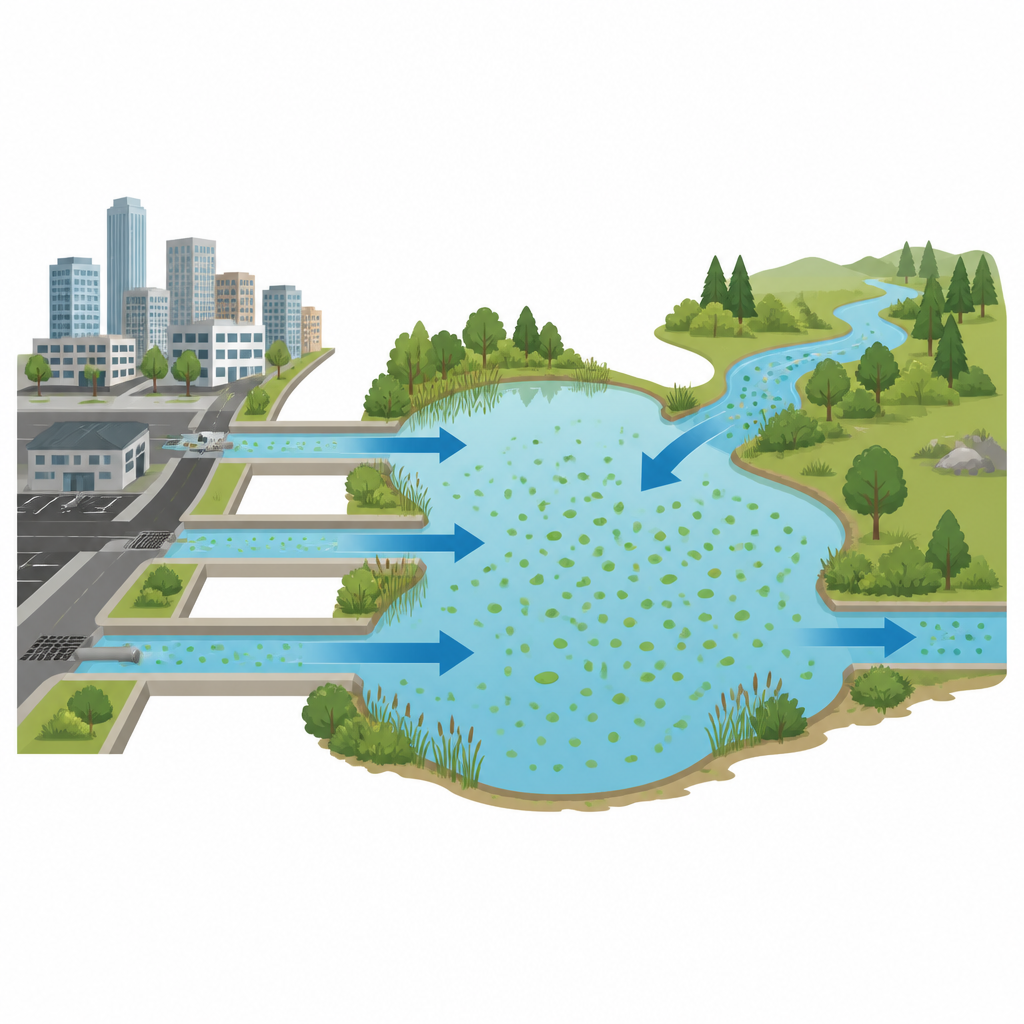
The Qian Lake water system lies in an urban rural border zone where concrete has rapidly replaced fields. Over just five years, built up land in its watershed expanded to nearly three quarters of the area, while cropland shrank sharply. The water network includes straightened canals carrying water from suburbs and a sewage treatment plant, a natural lake at the center, and an outlet canal downstream. This layout creates a real world test bed for how human activities and natural lake processes interact. The researchers set out to measure water quality, map the phytoplankton community and pinpoint which environmental conditions control its structure.
Who lives in the water
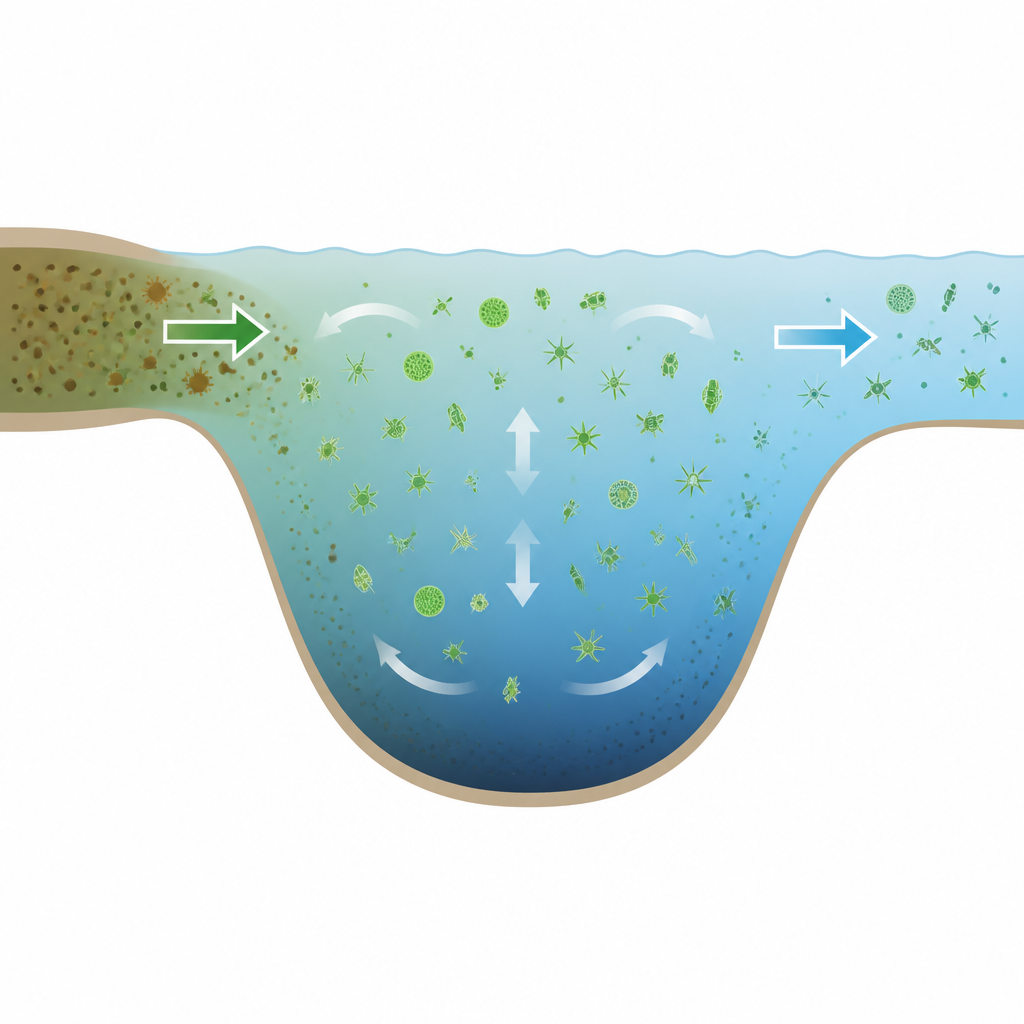
Sampling at 42 sites during a stable summer period revealed 112 phytoplankton species from seven major groups. Green algae were the most numerous in terms of species, but diatoms a group that builds glass like shells were the strongest overall competitors. The team links their success to soil erosion from nearby construction, which washes dissolved silicon into the lake, a key ingredient that diatoms use to grow. Together with certain blue green algae that tolerate dirty, nutrient rich water, these groups defined a community typical of waters that are neither pristine nor severely degraded. Overall cell numbers and biomass were moderate but varied from canal to lake and back again, reflecting shifting local conditions.
Water quality, flow and tiny drifters
The scientists measured common water indicators such as acidity, oxygen, suspended particles, nutrients and depth, then examined how these lined up with phytoplankton patterns. Most of the system showed only slight pollution by biological criteria, but nutrient levels were high enough to support future algal blooms, especially where nitrogen and phosphorus were abundant together. A statistical approach called redundancy analysis showed that two simple factors pH and suspended solids were especially important in shaping which algae dominated. At the same time, oxygen levels, flow speed and water depth helped decide how efficiently algae could use available nutrients and whether they built up in dense patches or remained more evenly spread.
Different channels, different pressures
Not all parts of the network behaved the same. In the Huanan Canal, urban runoff and modest vegetation cover created conditions that favored green algae and diatoms under stable but slightly cloudy water. The Yongqiang Canal, fed by cropland and a sewage plant, carried much higher nutrient loads but relatively low oxygen, limiting how fast algae could actually grow despite the abundance of food. As water moved into the main trunk canal and then the open lake, extra river water diluted nutrients, slowed the flow and boosted oxygen. These changes let phytoplankton accumulate, especially in Qian Lake itself, where a long residence time and gentle circulation created a comfortable habitat even though nutrient concentrations were lower than upstream.
What this means for lake health
To a lay observer, Qian Lake may appear only mildly affected, yet the study shows that its tiny plant like drifters already reflect strong human influence. The community is dominated by a few hardy groups, overall stability is low and nutrient levels point to a real risk of more frequent algal blooms, particularly of blue green algae, if conditions tip further. By highlighting how pH, suspended particles, oxygen and water movement jointly steer phytoplankton in this urban rural setting, the work offers practical guidance: managing erosion, curbing nutrient inputs and carefully controlling water transfers can help keep these edge of city waters clearer, more stable and better able to support life.
Citation: Wang, L., Wang, C., Liu, X. et al. Characteristics and driving factors of phytoplankton community in urban-rural interface watershed. Sci Rep 16, 15761 (2026). https://doi.org/10.1038/s41598-026-45995-z
Keywords: phytoplankton, urban lake, water quality, eutrophication, nutrient pollution