Clear Sky Science · en
Dynamics of the water-plasma interface in various discharge modes of atmospheric-pressure plasmas
Sparks on Water in Everyday Life
What happens when an electric spark hovers above a pool of water? Far from being just a light show, the meeting point between air plasma (an ionized gas) and water is at the heart of new tools for cleaning water, killing germs, and making fertilizers. This study looks closely at that meeting point and shows, frame by frame, how the water surface bends, caves in, and finally smooths out again as the electrical conditions change. By tracking both the light from the plasma and the motion of the water, the researchers reveal which physical forces are really in control at each stage.
How the Experiment Was Set Up
The team created a simple but revealing setup: a sharpened metal needle held a few millimeters above a shallow layer of distilled water inside a clear container. A high-voltage source sent a sinusoidal alternating signal to the needle at a fixed frequency, while the water rested on a grounded metal plate at the bottom. There was no extra gas flow to push the plasma around, so any motion at the water surface had to come from the discharge itself. High-speed shadowgraph imaging captured how the water surface rose, fell, or rippled at 40,000 frames per second, while electrical probes recorded voltage and current, and optical emission spectroscopy identified the type and temperature of the glowing gas above the water.
Three Ways the Spark Behaves
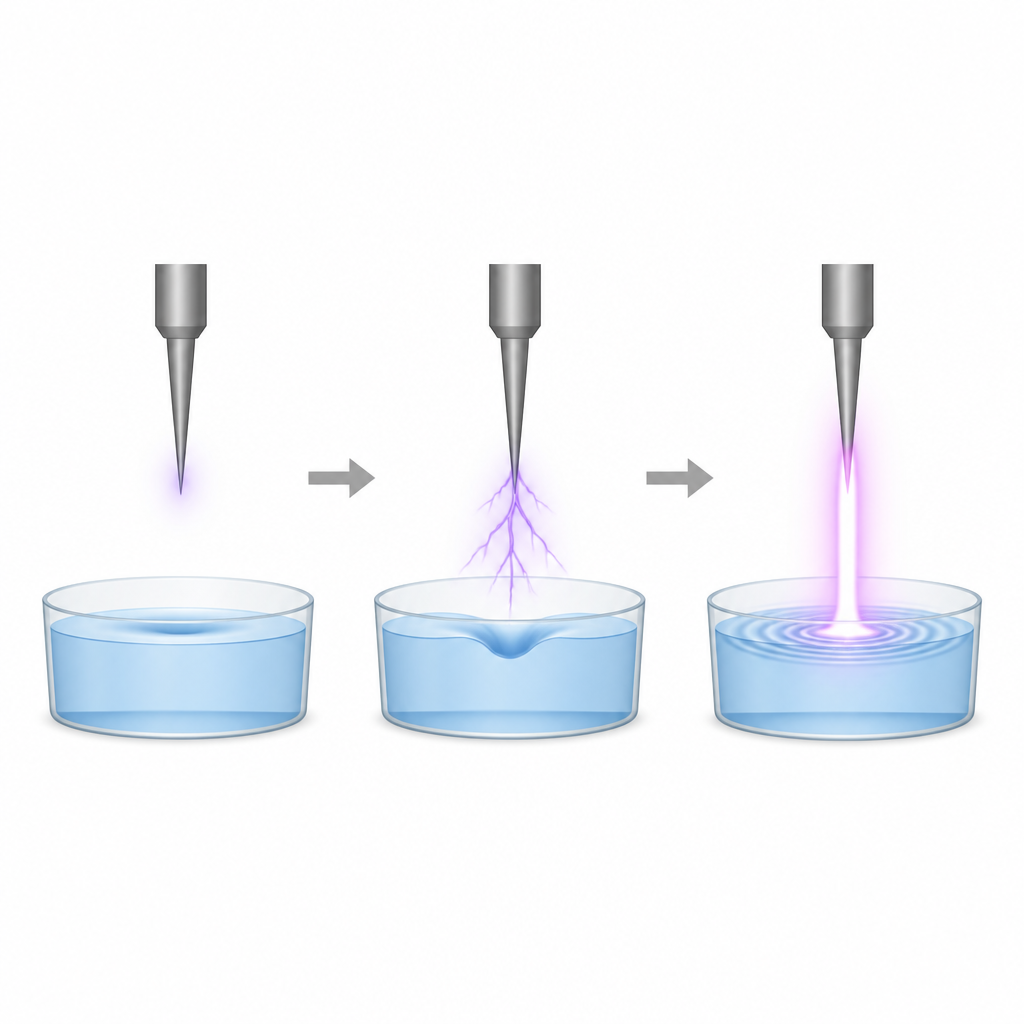
As the applied voltage increased, the discharge above the water passed through three clear regimes. In the first, at relatively low voltages from about 3 to 10.6 kilovolts, a faint, thin plasma channel formed between the needle and the water with almost no sound. Under this gentle glow, the water surface directly under the needle slowly caved in to form a smooth, symmetric cavity, whose depth grew in a nonlinear way as the voltage rose. In the second regime, at about 12.6 kilovolts, the discharge became loud and highly branched, sending multiple streamer channels toward the water. The cavity then reached its maximum depth, indicating that the forces pushing the surface downward had clearly overtaken those trying to keep it flat.
When Waves Replace the Cavity
Curiously, further increases in the power did not just keep deepening the cavity. Instead, the system shifted into a third regime in which the voltage across the gap dropped while the current rose, and the discharge turned into a continuous, flame-like channel. In this stage, the cavity disappeared and was replaced by wave-like motions spreading outward across the surface, along with internal swirling flows beneath. Over about 20 minutes of operation in this regime, the water warmed to roughly 70 degrees Celsius, its depth shrank due to evaporation, and its pH fell from neutral to mildly acidic, showing that the plasma was also changing the water chemistry as it stirred it.
Who Wins in the Tug-of-War of Forces
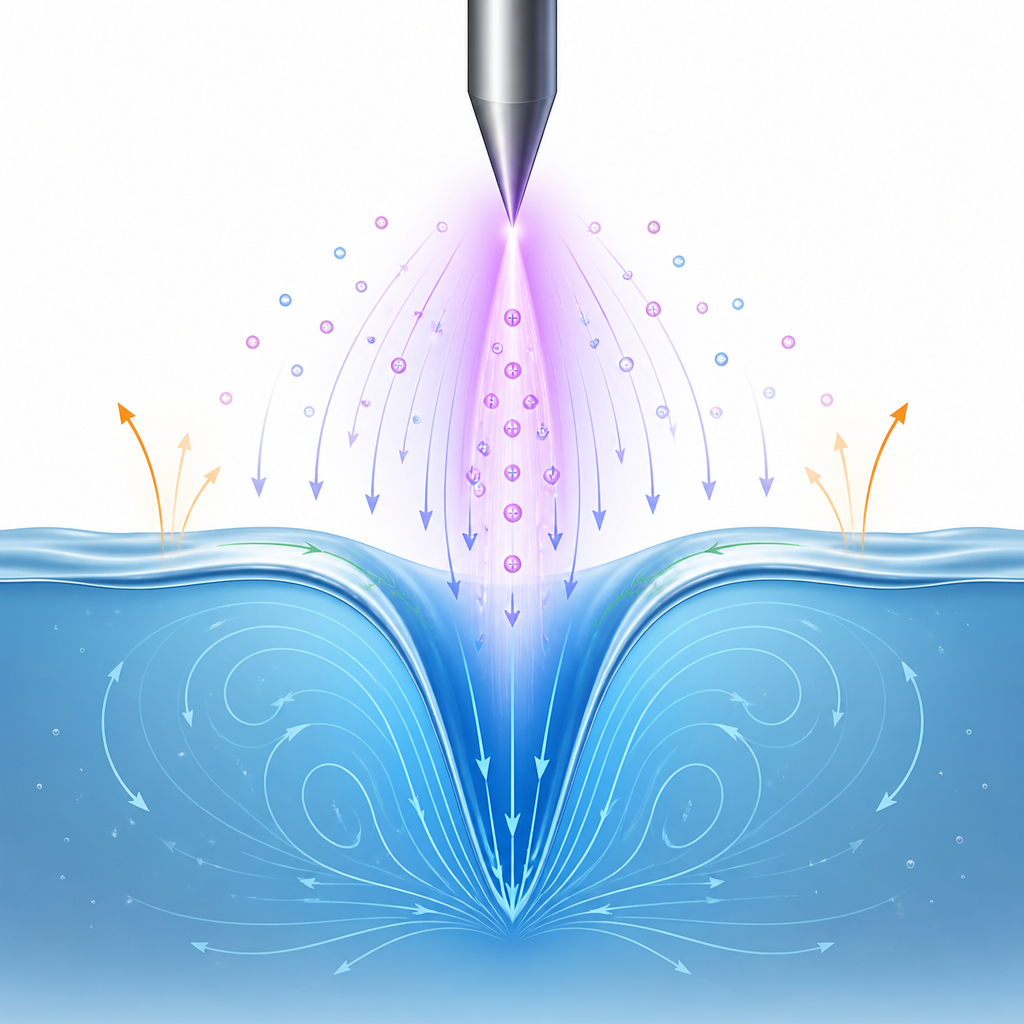
To explain these shape changes, the authors compared several competing forces acting at the water surface. On one side are electrical forces that press downward: the electrostatic pressure from the electric field and the push from charged particles and plasma-driven gas flow. On the other side are forces that resist deformation: surface tension, which prefers a flat surface, and gravity, which pulls displaced water back into place. Calculations show that at low voltage the resisting forces win, so only a small dent forms. At higher voltages in the second regime, the electrical forces become much larger than surface tension and gravity combined, carving out a deep cavity. In the third regime, as the electric field weakens and the water heats up, surface tension drops and temperature-driven flows (such as Marangoni currents along the surface) take over, erasing the cavity and creating stable patterns of waves and vortices instead.
Why This Matters for Real-World Uses
The study shows that the shape and motion of a water surface under a plasma are not random; they follow a clear shift in the balance of forces as the discharge evolves. By linking electrical signals, gas emission, and direct images of the water interface, the authors build a mechanistic picture of how a thin spark first digs a cavity, then branches, and finally settles into a steady, thermally driven channel with surface waves. For designers of plasma-activated water systems in fields like water purification, medicine, and agriculture, these insights help explain when the interface will be strongly punched inward and when it will instead be mixed by gentle flows. Understanding and tuning these regimes could make it easier to control how energy and reactive species from the plasma enter the liquid, improving both safety and effectiveness in future applications.
Citation: Toremurat, A., Ashirbek, A., Akildinova, A. et al. Dynamics of the water-plasma interface in various discharge modes of atmospheric-pressure plasmas. Sci Rep 16, 15293 (2026). https://doi.org/10.1038/s41598-026-45989-x
Keywords: plasma water interface, atmospheric pressure plasma, plasma activated water, surface deformation, electrohydrodynamics