Clear Sky Science · en
Exploring the effects and mechanisms of Chinese yam in treating osteoporosis using network pharmacology analysis and biological validation
Why a common root could matter for fragile bones
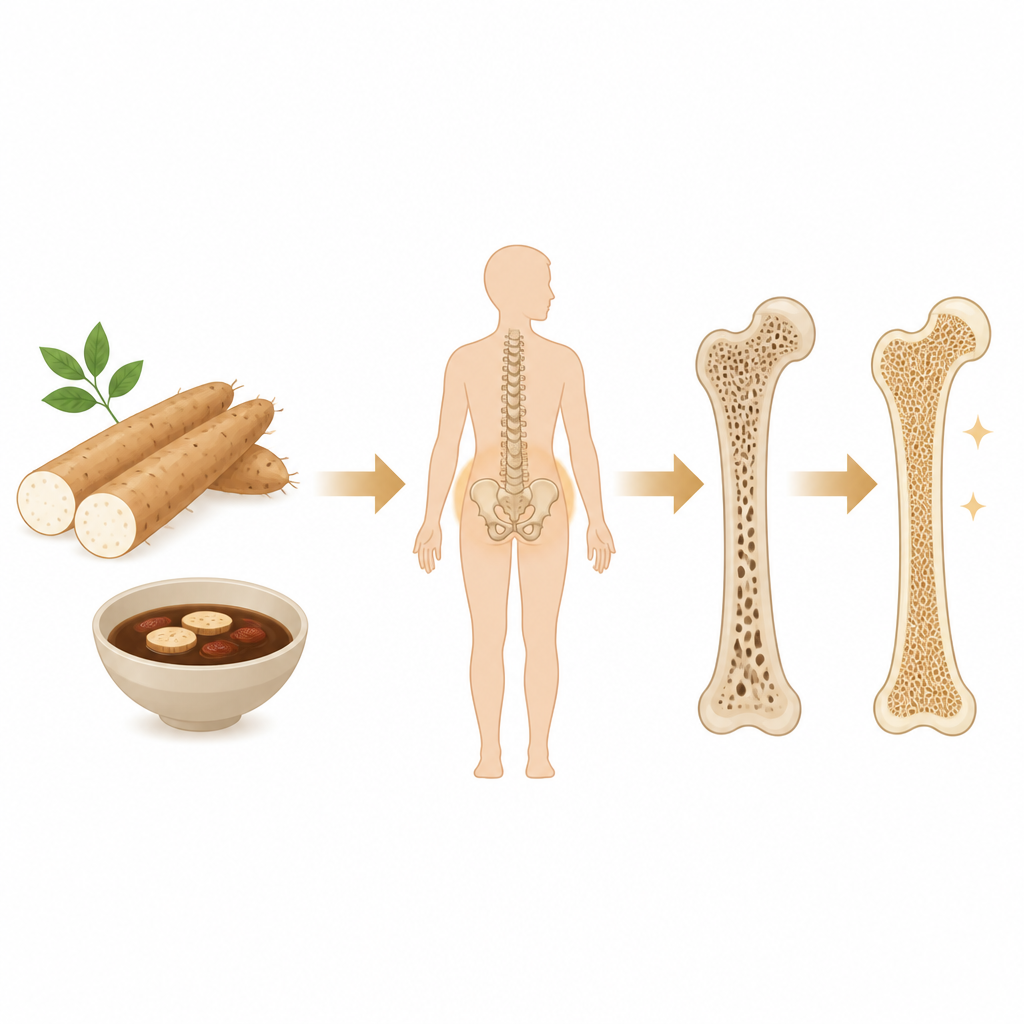
Osteoporosis quietly weakens bones in hundreds of millions of people, raising the risk of painful fractures from simple falls. Standard drugs can help but often bring side effects and do not work for everyone. This study looks at Chinese yam, a starchy root eaten as food and used in traditional medicine, to ask a modern question: can its natural ingredients help protect bones, and if so, how?
From kitchen ingredient to lab spotlight
Chinese yam has long been used in East Asia to “nourish” the body, but its effects on bone health had not been mapped out in detail. The researchers began by combing through large chemical and gene databases to list the many small molecules found in the yam and predict which ones might reach the bloodstream and behave like drugs. They identified more than 70 likely candidates, including plant steroids and antioxidant compounds. Next, they compared the genes these molecules might influence with thousands of genes already linked to osteoporosis, finding nearly 200 points of overlap that suggested where the yam could act inside the body.
Finding the key switches inside cells
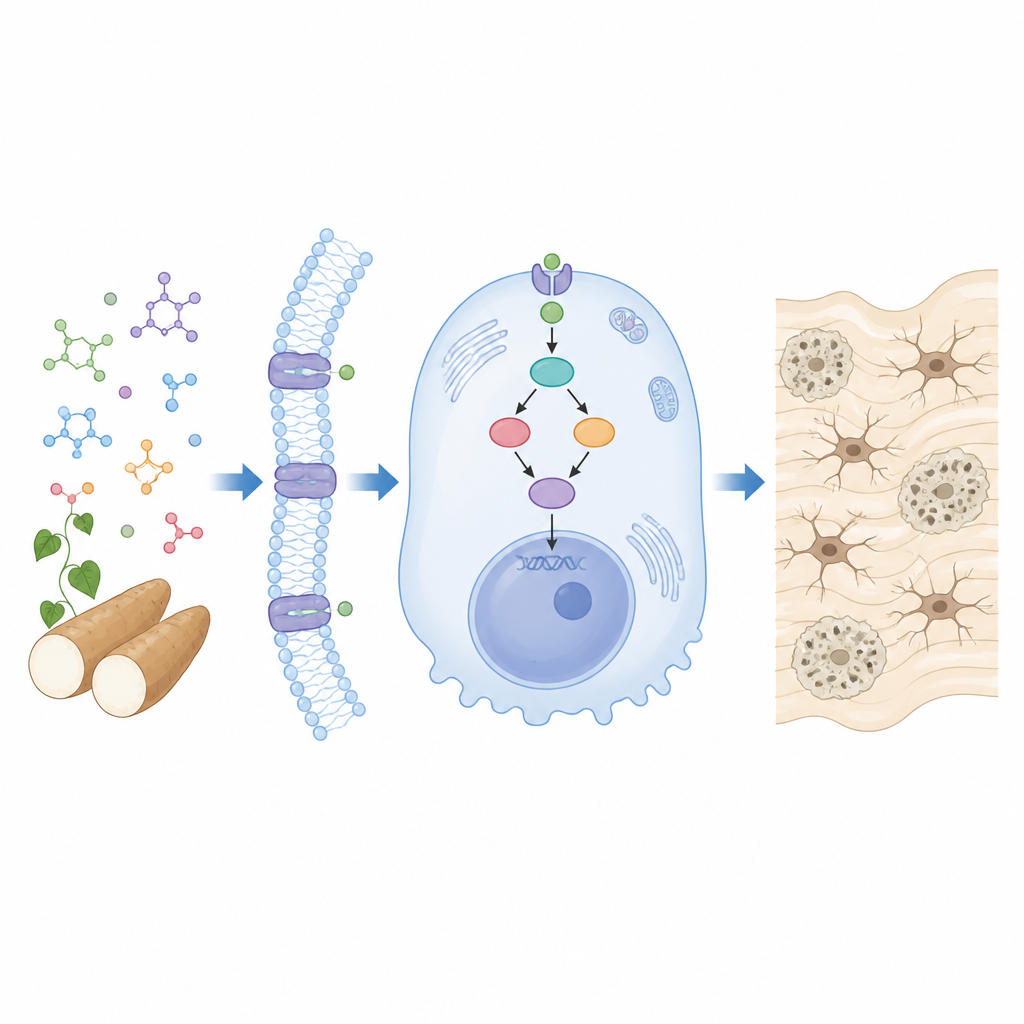
Using computer tools, the team then built networks showing how yam ingredients and bone-related proteins connect with each other. Several proteins stood out as central “switches” in these maps, including ones that control cell growth, inflammation, and the balance between bone breakdown and bone building. The analysis pointed strongly to a cell communication route called the PI3K/Akt pathway, as well as related routes often involved in stress and inflammation. When the scientists docked six prominent yam compounds onto these protein targets in detailed 3D simulations, they found that several, especially dihydroquercetin and garcinone D, could fit snugly into the proteins’ pockets and remain stable over simulated time, suggesting that they might realistically influence these switches in living cells.
Testing the extract in tiny fish and bone cells
Predictions on a computer only go so far, so the researchers moved into living systems. They first used zebrafish larvae, which develop bones in ways that mirror human skeletons. The fish were exposed to dexamethasone, a steroid drug known to trigger bone loss, and then treated with different doses of Chinese yam extract. Staining methods that highlight mineral deposits showed that the steroid sharply reduced bone formation in the fish skulls, while the yam extract restored much of the lost mineralization, comparable to a standard bone-protective drug. In parallel, mouse bone-forming cells grown in dishes were also damaged by dexamethasone, showing lower activity of an early bone marker enzyme and reduced signs of maturing into bone cells; adding the yam extract reversed these effects over a safe range of doses.
Tracing a pathway from root to stronger bone
To link these benefits to a concrete mechanism, the team measured proteins inside the cultured bone cells. Dexamethasone dampened signals in the PI3K/Akt pathway and reduced levels of two key bone-building markers, RUNX2 and osteocalcin. Chinese yam extract boosted the activated form of PI3K and raised RUNX2 and osteocalcin, consistent with renewed bone formation. When the researchers added a specific PI3K blocker, these positive effects largely disappeared, suggesting that yam’s action depends on this pathway. Together with the docking and simulation work, these cell and animal experiments support a picture in which several yam ingredients act together on overlapping protein networks to favor bone building over bone loss.
What this means for future bone care
In plain terms, the study suggests that Chinese yam contains a mix of natural compounds that can help counter steroid-induced bone thinning by nudging key cell switches back toward bone formation, especially through the PI3K/Akt route. The work does not prove that eating yam alone will prevent fractures in people, and the authors stress that more studies in mammals and humans are needed, as well as careful checks on dose and safety. Still, the findings offer a scientific basis for viewing Chinese yam not just as a traditional remedy, but as a potential source of new, gentler helpers for keeping bones strong as we age.
Citation: Huang, Z., Zou, L., Xie, B. et al. Exploring the effects and mechanisms of Chinese yam in treating osteoporosis using network pharmacology analysis and biological validation. Sci Rep 16, 15139 (2026). https://doi.org/10.1038/s41598-026-45981-5
Keywords: osteoporosis, Chinese yam, bone health, PI3K Akt pathway, traditional medicine