Clear Sky Science · en
Spatio-temporal evolution and regional heterogeneity in the efficiency of agricultural non-point source pollution control within the Chaohu Lake Basin
Why farm pollution near a lake matters
Agriculture feeds people, but it can quietly damage lakes and rivers when rain washes fertilizer and pesticides off fields. In China’s Chaohu Lake Basin, a vital source of grain and drinking water, this type of diffuse farm pollution is a stubborn driver of murky water and algal blooms. This study asks a practical question that concerns farmers, residents, and policy makers alike: how efficiently is the region using land, water, chemicals, and machines to grow food while keeping the lake clean, and how does that efficiency change over time and from place to place?
Measuring how wisely farm resources are used
To tackle this question, the researchers examined data from 17 counties and districts around Chaohu Lake between 2016 and 2023. They treated each county as a small production system that turns inputs such as labor, land, machinery, irrigation water, fertilizers, and pesticides into crop value, while also generating unwanted byproducts like greenhouse gases and nutrient pollution. Using advanced efficiency tools, they compared how close each county came to an ideal frontier where farm output is high and pollution is low for a given level of inputs. This allowed them to calculate how much of each input was effectively wasted and how much room there was to cut emissions without hurting harvests.
Too much of a good thing on the farm
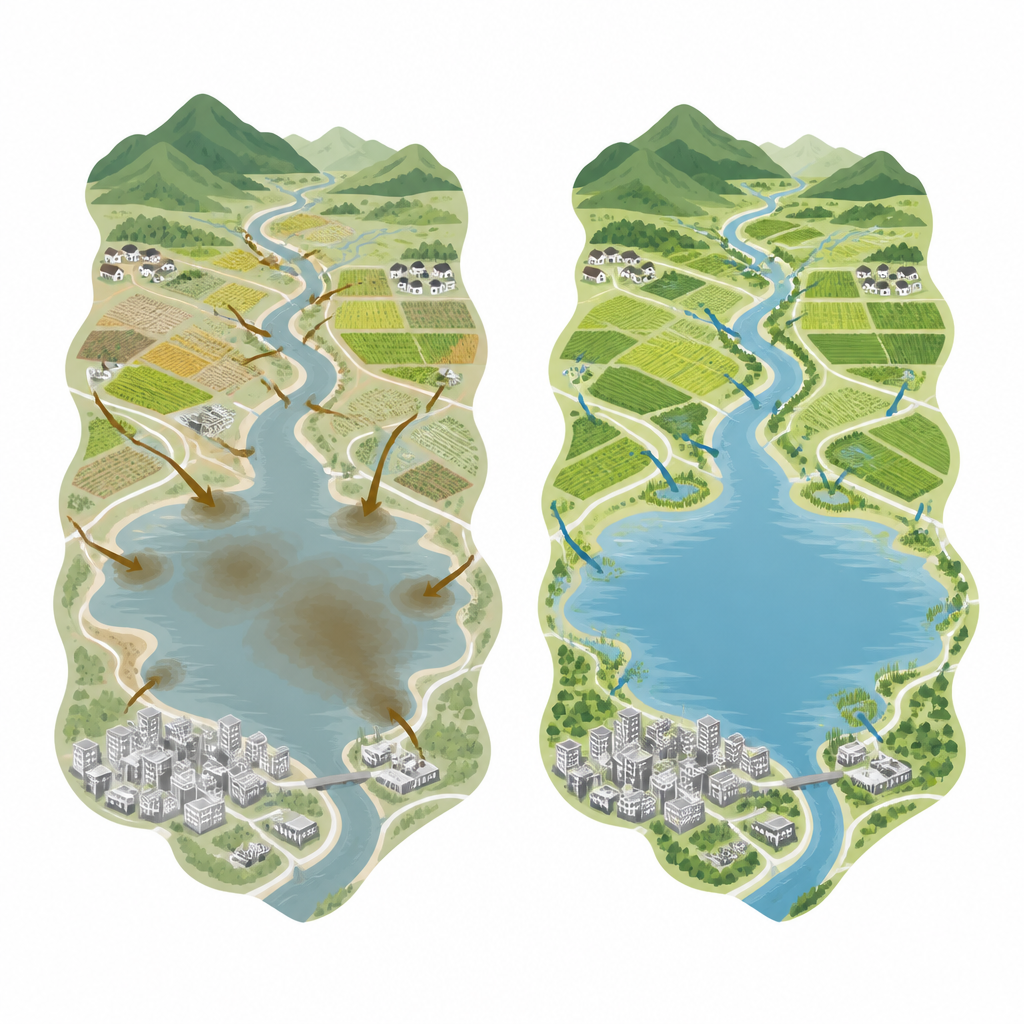
The numbers reveal a clear pattern: across the basin, farms are generally using more inputs than needed. Fertilizers and pesticides stand out as the main culprits, with their “slack” values staying high even as other inputs improved. In many places, machinery, irrigation water, and labor are also underused or poorly matched to actual needs. When the researchers tracked changes over time, they saw a sharp drop in these excesses around 2017 and 2018, when local authorities launched strong programs to create a “Beautiful and Green Chaohu Lake.” After that burst of progress, gains slowed and even slipped in some years, suggesting that early campaigns were effective but hard to sustain without deeper structural changes.
Different stories upstream, midstream, and downstream
The study also shows that not all parts of the basin behave the same. Upstream, in hilly and mountainous areas, labor, machinery, and pesticides are especially excessive, yet both technology adoption and day to day management remain weak. Scattered plots and an older farming population make it hard to introduce modern, precise practices. Midstream areas near the main city use land and machines relatively well and rely least on chemical pesticides, but their performance swings as policies and pilot projects are introduced, revised, or scaled back. Downstream, where rivers empty into the lake, fertilizer use and irrigation are heavily overdone, and this overinvestment feeds high nitrogen and phosphorus runoff into Chaohu, even though some advanced technologies are available but not managed in a balanced way.
When tools and management do not work together
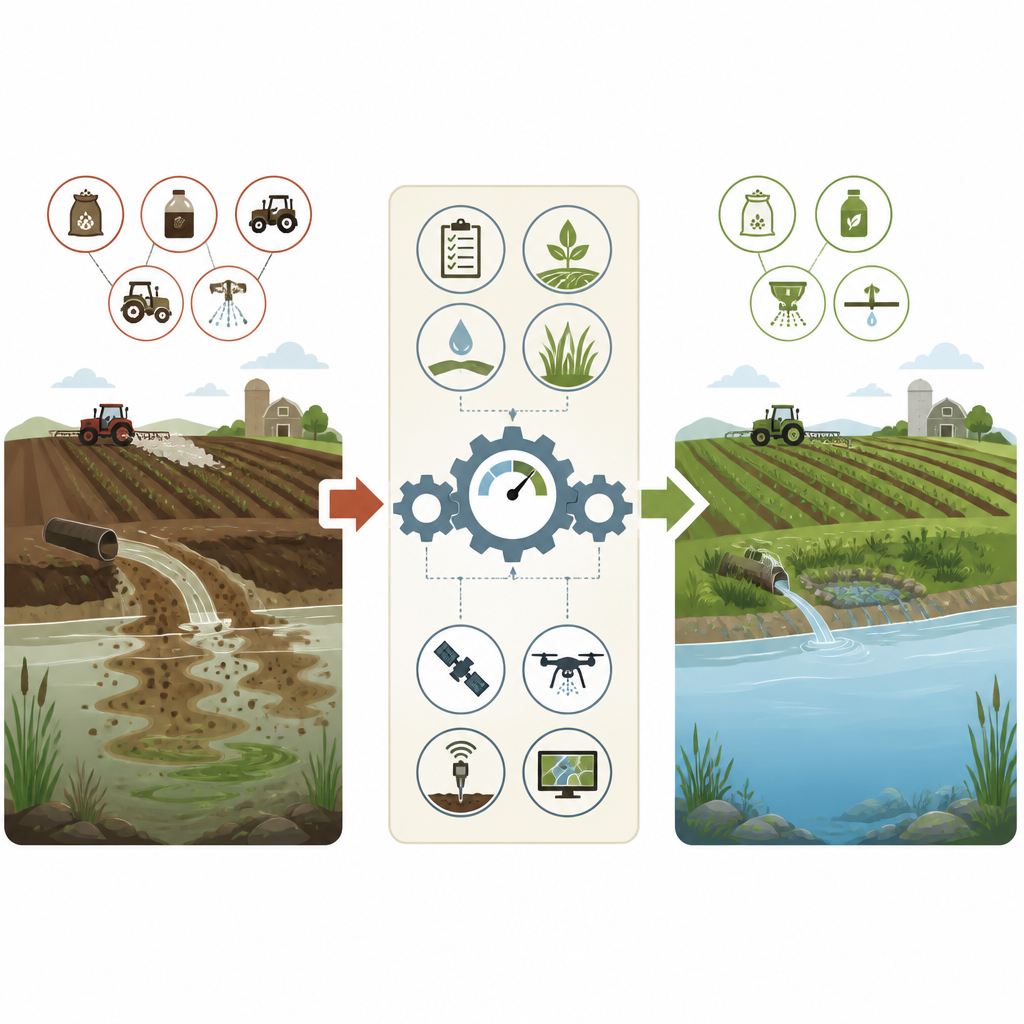
By separating the effects of new technology from the effects of better management, the authors uncover a hidden problem. In some counties, technical upgrades like better machinery or monitoring systems push efficiency forward, but local management systems do not adjust, so these tools become “technology islands” with limited real impact. In others, managers squeeze better performance out of outdated tools, a kind of “management compensation” that cannot last without new technology. Overall, the most successful places are those where technology and management move in step, while low performing areas tend to have both weak tools and weak oversight.
What this means for cleaner water and greener farming
For non specialists, the takeaway is straightforward. Chaohu Lake’s farm pollution problem is not simply about telling farmers to use less fertilizer and water. It is about using these inputs more intelligently, in ways that match local landscapes and social realities. The study suggests that upstream zones need support to adopt green farming suited to hillsides, midstream zones need more stable and consistent policies, and downstream zones must curb fertilizer and irrigation excesses while aligning high tech tools with practical field management. If technology, policy, and day to day decisions can be better coordinated in each part of the basin, Chaohu Lake stands a much better chance of staying both productive and clean over the long term.
Citation: He, Q., Han, Q. & Lu, W. Spatio-temporal evolution and regional heterogeneity in the efficiency of agricultural non-point source pollution control within the Chaohu Lake Basin. Sci Rep 16, 15244 (2026). https://doi.org/10.1038/s41598-026-45974-4
Keywords: agricultural pollution, non-point source, Chaohu Lake, water quality, farm efficiency