Clear Sky Science · en
Uncovering adulteration and quality variations in commercial lavender essential oils from the Egyptian market using GC–MS and chemometrics
Why the Scent in the Bottle Matters
From pillow sprays to massage blends, lavender essential oil is marketed as a natural way to relax, sleep better, or soothe the skin. Yet not every bottle on the shelf contains the same thing. Some are pure plant distillates, while others may be stretched with cheap carrier oils or synthetic additives. This study peeks behind the label of four popular lavender oils sold in Egypt, using advanced chemical fingerprinting to see which products are truly close to genuine lavender and which may be cut or altered.
Looking Inside Lavender Oils
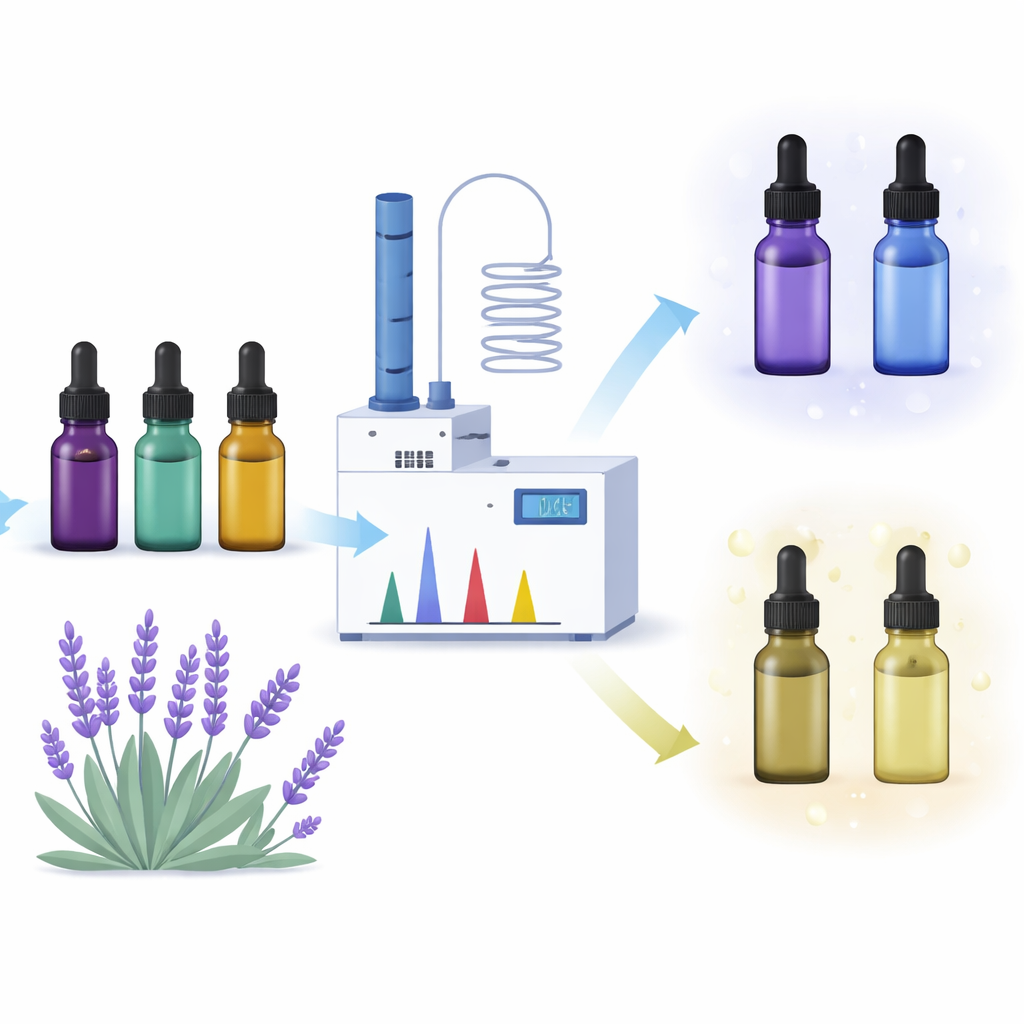
The researchers focused on four commercial products, each from a different local brand. Two were labeled as steam-distilled, the traditional way of making essential oils, and two as solvent-extracted, a method more likely to pull out heavier, oily materials. To compare them fairly, the team ran all four through gas chromatography–mass spectrometry, an analytical technique that separates and identifies dozens of tiny scent molecules in a mixture. They then used mathematical pattern-recognition tools to see how similar or different the chemical fingerprints of each oil really were.
Key Natural Ingredients as Quality Clues
High-quality lavender oil is known to contain two main fragrant ingredients: linalool and linalyl acetate. International standards even specify typical ranges for these compounds. In this study, the two steam-distilled products, labelled L-Sha and L-Rag, had relatively high levels of both molecules and overall profiles that closely matched what is expected from genuine Lavandula angustifolia oil. In contrast, the other two products, L-Imt and L-Nef, contained much lower amounts of these hallmark components and instead showed unusually high levels of other substances not normally abundant in true lavender oil.

Red Flags for Dilution and Additives
Several of the suspicious compounds point toward commercial tampering rather than natural variation. One sample, L-Imt, contained a large share of fatty acid esters such as isopropyl linoleate and oleyl acetate—materials more commonly found in cosmetic carrier oils than in distilled essential oils. Their presence suggests that the lavender oil was likely diluted with cheaper oily ingredients. Another sample, L-Nef, showed a strikingly high level of 2,4‑pentanediol and related synthetic glycols, which are used as solvents or stabilizers in fragrances but are not produced by the lavender plant itself. These findings indicate that some products sold as lavender essential oil are probably blends of true oil with added industrial ingredients.
Patterns That Separate Pure and Altered Oils
To move beyond single compounds and look at the overall pattern, the team applied multivariate “chemometric” analyses. These statistical tools group samples based on how their full chemical signatures compare. The methods clearly split the four oils into distinct clusters. L-Sha and L-Rag grouped together, driven by their higher amounts of natural lavender markers. L-Imt and especially L-Nef separated from these, pulled apart by their excess fatty esters and synthetic glycols. When the most atypical sample (L-Nef) was removed from some models, the differences between the remaining oils became even clearer, reinforcing the picture of two relatively authentic products and two that appear modified.
What This Means for Shoppers
For everyday consumers, all four bottles may smell pleasantly of lavender, but their chemistry—and likely their effects and value—are not the same. This study shows that combining detailed chemical profiling with modern data analysis can reliably distinguish more authentic lavender oils from those that seem diluted or doctored with additives. In simple terms, two of the tested Egyptian products were close to what a buyer would expect from real lavender essential oil, while the other two likely contain extra oils or synthetic helpers that are not disclosed on the label. The work underscores the need for routine, science-based quality checks so that people who pay for “pure” lavender actually get it, and not just a nicely scented mixture.
Citation: Abouelela, M.B., El-Taher, E.M., Shawky, E.M. et al. Uncovering adulteration and quality variations in commercial lavender essential oils from the Egyptian market using GC–MS and chemometrics. Sci Rep 16, 12735 (2026). https://doi.org/10.1038/s41598-026-45972-6
Keywords: lavender essential oil, product adulteration, GC-MS analysis, quality control, chemometric profiling