Clear Sky Science · en
Demographic skew and market dynamics reveal unsustainable trade and conservation risks of the West African dwarf crocodile
Why a small crocodile matters
The West African dwarf crocodile is the smallest of Africa’s crocodiles, living quietly in the swamp forests and creeks of West and Central Africa. In Nigeria’s Niger Delta, it is also a valued source of meat, medicine, and leather. This study looks closely at how these animals move from hidden river burrows to busy markets, and what that journey means for both local livelihoods and the survival of the species.
From quiet creeks to crowded stalls
Researchers followed the path of dwarf crocodiles from remote river communities in Delta and Edo States to major bushmeat markets. Over two years of weekly visits, they identified nine key markets, with Ugbenu emerging as the main hub. There, traders offered nearly 1,800 crocodiles across 105 market days, often arriving alive after canoe and road transport. The study mapped the trade routes with GPS, revealing a clear chain: hunters in riverine villages, middlewomen who collect and move animals, and urban markets in places like Benin City where meat is finally sold. 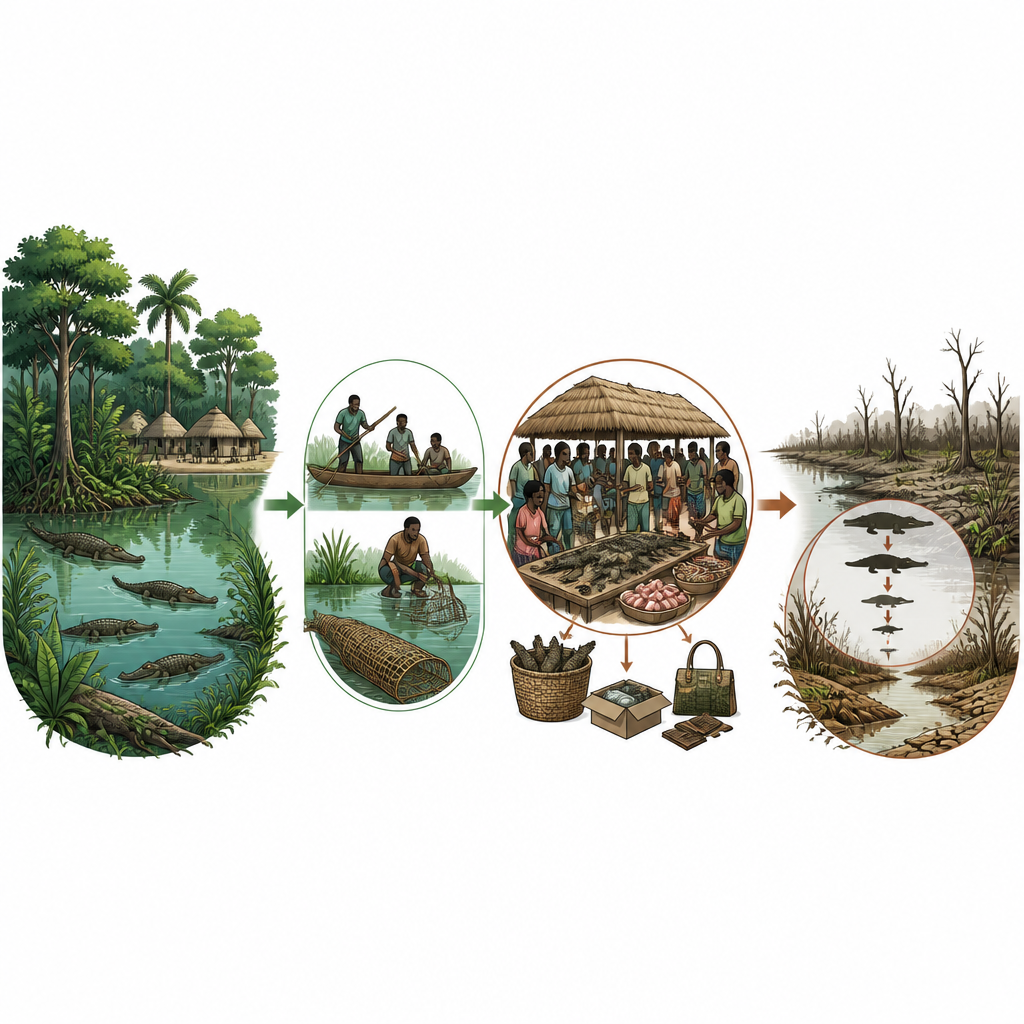
Women at the center of the trade
One striking feature of this trade is how strongly it is shaped by gender. Middlewomen control about 80 percent of the crocodile flow at Ugbenu. They negotiate prices with hunters, organize boats and vehicles, and manage sales to retailers and consumers. For many households, this income is essential. At the same time, the trade is largely informal, with little attention to national laws or global rules that list the dwarf crocodile as a protected species. This mix of economic need, cultural custom, and weak enforcement makes regulation difficult.
How hunting methods shape the catch
The team visited hunting camps to see how crocodiles are caught. They documented five main techniques: wire traps at burrow entrances, baited hooks, burrow excavation, manual capture, and occasional use of firearms. Wire traps were the most common and effective, but they also cause injuries and can harm other animals. Hunters reported that older methods like digging burrows and grabbing animals by hand now yield fewer crocodiles, suggesting that local populations are thinning out. Despite declining success in the field, markets still receive steady supplies, which points to increasing effort and wider hunting areas rather than healthy populations.
Missing babies and disappearing giants
By measuring every crocodile on sale at Ugbenu, the researchers built a detailed picture of which animals are being removed from the wild. Trade is heavily skewed toward mid-sized individuals between about one and one and a half meters long, which are sexually mature and provide good meat with easier handling. Very small juveniles were almost absent, likely because they are not worth the effort or are sometimes released. The largest adults showed a sharp decline over the study, nearly vanishing in the second year. Trade was also seasonal: numbers peaked in the dry months, when burrows are easier to reach and demand rises around holidays. Together, these patterns show a size-selective, seasonally intense harvest that targets the breeding backbone of the population. 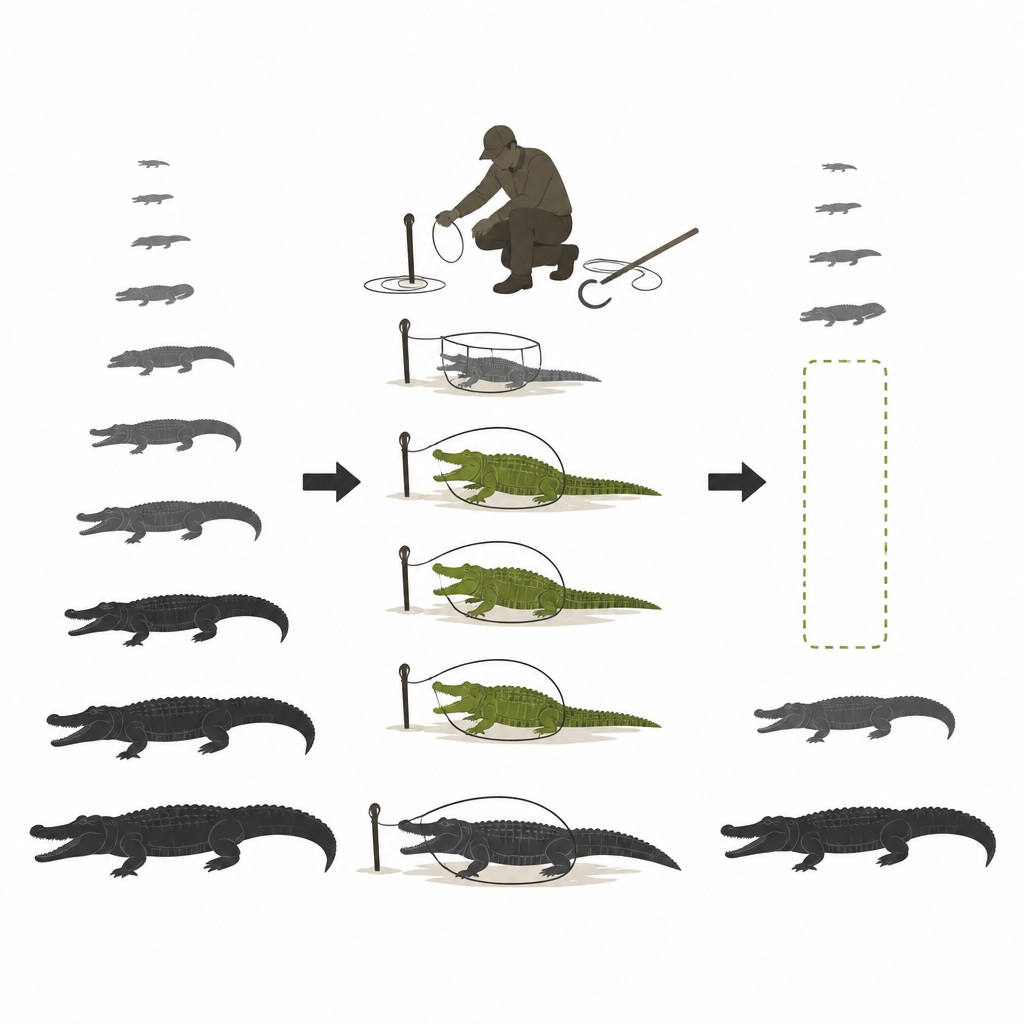
What it means for people and wetlands
For a slow-growing animal that depends on specialized wetlands, the removal of so many mid-sized and large adults is a serious warning sign. The authors argue that without change, recruitment of young animals will falter and local populations may collapse, with ripple effects on nutrient cycling and food webs. They call for stronger enforcement of wildlife laws at key markets, seasonal and size-based harvest limits, and community-led monitoring that respects local livelihoods. By working with hunters and traders rather than against them, the study suggests it may be possible to reduce pressure on the dwarf crocodile while maintaining the cultural and economic roles it plays in the Niger Delta.
Citation: Arimoro, F.O., Dore, M.P. & Ikomi, R.B. Demographic skew and market dynamics reveal unsustainable trade and conservation risks of the West African dwarf crocodile. Sci Rep 16, 15702 (2026). https://doi.org/10.1038/s41598-026-45968-2
Keywords: West African dwarf crocodile, bushmeat trade, wildlife conservation, Niger Delta wetlands, crocodile hunting