Clear Sky Science · en
Combining network pharmacology and experimental validation to study the action and mechanism of brusatol against lung adenocarcinoma
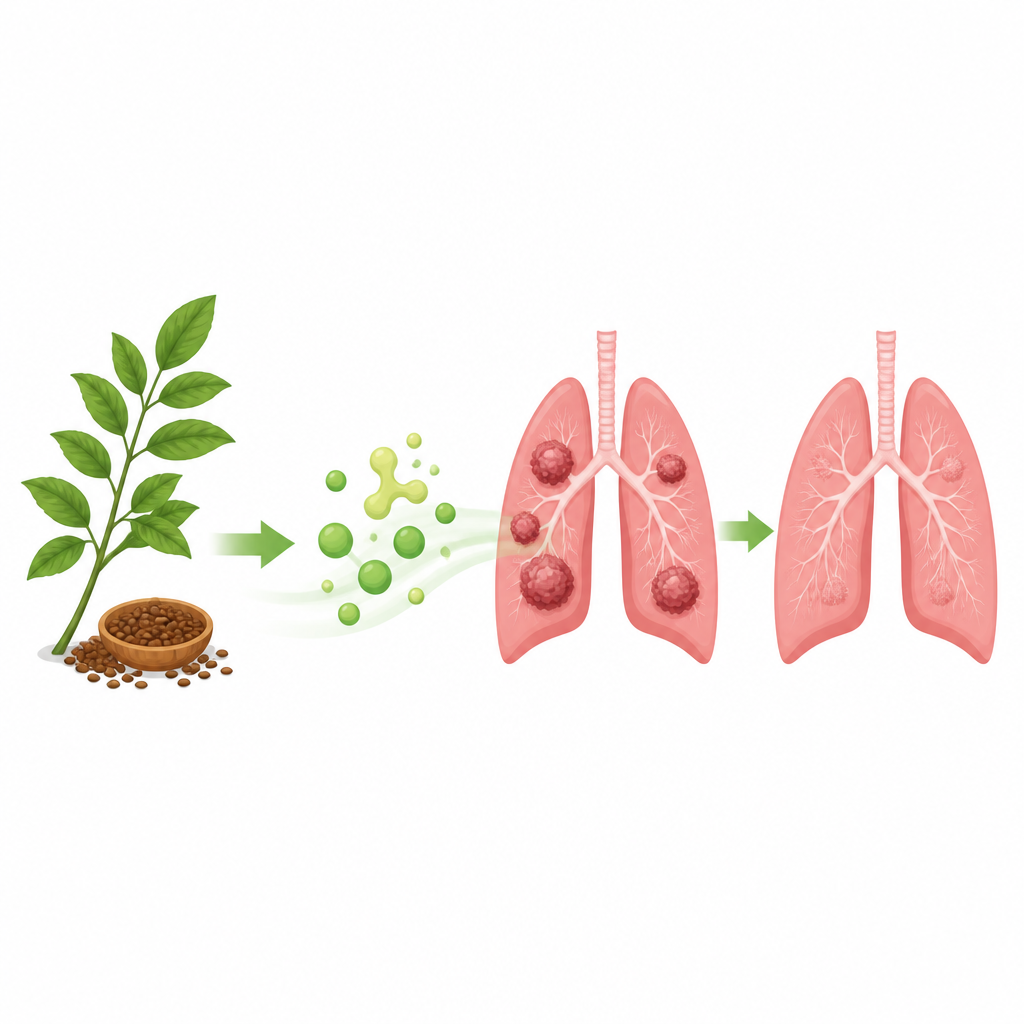
From rainforest seed to lung cancer research
Many of today’s cancer drugs can trace their origins to plants. This study follows that tradition by exploring brusatol, a natural compound from the seeds of the plant Brucea javanica, long used in traditional Chinese medicine. The researchers asked a simple but important question: can this plant molecule help stop one of the deadliest cancers, lung adenocarcinoma, and if so, how does it work inside our cells?
Why lung cancer needs new options
Lung cancer remains a leading cause of cancer death worldwide, and lung adenocarcinoma is its most common form. Standard treatments such as chemotherapy, targeted drugs, and immunotherapy have improved survival for some patients, but side effects and drug resistance are major problems. Because traditional Chinese medicine is often seen as gentler and multitargeted, scientists are hunting for single active ingredients within these remedies that could become modern anticancer drugs. Brusatol has already shown the ability to kill several types of tumor cells, but its impact on lung adenocarcinoma had not been clearly mapped.
Using big data to predict how a plant molecule works
To uncover brusatol’s possible targets, the team turned to “network pharmacology,” a data-driven way to match small molecules with many human proteins at once. They first used online databases to predict hundreds of proteins that brusatol might bind. Next, they collected thousands of genes linked to lung adenocarcinoma from large patient data sets. By overlapping these lists, they pinpointed nearly 300 shared targets that could mediate brusatol’s action against this cancer. Computer tools then built a protein interaction map to highlight the most connected nodes, and docking simulations tested how snugly brusatol might fit into these key proteins, much like trying different keys in a set of locks. One protein called MAPK1, an important player in a growth-control pathway often hijacked by tumors, emerged as the strongest candidate.
Putting predictions to the test in lung cancer cells
Computers alone cannot confirm a treatment, so the researchers carried brusatol into the lab. They treated two human lung adenocarcinoma cell lines with rising doses of the compound. Cell survival tests showed that brusatol reduced cell growth over time and at higher concentrations. Colony formation assays, which measure a cell’s ability to keep dividing and form visible clusters, also dropped sharply. Detailed cell cycle measurements revealed that brusatol caused cells to stall in the G2/M phase, a checkpoint just before division, and this was accompanied by shifts in cell cycle proteins that are known to enforce such a halt. At the same time, markers of programmed cell death increased: pro-death proteins rose, survival proteins fell, and executioner enzymes involved in dismantling cells became more active.
Stopping invasion and blocking a cancer signaling route
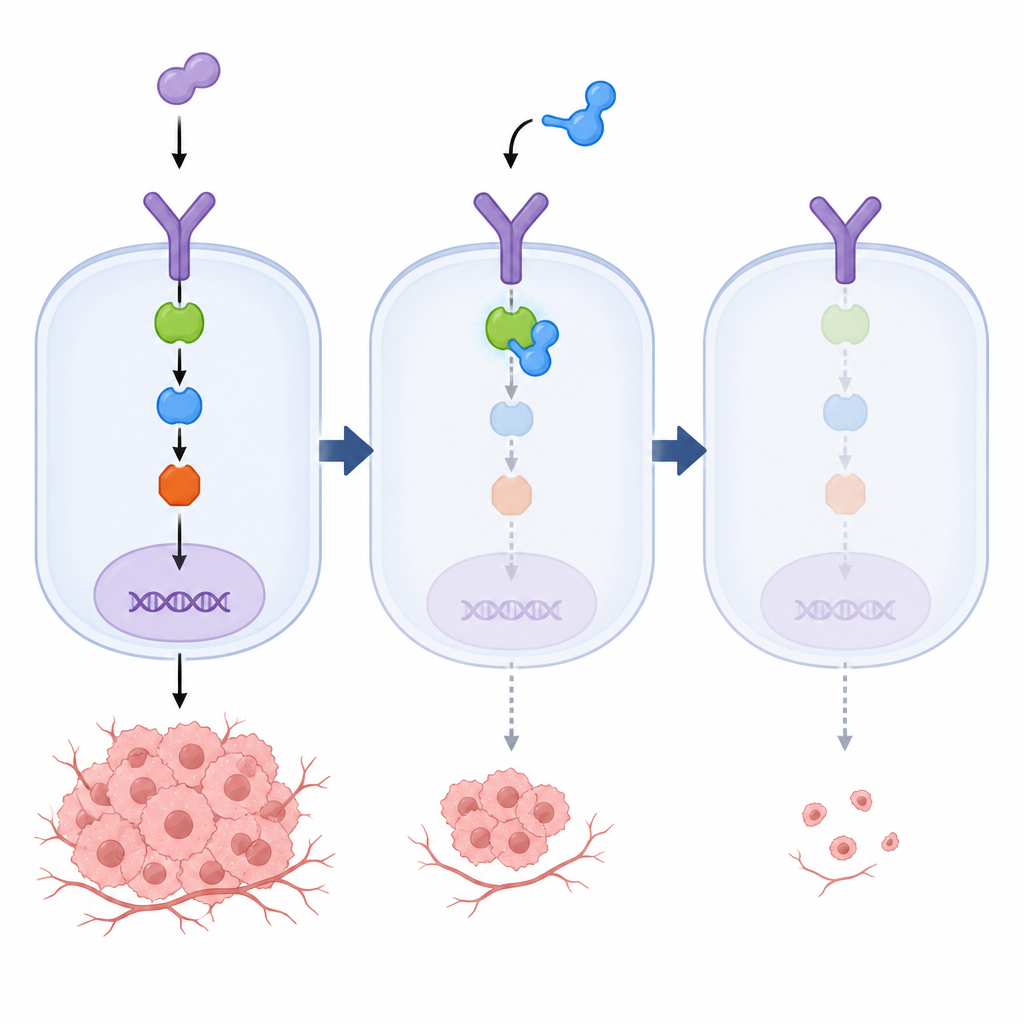
Beyond simply slowing growth, brusatol also curtailed the cancer cells’ ability to invade through a simulated tissue barrier, a test that mimics early steps of metastasis. Proteins that help cells detach and move, such as vimentin and MMP9, went down, while E-cadherin, which helps cells stay anchored in place, went up. To connect these changes to a specific molecular route, the team measured proteins in the Ras–MAPK pathway, a well-known chain of signals that drives cell division and survival in many cancers. Brusatol reduced the active (phosphorylated) forms of MAPK1 and related pathway proteins Raf and MEK. When the researchers added an ERK activator after brusatol treatment, it partly reversed brusatol’s effects on growth and cell cycle, supporting the idea that blocking this pathway is central to the compound’s action.
What this means for future cancer therapies
Taken together, the findings suggest that brusatol, a molecule derived from traditional medicine, can slow lung adenocarcinoma cell growth, trigger their death, and reduce their invasive behavior by targeting MAPK1 and dampening the Ras signaling pathway. While these results are limited to cell models and do not yet prove benefit in patients, they offer a clear road map for further animal studies and eventually clinical trials. The work highlights how blending modern data science with lab experiments can reveal how age-old remedies act on modern diseases, and may help turn promising plant compounds like brusatol into future members of the anticancer drug toolbox.
Citation: Jin, X., Yang, S., Pan, D. et al. Combining network pharmacology and experimental validation to study the action and mechanism of brusatol against lung adenocarcinoma. Sci Rep 16, 15961 (2026). https://doi.org/10.1038/s41598-026-45960-w
Keywords: brusatol, lung adenocarcinoma, Ras signaling, MAPK1, traditional Chinese medicine