Clear Sky Science · en
A hybrid pelican-GWO optimized fractional order PID controller for enhanced performance of hybrid active power filters
Why cleaner electricity matters
Homes, hospitals, data centers, and factories all depend on electricity that arrives in smooth, regular waves. But modern devices such as computers, LED lighting, and industrial drives draw power in a choppy way, injecting “electrical noise” called harmonics back into the grid. These distortions waste energy, stress equipment, and can even trip protection systems. This paper explores a smarter way to clean up that electricity in real time, using a combination of advanced filters and an AI‑like tuning method to keep power quality high even as loads change.
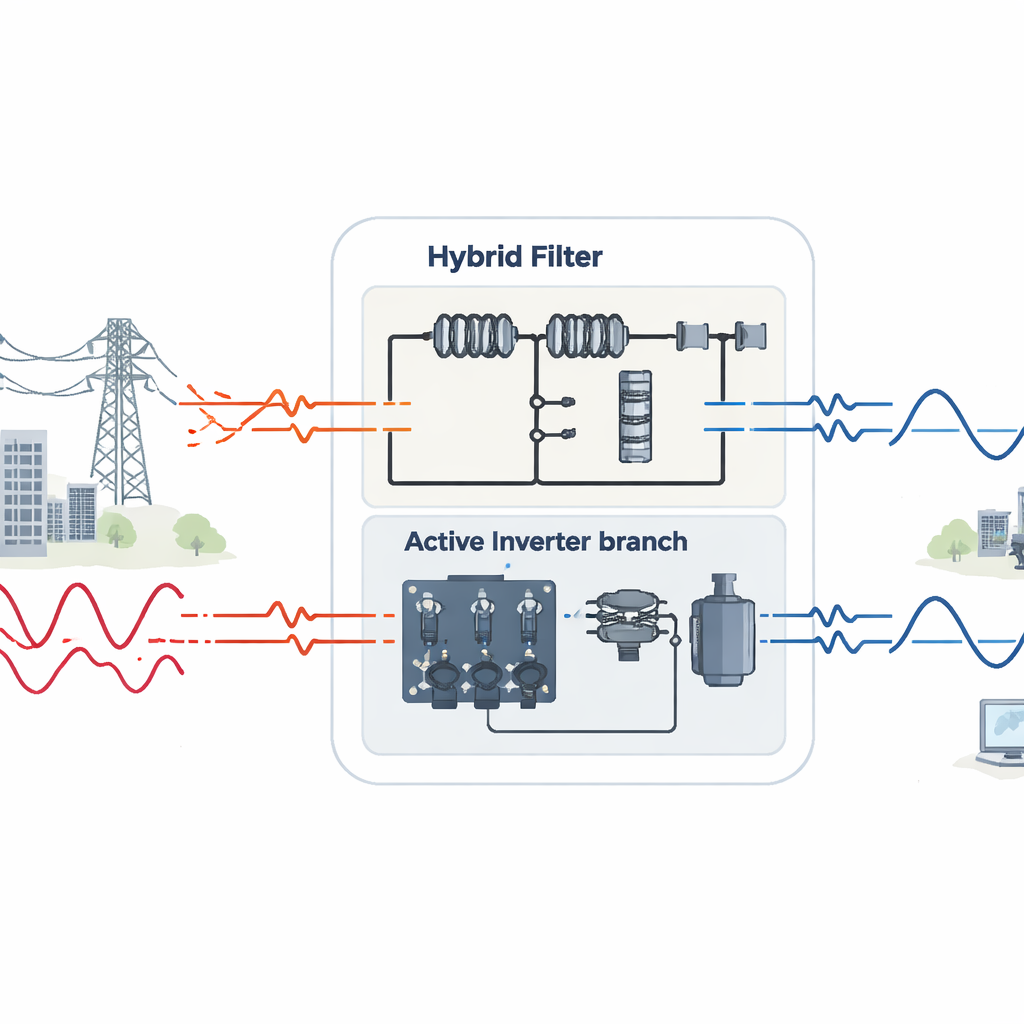
Mixing two ways to clean the power
Engineers often use two broad strategies to scrub unwanted harmonics: passive filters built from coils and capacitors, and active filters based on fast power electronics. Passive filters are robust and simple but only target specific frequencies. Active filters can adapt on the fly but are more complex to control. The study focuses on a hybrid active power filter, which blends both approaches. Double‑tuned passive sections tackle the most troublesome harmonic orders, while an active inverter deals with the remaining distortion by injecting equal‑and‑opposite “cleaning” currents into the line.
Giving the filter a smarter brain
The heart of the hybrid filter is its control system, which decides exactly how much corrective current to inject. Traditional PID controllers, widely used in industry, struggle with the highly nonlinear and tightly coupled behavior of power filters. The authors instead use a fractional‑order PID controller, which adds two extra “knobs” that let the controller shape its response more finely in time and frequency. This extra flexibility can make the system more stable and responsive, but it also makes tuning far harder: five parameters must be adjusted together, and poor choices can lead to slow response or even instability.
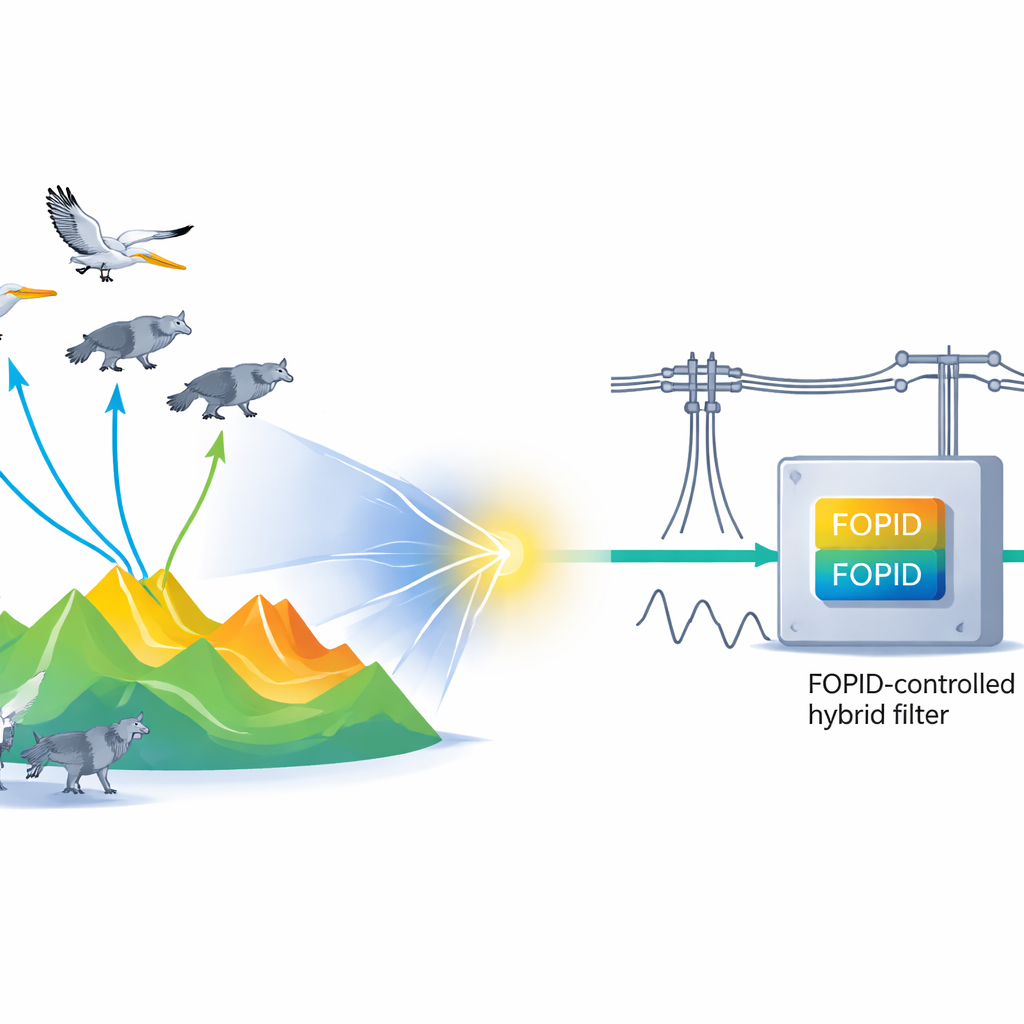
How virtual pelicans and wolves help tune the system
To solve the tuning challenge, the paper introduces a hybrid optimization method inspired by animal behavior. A pelican‑based algorithm first explores the full space of possible controller settings, behaving like a flock searching widely for food. Its best candidates are then handed off to a grey‑wolf‑based optimizer, which imitates a hunting pack closing in on prey. This two‑stage scheme balances broad exploration with fine‑grained refinement. The goal is to minimize a measure of control error over time, while keeping the voltage on the filter’s internal energy store steady so that the active filter can react quickly to changing loads.
What the simulations reveal
Using detailed simulations in MATLAB/Simulink, the authors test the new controller under both balanced and deliberately unbalanced loading conditions. First, passive filters alone reduce current distortion from about 28 percent to just over 6 percent. When the hybrid active filter is added and its fractional‑order controller is tuned with single algorithms, performance improves further but remains limited. With the proposed pelican–grey‑wolf combination, distortion in the supply current drops to around 4.3 percent, comfortably meeting international power‑quality targets. The improved controller also settles to its target voltage faster, with less overshoot, and maintains nearly sinusoidal source currents even as the loads switch between nonlinear, balanced, and unbalanced scenarios.
Why this approach is promising
For readers, the key message is that smarter control, not just more hardware, can make electricity cleaner and more reliable. By pairing a flexible fractional‑order controller with a hybrid nature‑inspired tuning method, the authors show that a single filter setup can adapt to many real‑world conditions without constant retuning. Their results suggest a practical path toward more resilient “self‑healing” distribution systems, particularly important as cities add more electronics, electric vehicles, and renewable energy sources. While the work is currently demonstrated in simulation, it lays the groundwork for real‑time hardware tests and future designs that automatically keep power quality within strict limits, largely invisible to the end user but critical to keeping the lights—and everything behind them—running smoothly.
Citation: Salah Eldeen, R.S., Elkoshairy, A.D., Mageed, H.M.A. et al. A hybrid pelican-GWO optimized fractional order PID controller for enhanced performance of hybrid active power filters. Sci Rep 16, 12461 (2026). https://doi.org/10.1038/s41598-026-45958-4
Keywords: power quality, harmonic filtering, fractional order control, metaheuristic optimization, smart grid