Clear Sky Science · en
High energy and durable PANI, CuO and ZnO nanocomposites for aqueous/organic supercapacitors and their H+/NH+4 ions co-intercalation
Why this new power source matters
From phones to electric cars, modern life runs on devices that need energy storage that is safe, long lasting and affordable. Today, we mostly rely on heavy metal batteries that are powerful but slow to charge and difficult to recycle. This study explores a different path: supercapacitors made from a mix of common, low cost materials that store energy almost like a battery while keeping the fast response and durability of a capacitor.
Blending three simple materials
The researchers focused on a ternary nanocomposite built from polyaniline, a conducting plastic, and two metal oxides, copper oxide and zinc oxide. By carefully tuning the recipe, they arrived at a blend called PCZ9 with about half polyaniline, a bit more than one third copper oxide and a small amount of zinc oxide. The ingredients are grown together in a single low temperature, water based step, forming tiny grains coated with the metal oxides and laced with pores. These pores let the liquid electrolyte move in and out easily, improving how quickly charges can be stored and released. 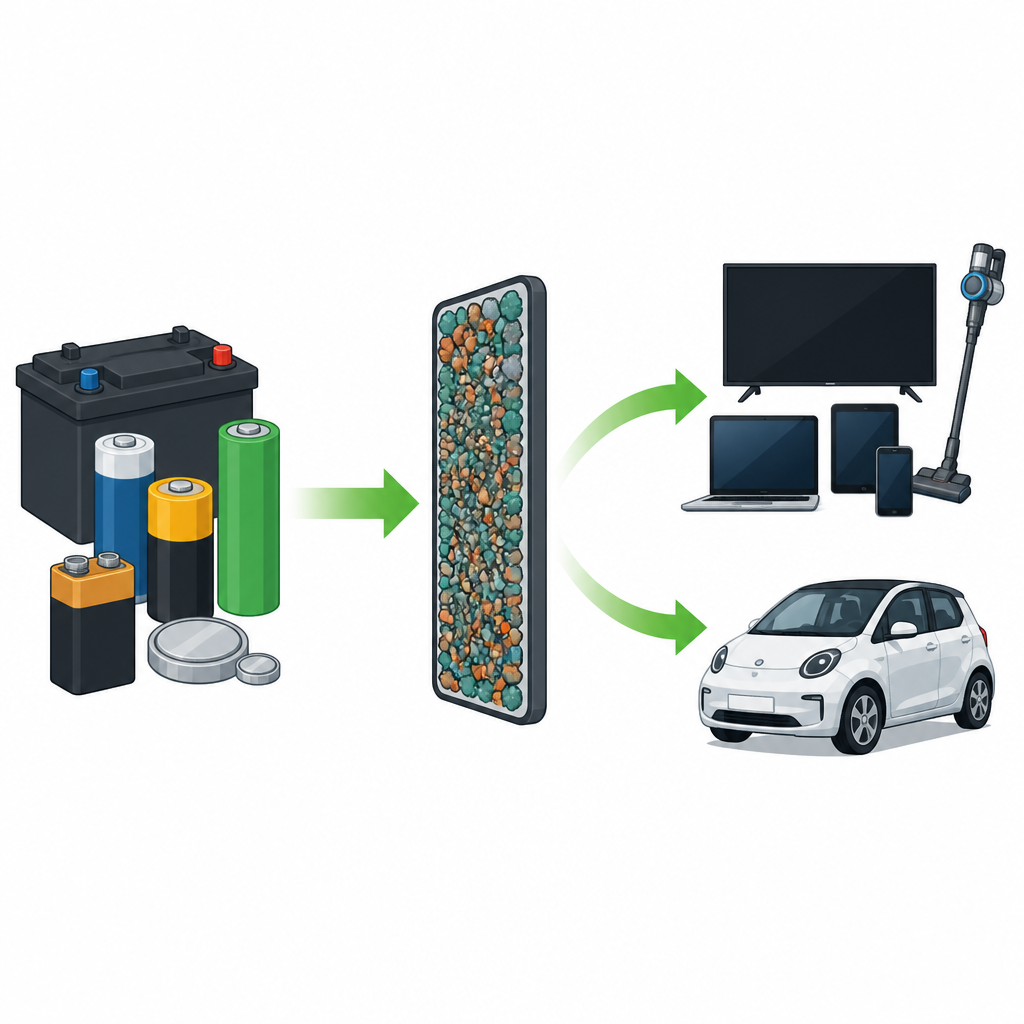
Making supercapacitors act more like batteries
Conventional supercapacitors charge and discharge very quickly, but they typically hold far less energy than batteries. Here, the team built test cells using PCZ9 and related two part mixtures, then soaked them in either an acidic water solution or an organic liquid similar to those used in lithium ion batteries. In water, symmetric cells made from PCZ9 reached an energy density of about 27 watt hours per kilogram, higher than many commercial flow batteries and approaching values seen in lead acid batteries. In the organic liquid, an asymmetric cell built from the copper oxide–zinc oxide blend (CZ) paired with carbon achieved about 71 watt hours per kilogram, exceeding several common battery chemistries under the same comparison.
Helping ions work together
A key twist in the aqueous cells lies in the electrolyte itself. During the chemical synthesis of polyaniline, a clear liquid by product is formed that contains both hydrogen ions and ammonium ions. Instead of throwing this liquid away, the authors used it directly as a “green” electrolyte. Inside the porous PCZ9 electrode, both types of ions slip into and out of the material during charging and discharging. This co insertion process, together with the built in junction between the p type copper oxide and n type zinc oxide, promotes fast electron and ion motion through the composite. As a result, the cell can store more energy without sacrificing its ability to deliver bursts of power.
Durability and real world behavior
For any energy device to be useful, it must endure thousands of charge and discharge cycles. The PCZ9 water based supercapacitor retained about 58 percent of its initial energy after 5000 rapid cycles, while the organic CZ based cell kept around three quarters of its capacity after 2500 cycles at various temperatures. The CZ system also performed well from below freezing to well above room temperature, showing that ion movement and reactions in the organic electrolyte remain robust across everyday conditions. 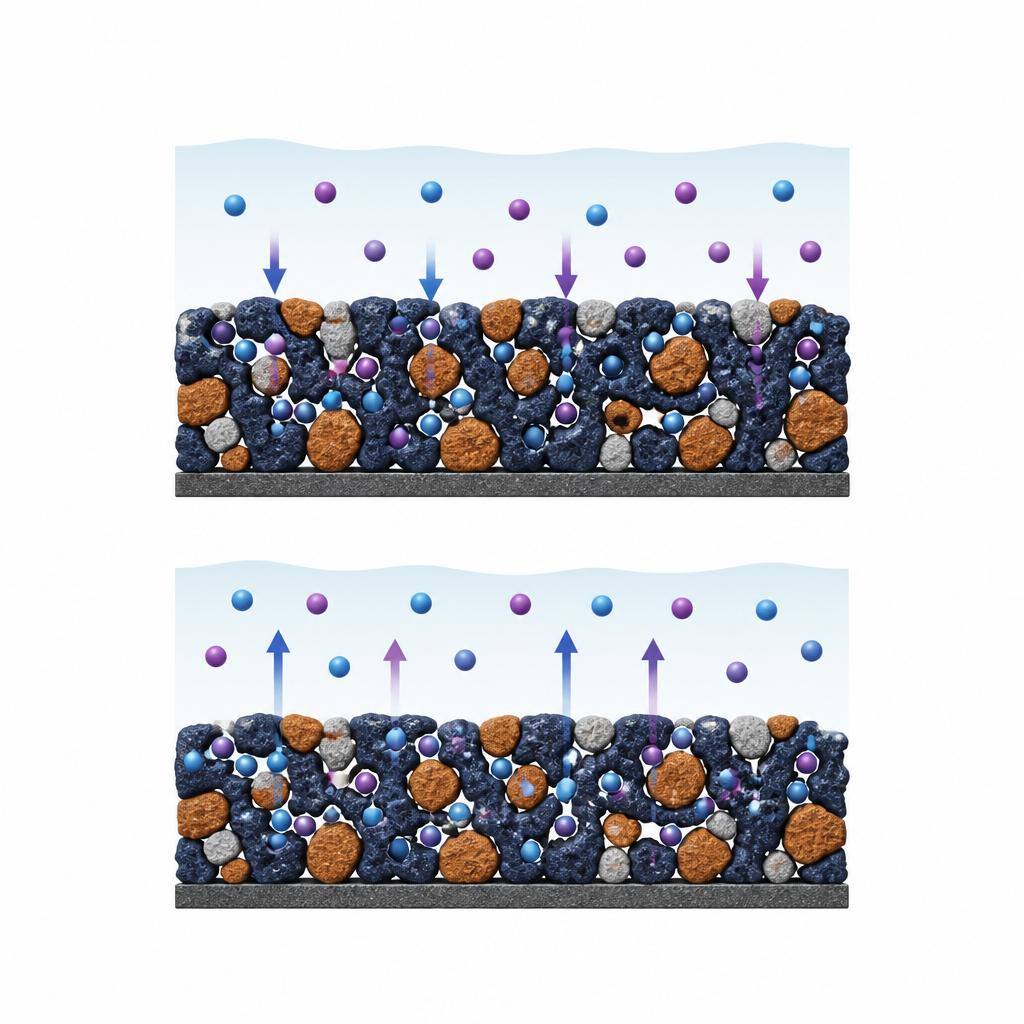
What this means for future devices
In simple terms, this work shows that a carefully engineered mix of a conducting plastic and two common metal oxides can push supercapacitors into the energy range usually associated with batteries, while keeping their speed and durability. By reusing a waste liquid as a dual ion electrolyte and exploiting how hydrogen and ammonium ions move together through the material, the team created light, high energy cells that could one day offer safer, more sustainable alternatives to traditional lead acid and other battery types.
Citation: Viswanathan, A., Manohar, A. & Aravindan, V. High energy and durable PANI, CuO and ZnO nanocomposites for aqueous/organic supercapacitors and their H+/NH+4 ions co-intercalation. Sci Rep 16, 15700 (2026). https://doi.org/10.1038/s41598-026-45954-8
Keywords: supercapacitors, polyaniline, copper oxide, zinc oxide, ammonium ion electrolyte