Clear Sky Science · en
The spatiotemporal effects of electrification on China’s synergistic pollution and carbon reduction efficiency
Cleaner air and climate goals
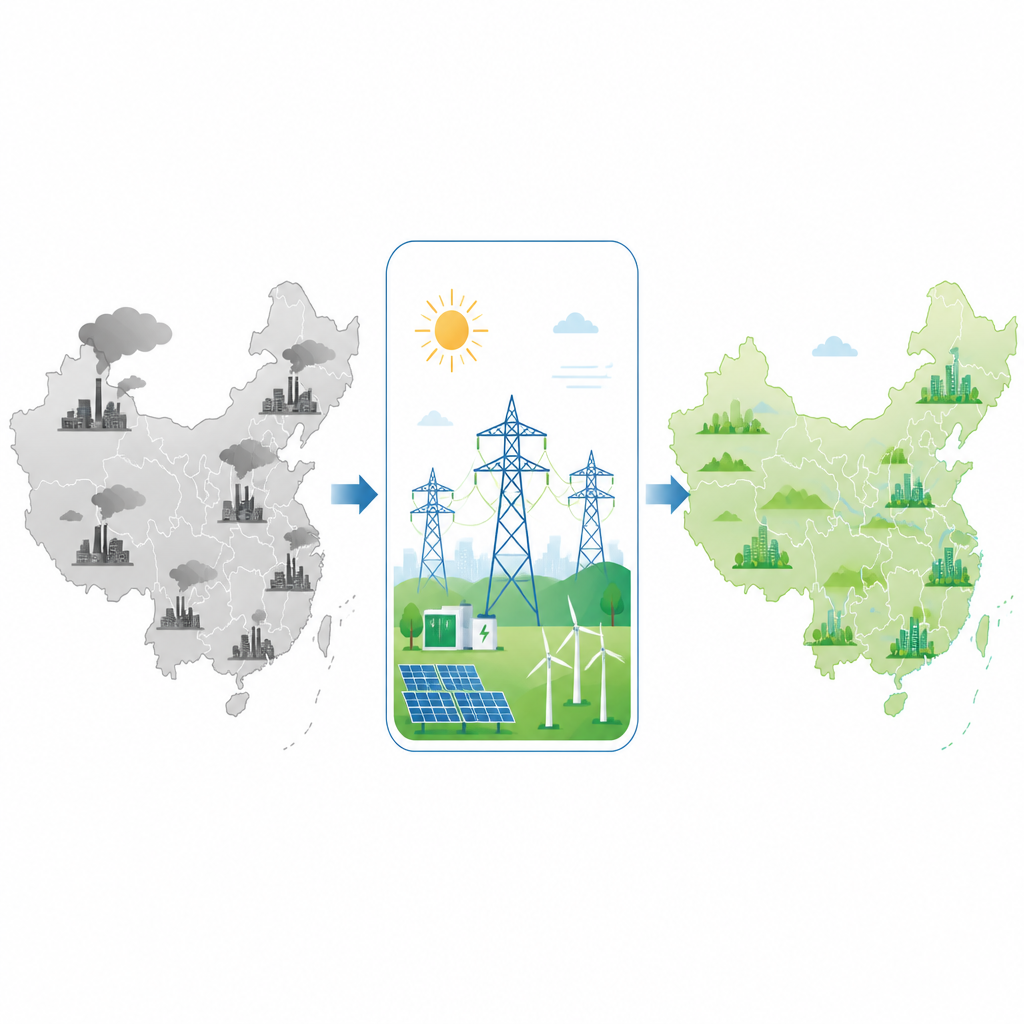
China is trying to clear its skies while also cutting the greenhouse gases that drive climate change. This study asks a simple but important question: when China swaps coal and oil for electricity, does it really help both air quality and carbon goals at the same time, and does it work equally well in every region?
Measuring progress fairly
Most past studies judged progress by looking only at total pollution or carbon coming out of smokestacks. That is like rating two factories only by how much smoke they emit without asking how many people they employ or how much they produce. This paper instead focuses on efficiency: how well each province turns labor, capital and energy into economic output while keeping both carbon dioxide and major air pollutants low. The authors build an index called the Efficiency of Synergistic Air Pollution and Carbon Emissions Reduction, or ESACR, for 30 provinces from 2000 to 2021.
Uneven gains across regions
The results show that China’s overall synergy between cleaner air and lower carbon is still modest, with plenty of room to improve. Progress has been slow but steady over the past two decades. Provinces along the eastern coast, such as Guangdong, Fujian and Jiangsu, perform much better than many western regions. These leading areas tend to have higher levels of electrification, meaning a larger share of their final energy use comes from electricity rather than direct burning of coal or oil. The study also finds that neighboring provinces tend to resemble each other: clusters of high or low performance appear across the map, revealing strong spillover effects.
Electrification as a key driver
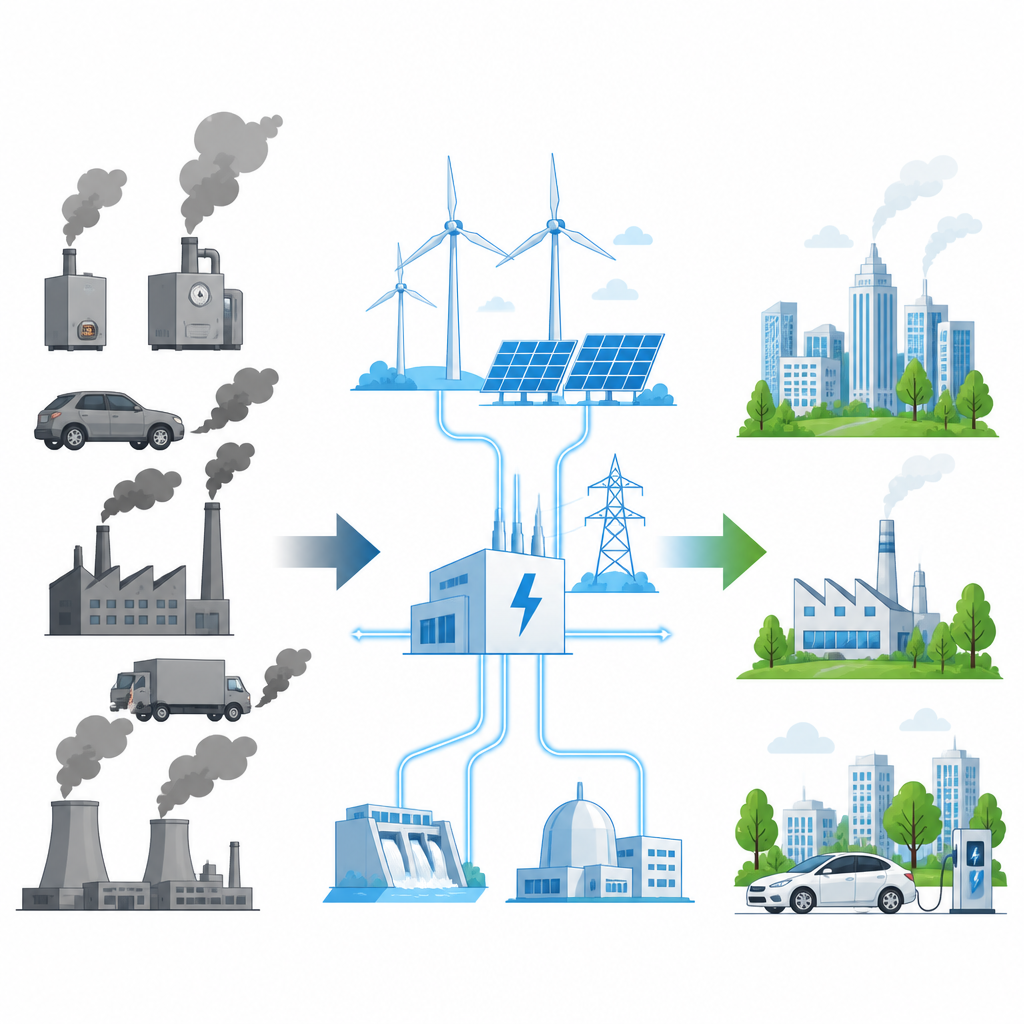
To understand what drives these patterns, the researchers use spatial statistics that account for links between nearby provinces and for changes over time. They test factors such as economic growth, energy intensity, industrial structure, green innovation and environmental rules, with a special focus on electrification. They find that higher electrification usually goes hand in hand with better joint performance on air and carbon, second in importance only to economic development. In coastal provinces and in Qinghai, where electricity already makes up a large share of energy use and the power mix is getting cleaner, the boost from electrification is especially strong. In contrast, regions still early in their electrification journey see weaker benefits so far.
Why some factors help and others harm
Other drivers matter too. Shifting from heavy industry toward services supports cleaner growth, as does investing in green technologies and in pollution control. Stronger environmental rules tend to help in regions where they are backed by funding and enforcement. On the negative side, high energy intensity and rapid urbanization often pull performance down, especially where cities expand faster than clean energy and public services can keep up. The study’s methods also show that the strength and even the direction of these influences vary from place to place and change over the two decades examined.
What it means for policy and everyday life
For non-specialists, the core message is that electrification can be a powerful tool for tackling dirty air and climate change together, but only if it is paired with cleaner power sources and smart planning. Simply wiring more machines and homes to the grid is not enough. Regions already rich in clean electricity can aim for deep cuts by electrifying industry, transport and heating. Others need to build cleaner grids and improve efficiency at the same time. By tailoring electrification and supporting policies to local conditions, China can move closer to a future where growth, blue skies and lower carbon emissions reinforce one another rather than compete.
Citation: Chen, W., Ruan, Z., Shao, Z. et al. The spatiotemporal effects of electrification on China’s synergistic pollution and carbon reduction efficiency. Sci Rep 16, 15008 (2026). https://doi.org/10.1038/s41598-026-45948-6
Keywords: electrification, air pollution, carbon emissions, China energy policy, spatial analysis