Clear Sky Science · en
Synergistic effects of advantageous agronomic measures and sensitive environmental factors on the carbon footprint of crop production based on a meta-analysis
Why farm choices matter for the climate
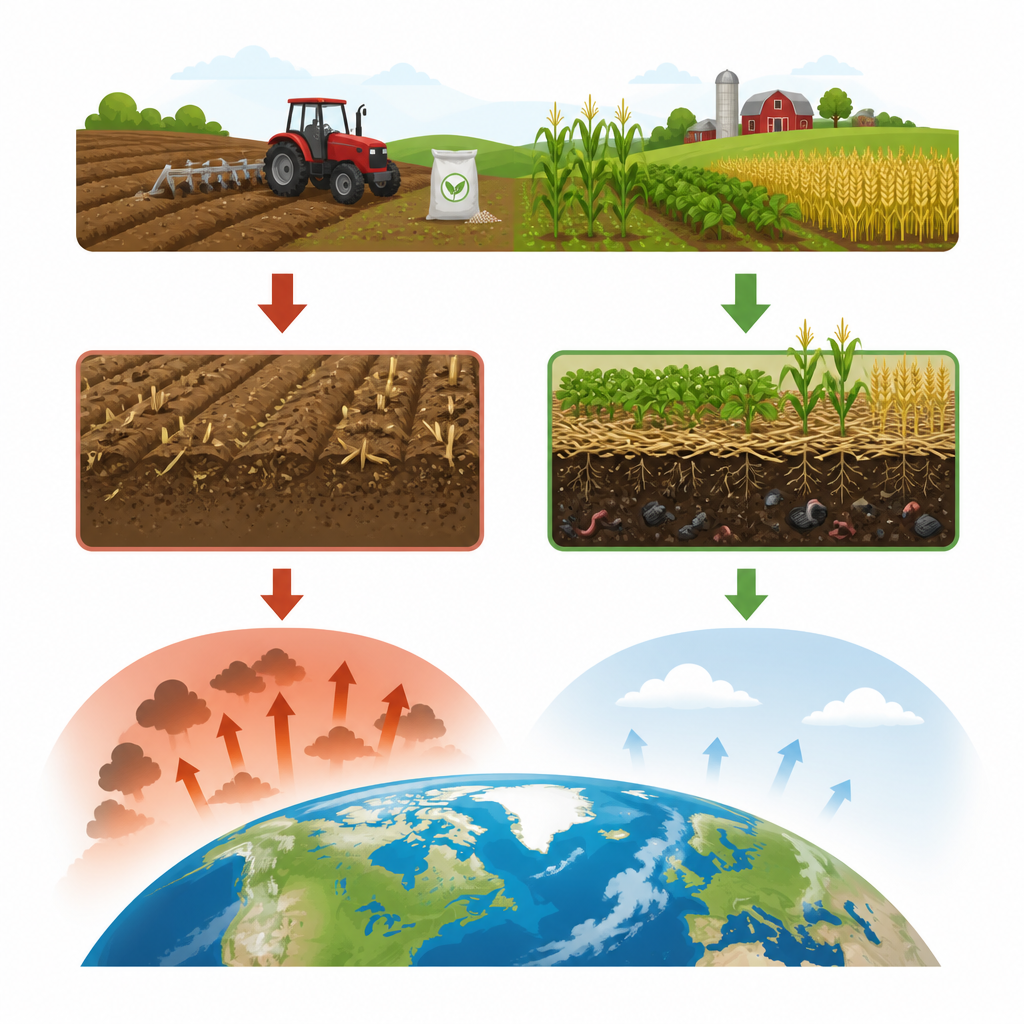
Most of us do not connect our daily bread with climate change, yet growing crops releases a surprising amount of greenhouse gases. This study asks a practical question with global consequences: which everyday farming choices, like how we till the soil or what we add to it, can shrink the carbon footprint of crop production, and how does local climate and soil shape those results?
Looking across many farms and many studies
Instead of doing a single field trial, the researchers combined results from 31 published studies carried out mainly in China, covering 181 separate comparisons between different farming practices. They focused on the "narrow" crop production stage, from sowing to harvest, and used a standard metric called carbon footprint intensity, which relates greenhouse gas emissions to the amount of grain produced. By applying statistical tools that weigh each study according to its reliability, they estimated how much various practices and local conditions tend to raise or lower emissions per kilogram of crop.
The big winners: returning organic matter to the soil
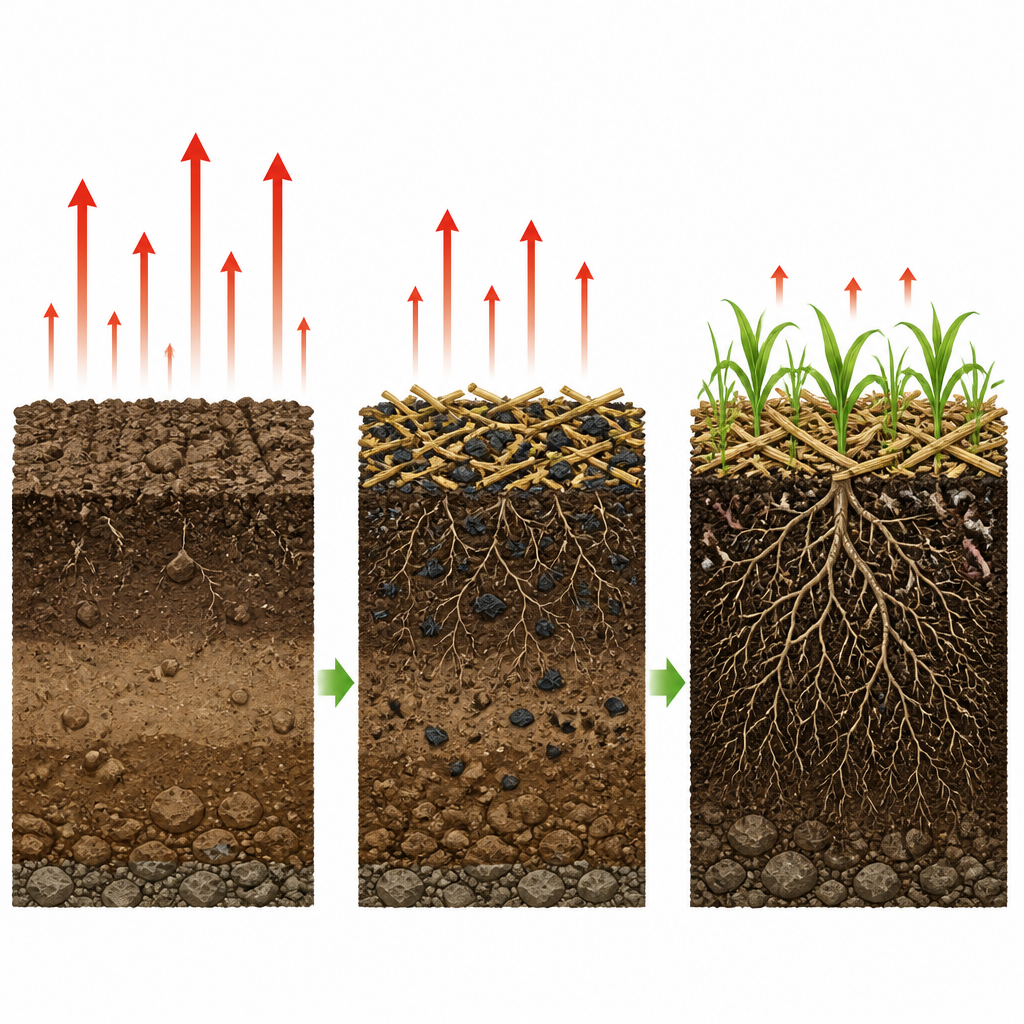
On average, the farming measures and environmental conditions examined cut carbon footprint intensity by about 14 percent. One practice stood out clearly: returning organic materials such as crop residues, manure, or biochar to fields. Compared with not adding such organic matter, this approach lowered emissions per unit of yield by roughly 22 percent. When the team looked more closely, plant based materials performed especially well, and biochar, a charcoal like soil amendment made from plant matter, was linked to nearly a 50 percent reduction. These additions both reduce the need for energy intensive synthetic fertilizers and help build up carbon stored in the soil, turning fields into stronger carbon sinks.
Tilling the soil and working with the environment
Conservation tillage, which disturbs the soil less and often keeps crop residues on the surface, tended to reduce the carbon footprint by about 23 percent, though this trend was not statistically strong across all studies. A closer look suggested that conservation tillage that includes organic mulching can cut emissions more sharply, while results for reduced plowing alone were more mixed. The lack of a clear overall signal likely reflects many differences among experiments, such as crop type, trial length, and how changes in soil carbon were counted.
Power in combinations and local conditions
When farmers used both organic material return and conservation tillage together, the benefits became clearer. This combination lowered carbon footprint intensity by about one third, showing that smart bundles of practices can work better than single changes. The study also examined how soil acidity, temperature, and rainfall influence these gains. Certain soil pH ranges appeared to strengthen the effect of good management, and climate factors like temperature and precipitation shaped how much emissions rose or fell. For example, under high rainfall, conservation tillage helped preserve the carbon savings from returning organic matter, acting as a buffer against emission increases.
What this means for climate smart farming
For a layperson, the main message is straightforward: how we grow crops can significantly shrink their climate impact, especially when farmers add plant based organic materials or biochar to the soil and combine this with gentler tillage. These choices do not work the same way everywhere, because soil and climate matter, but the evidence suggests that tailoring such practices to local conditions can help build high yield, low carbon farming systems that support both food security and climate goals.
Citation: Tao, Q., Zhang, Y., Zhang, H. et al. Synergistic effects of advantageous agronomic measures and sensitive environmental factors on the carbon footprint of crop production based on a meta-analysis. Sci Rep 16, 15978 (2026). https://doi.org/10.1038/s41598-026-45933-z
Keywords: carbon footprint, crop production, organic material return, conservation tillage, soil and climate