Clear Sky Science · en
Hybrid aerodynamic and structural optimization of super-tall buildings under wind loads for sustainable and cost-efficient design
Why Skyscraper Shape and Structure Matter
As cities grow upward instead of outward, super-tall towers must stand safely in powerful winds while remaining affordable and climate-friendly. This study shows how carefully reshaping a skyscraper’s corners and fine-tuning its internal skeleton can make it sway less in storms, use far less concrete, and cut thousands of tons of carbon emissions—all without changing its basic appearance or function.
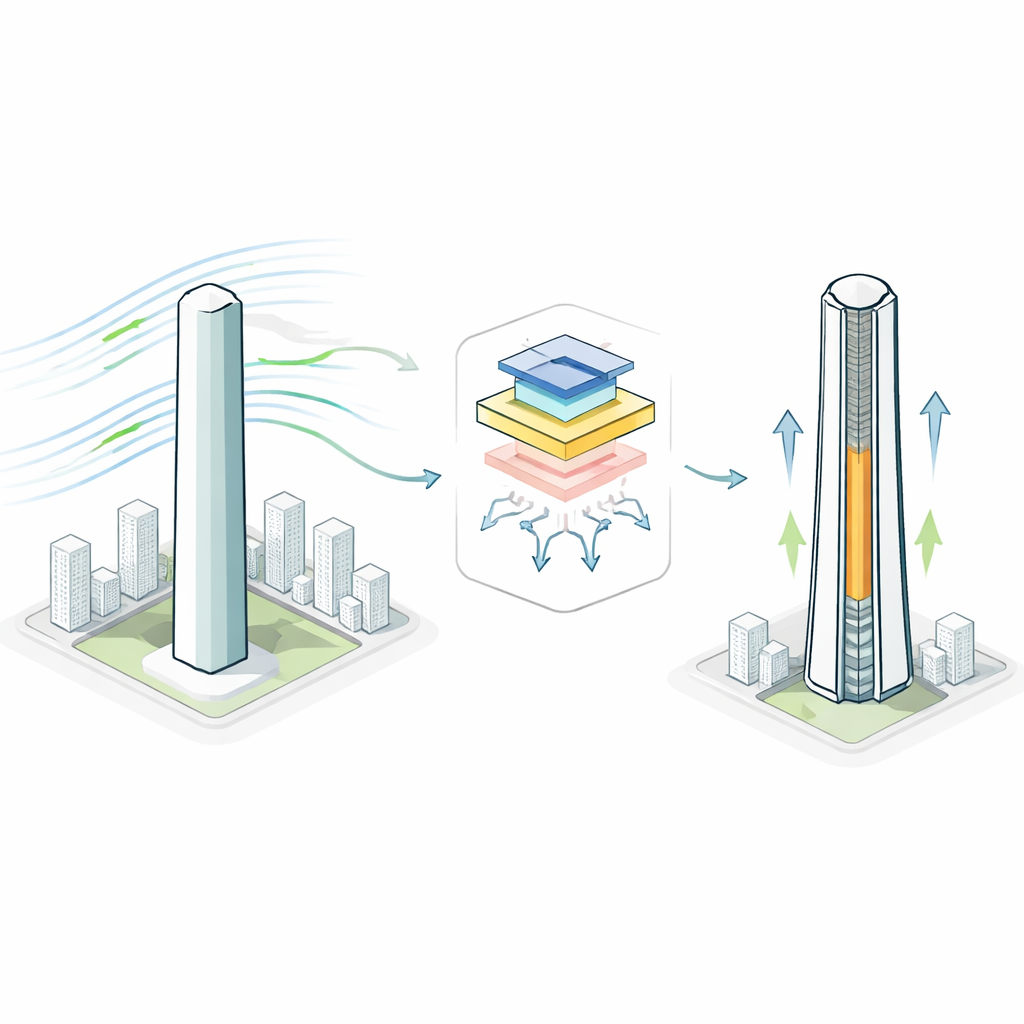
Making Tall Buildings Dance Less in the Wind
Very tall buildings behave a bit like giant reeds in the wind: if their form and structure are not carefully designed, they can sway uncomfortably for occupants and even risk damage. Traditional solutions often rely on wind-tunnel tests plus extra structural material or add-on devices such as tuned mass dampers. Those methods work, but they can be costly and slow to explore. The authors instead combine modern computer simulations to explore how subtle changes to a tower’s outer shape and internal frame can tame the wind response while keeping the building light and economical.
Shaping the Corners to Calm the Air
The researchers focus on an existing 90-story, octagonal residential tower in Dubai as a real-world test bed. Using computational fluid dynamics, they simulate steady wind flowing around many variants of the building with different corner treatments: rounded, chamfered (cut off at an angle), and recessed versions. A mathematical “surrogate” model then learns from a limited set of detailed simulations how each corner radius and area change affects the sideways movement at the top of the tower. This allows the team to quickly scan the design space and pinpoint which corner shapes best reduce wind forces without chopping away much usable floor area.
Teaching the Structure to Use Less Material
Once they have an aerodynamically improved shape, the authors turn to the building’s hidden skeleton—its core walls, perimeter columns, and floor beams. They use a genetic algorithm, a search method inspired by natural evolution, to try thousands of different combinations of thicknesses and depths for these elements. A structural analysis program checks each candidate design against strict limits on overall sway, relative movement between floors, and acceleration at the top, which relates to how occupants feel motion. Designs that break the comfort or safety limits are “penalized” and dropped, while better ones are preserved and recombined until the algorithm converges on a light yet robust configuration.
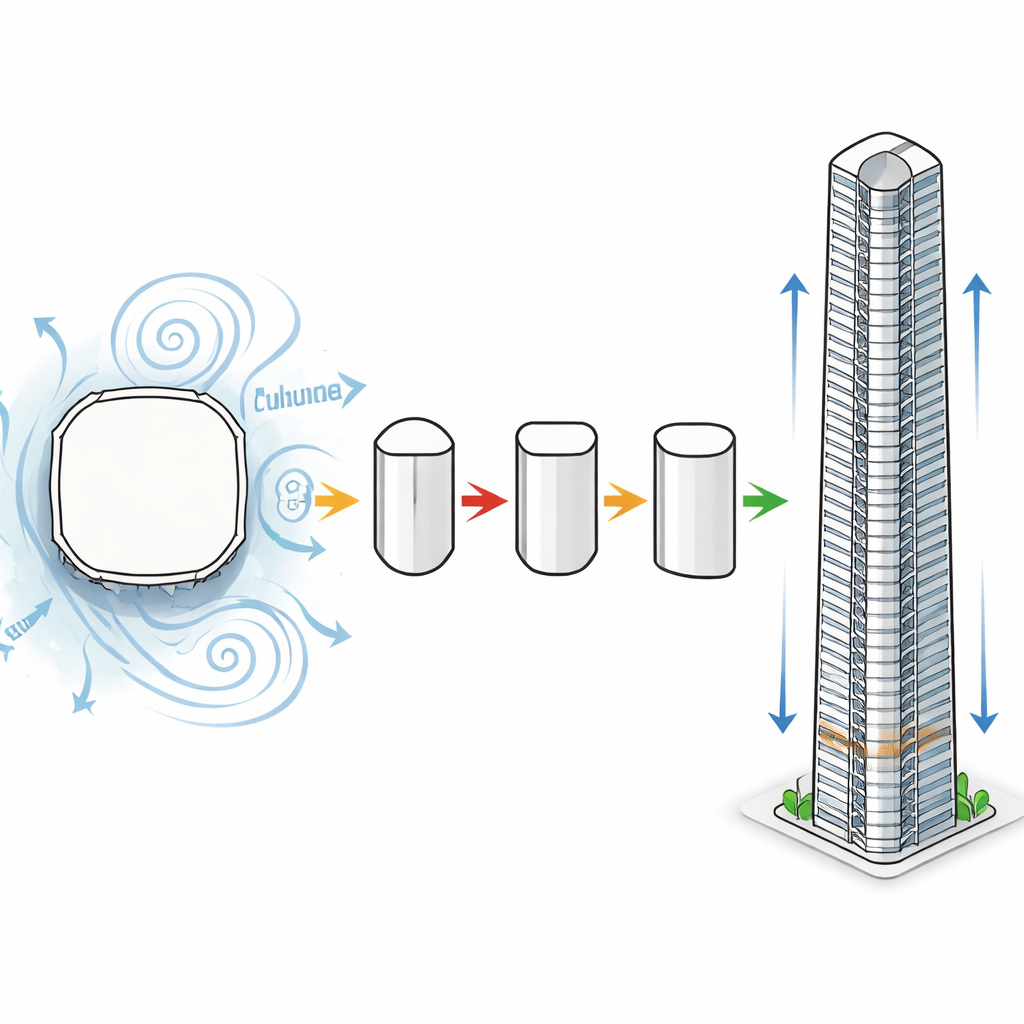
What the Combined Approach Achieves
By first reshaping the corners and then optimizing the structural frame, the study reaches impressive savings. The best chamfered-corner design cuts the maximum top displacement in the wind by about 28 percent compared with the original shape, while losing less than 1 percent of total floor area. Building on that, the structural optimization trims wall, column, and beam sizes along the height of the tower. In the final solution, the tower uses roughly 28.8 percent less concrete in its lateral system—a reduction of about 9850 cubic meters. Given typical emissions for high-strength concrete, this translates to around 4630 tons less embodied CO₂, all while keeping drift and acceleration within international comfort and safety standards.
What This Means for Future Skylines
In plain terms, the study shows that smart computer-aided tuning of both the outer shape and inner frame of a skyscraper can make it stiffer in the wind, cheaper to build, and kinder to the climate at the same time. Rather than simply adding more material or bolting on damping devices, designers can rely on integrated digital workflows to let the building’s own geometry and structure do more of the work. As cities continue to grow upward, such hybrid aerodynamic–structural strategies offer a path to taller skylines that are not just striking, but also safer, more comfortable, and significantly more sustainable.
Citation: Al-Masoodi, A.H.H., Shafiq, N. & Al-Masoodi, A.H.H. Hybrid aerodynamic and structural optimization of super-tall buildings under wind loads for sustainable and cost-efficient design. Sci Rep 16, 10634 (2026). https://doi.org/10.1038/s41598-026-45932-0
Keywords: super-tall buildings, wind engineering, structural optimization, aerodynamic design, sustainable construction