Clear Sky Science · en
Psychological-physical synergy of athletes based on artificial intelligence and deep learning
Why your body’s signals can reveal your mental state
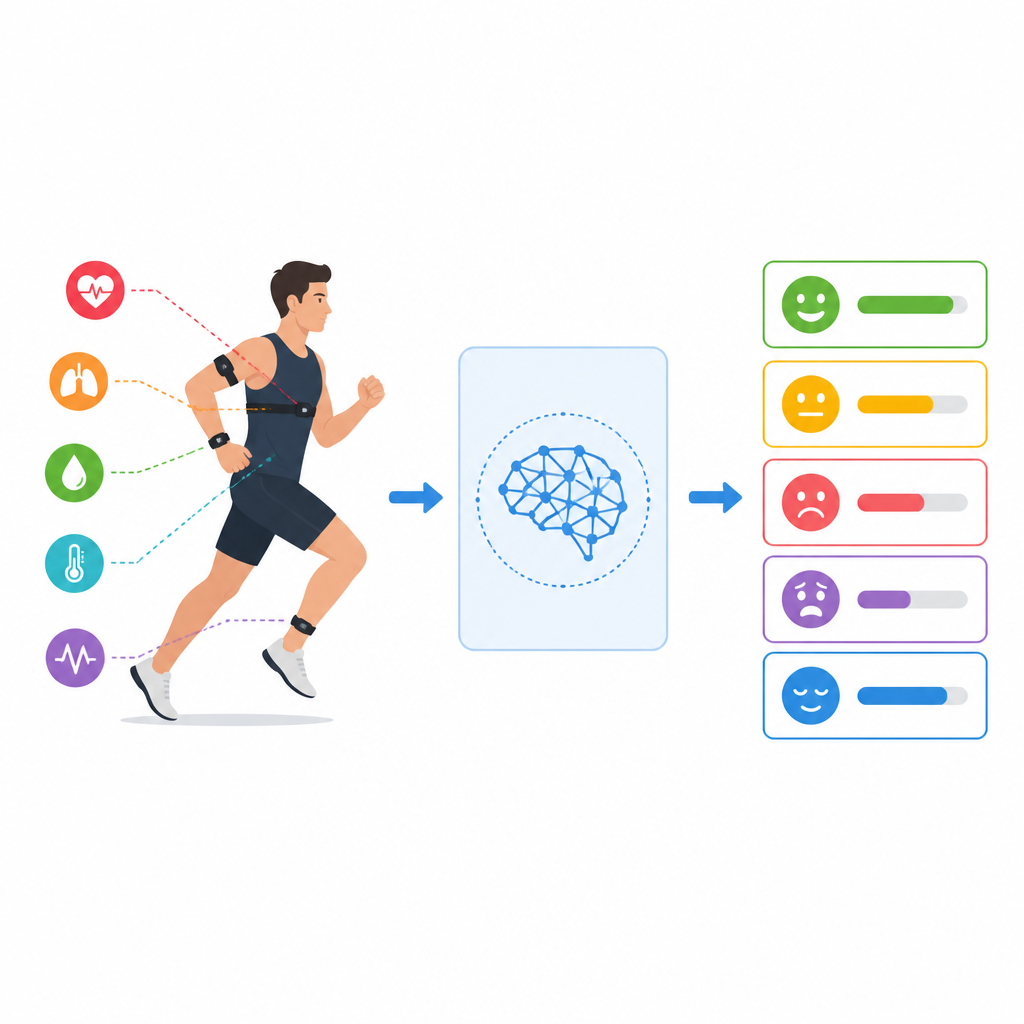
Elite athletes and people in high pressure jobs constantly walk a fine line between peak performance and overload. Our bodies quietly broadcast clues about how stressed, calm, or amused we are through heartbeats, sweat, breathing, and movement. This study explains a new way for computers to read those clues more accurately and, just as important, to say how sure they are about what they read. That mix of precision and honesty could make future wearables far more useful and trustworthy.
Turning scattered signals into a single picture
Modern chest straps and smart bands can record many physiological signals at once, such as heart rate variability, skin conductivity, breathing patterns, temperature, and motion. Traditional computer models often treat each channel as a separate stream and simply stack them together. The authors argue that this misses a key point: the body is an integrated system. Under stress, for example, heart rate, sweating, and breathing tend to shift together in a characteristic pattern. The study introduces the idea of a “physiological synergy graph,” in which each type of signal is a point in a network and the model learns how strongly they influence one another at every moment.
How the new AI framework reads the body
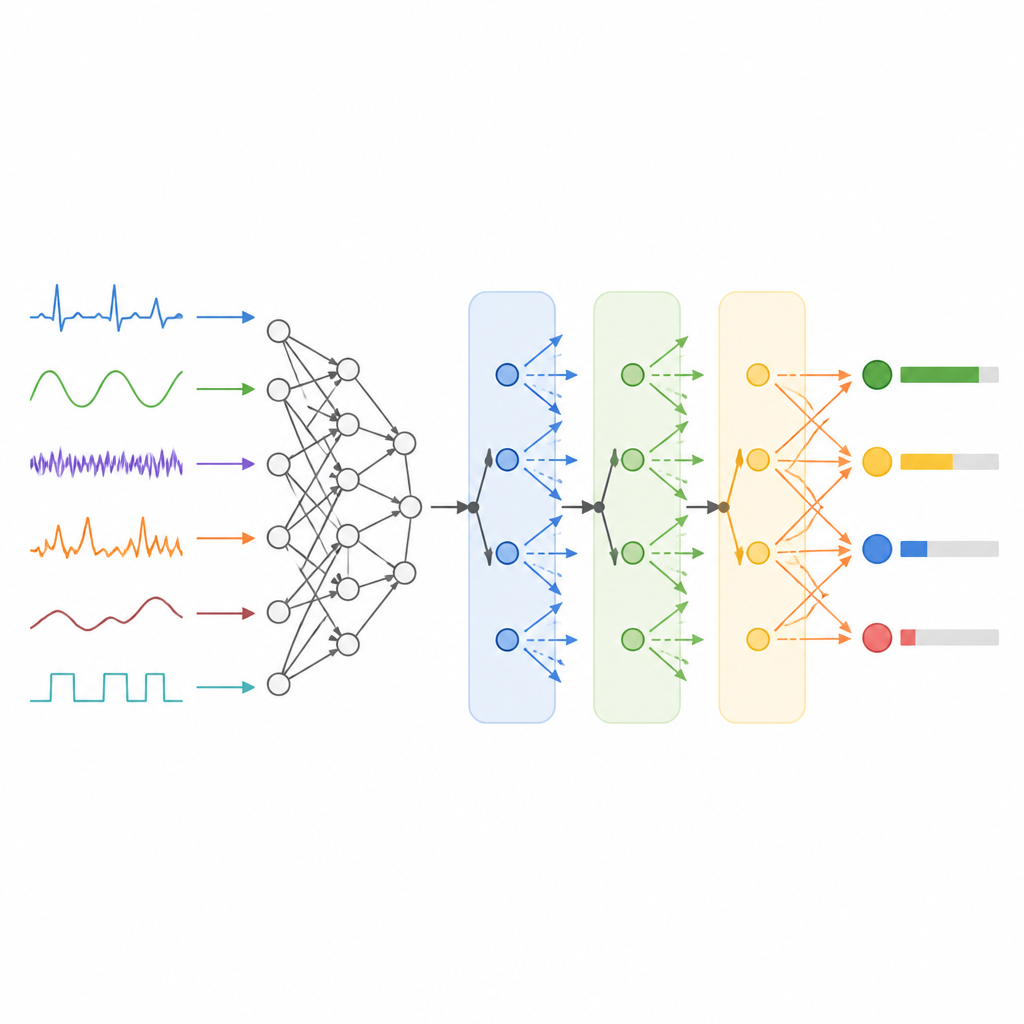
The proposed framework, called GABT Net, combines two powerful ideas from artificial intelligence. First, a graph attention network examines the different body signals within each short time window. It connects every signal to every other and learns which links matter most in a given state, producing a compact snapshot of how the body’s systems are working together at that instant. Second, these snapshots are fed into a Transformer based time series model that tracks how this collaborative pattern evolves over time. This temporal stage allows the system to notice long range trends, such as a gradual buildup of stress or a return to baseline calm.
Letting the model admit when it is unsure
Most machine learning tools output a single best guess, without indicating how reliable that guess is. For real world decisions in sport and health, this can be risky. GABT Net tackles this by using a Bayesian Transformer with Monte Carlo dropout, a technique that effectively runs many slightly different versions of the model on the same data. By averaging their outputs, the system produces both a prediction and a measure of its own uncertainty. The researchers show that when the model reports high confidence, its accuracy on stress and emotion states is extremely high, and when its internal “entropy” is large, errors are more likely. This makes it possible to flag cases where a coach, doctor, or user should be cautious.
How well the system performs in tests
The team evaluated GABT Net on a widely used dataset in which volunteers wore chest devices while moving through calm baseline periods, stressful tasks, and amusing activities. Using a sliding window over the signals and a strict cross subject testing approach, the model reached about 96 percent overall accuracy and a macro F1 score above 0.94, outperforming several strong baselines, including Bi LSTM networks and standard Transformers. It also beat recent state of the art methods that blend convolutional and recurrent networks. Despite this strong performance, the model remains relatively compact and efficient, with fewer parameters and faster prediction times than competing approaches, which is important for running on wearable or edge devices.
What this means for athletes and everyday users
In plain terms, this research shows that an AI system can not only read subtle patterns across multiple body signals to recognize stress and emotional states, but can also judge how trustworthy its own answers are. For athletes, that could translate into training tools that warn about mounting mental strain before performance drops or injury risk rises, and that know when to “ask for help” instead of giving misleading feedback. For broader health and workplace applications, the same principles could support safer, always on monitoring of stress and mood. While real world testing in noisy sports environments and personalization for individuals are still future steps, the study offers a promising blueprint for more intelligent and transparent mind body tracking technologies.
Citation: Cheng, Y., Gong, T. & Zhao, H. Psychological-physical synergy of athletes based on artificial intelligence and deep learning. Sci Rep 16, 14994 (2026). https://doi.org/10.1038/s41598-026-45920-4
Keywords: stress monitoring, wearable sensors, athlete physiology, emotion recognition, deep learning