Clear Sky Science · en
AI-driven optimization of hydrogen storage in porous carbon adsorbents
Why better hydrogen storage matters
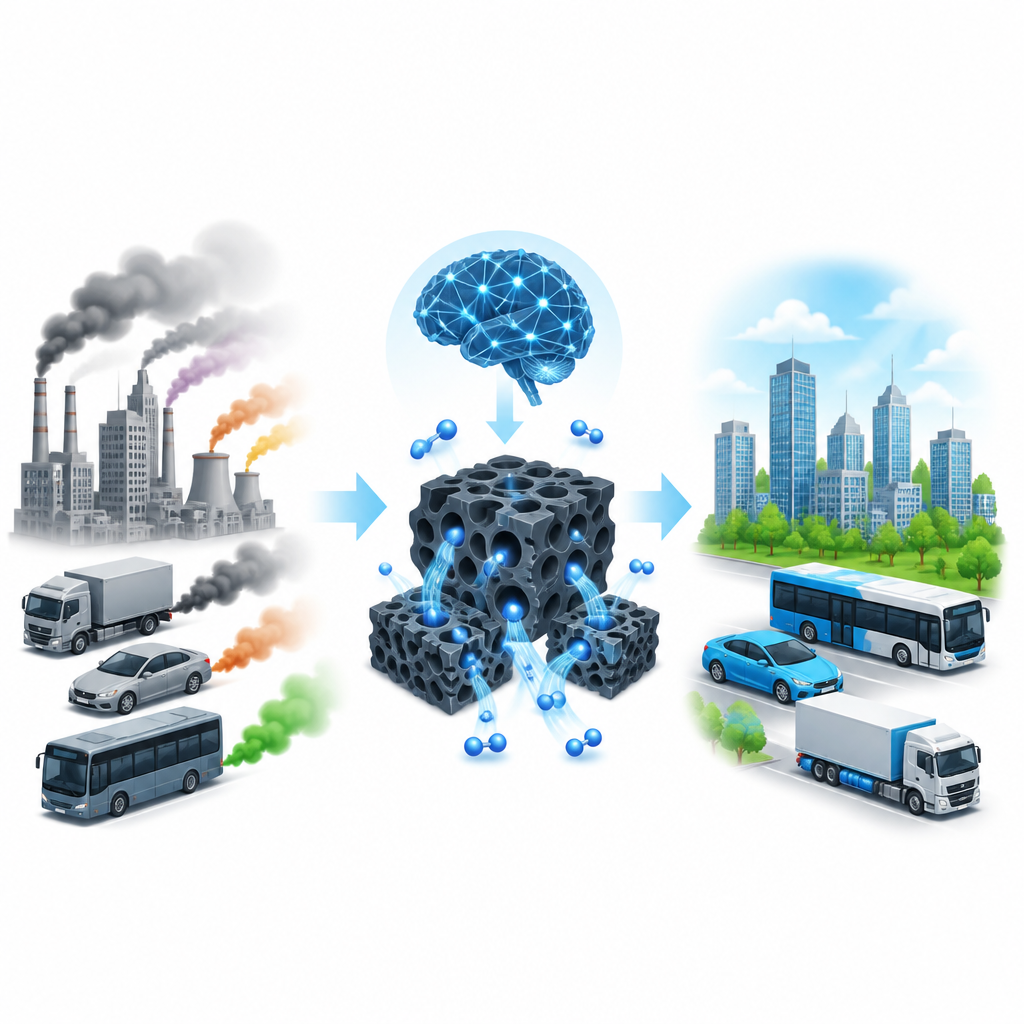
Hydrogen is often promoted as a clean fuel for cars, trucks, and buses, because when it is used it mainly produces water instead of greenhouse gases. The catch is that storing enough hydrogen safely and cheaply in a vehicle is very difficult. This study explores how artificial intelligence can help scientists design better sponge-like carbon materials that hold more hydrogen, potentially making hydrogen-powered transport more practical.
How carbon sponges hold hydrogen
The materials in focus are highly porous carbons that behave like solid sponges. Instead of soaking up water, they attract hydrogen molecules onto their inner surfaces. The more internal surface area these carbons have, and the more their pore sizes are tuned to hydrogen, the more fuel they can store. Traditional approaches rely on trial and error: change the way the carbon is made, measure hydrogen uptake at certain pressures and temperatures, and repeat. This process is slow, expensive, and limited by how many samples researchers can test.
Teaching computers from past experiments
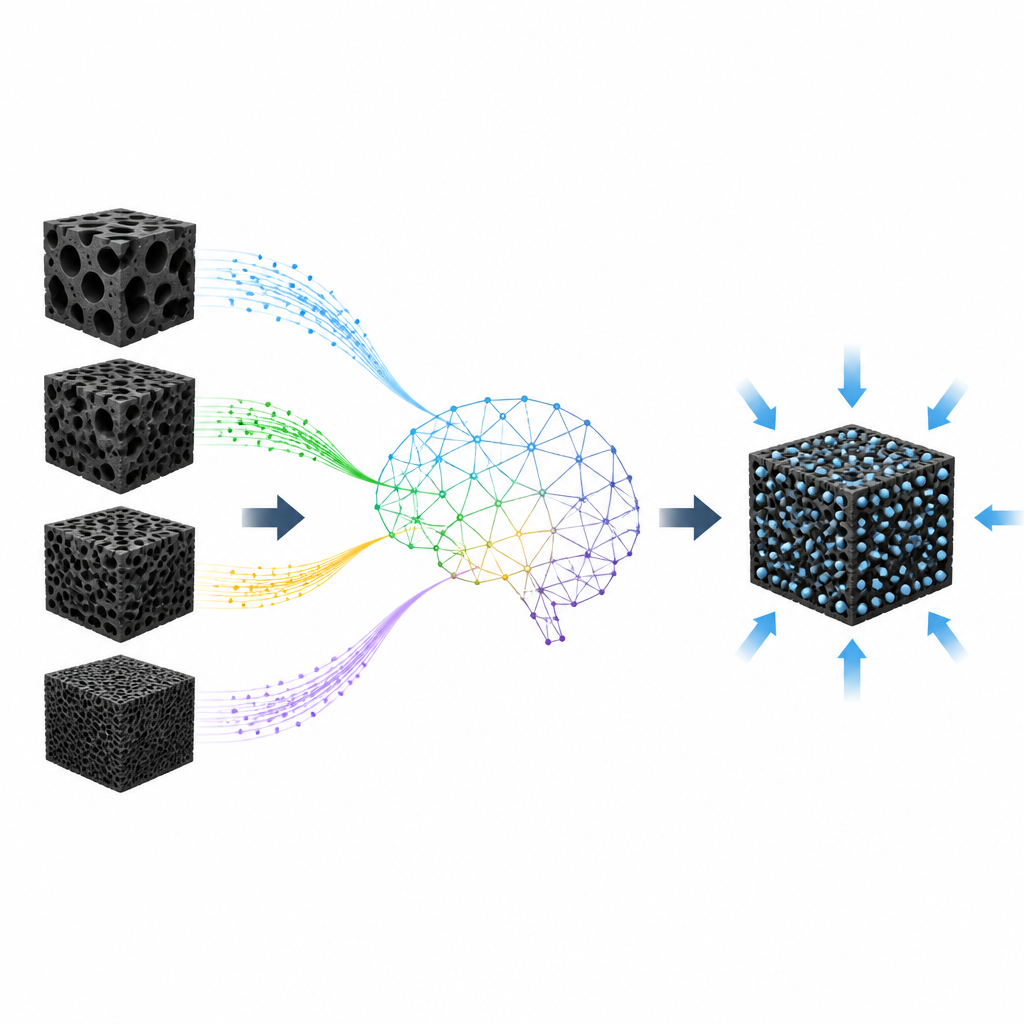
To speed things up, the authors gathered 917 data points from many earlier studies on hydrogen storage in porous carbons. Each entry linked how a carbon was made and what its structure looked like with how much hydrogen it stored under given conditions. They trained two machine learning models on this collection, one based on decision trees and one inspired by image recognition networks. Even though the data are just numbers, the neural network learned patterns well, predicting hydrogen storage with high accuracy when tested on unseen entries from within the same range of pressures, temperatures, and material properties.
Letting AI search for better designs
Once the neural network could reliably predict hydrogen uptake, the team coupled it to an automated optimization tool. Instead of only asking, “Given this material, how much hydrogen will it store?”, they reversed the question and asked, “Which combination of material features and operating conditions should give the best storage?”. The software varied factors such as surface area, tiny pore volumes, and gas pressure while also tracking an overall pore size measure. It searched for balanced choices that would both boost stored hydrogen and keep pores small enough to be realistic for carbon materials.
Balancing performance with physical realism
The optimization produced a set of “just right” trade offs, known as a Pareto front, where improving hydrogen storage any further would require sacrificing pore control, and vice versa. Some of the highest predicted storage values required pushing surface area and pore sizes beyond what has actually been made in the lab, so the authors treated these as theoretical upper limits rather than promises. When they restricted the search to more realistic surface areas and a common test temperature for hydrogen storage, the predicted best designs lined up with what is known from experiments, but also pointed to ambitious yet plausible targets for future materials. This shows that AI can suggest new recipes worth trying, not just explain old data.
What this means for clean energy
To a lay reader, the main message is that computers can now help design better solid “tanks” for hydrogen by learning from scattered results across many studies. The approach used here combines prediction and smart searching to highlight carbon structures that should store more hydrogen without guessing blindly. While the most extreme predictions still need to be verified in the lab, the work provides a roadmap for cutting down trial and error and could help engineers move closer to hydrogen storage systems that fit safely and efficiently into future vehicles.
Citation: Rocha, H.R.O., Romanos, J., Abou Dargham, S. et al. AI-driven optimization of hydrogen storage in porous carbon adsorbents. Sci Rep 16, 15143 (2026). https://doi.org/10.1038/s41598-026-45915-1
Keywords: hydrogen storage, porous carbon, machine learning, energy materials, gas adsorption