Clear Sky Science · en
Deep learning detection of ectopic canines and molars in mixed dentition
Why early tooth trouble matters for kids
When children lose their baby teeth and grow in their adult teeth, most parents hope for a straight, healthy smile. But sometimes new teeth drift off course and push against their neighbors. These wayward teeth can quietly damage nearby roots, steal space, and lead to bite problems that are hard and costly to fix later. The study behind this article explores whether a modern form of computer intelligence can spot these risky teeth on routine dental X rays before they cause trouble.
Teeth that grow in the wrong place
During childhood, there is a short window when baby teeth and adult teeth share the mouth. Dentists call this the mixed dentition period. In this stage, some teeth, most often upper eye teeth and first big back teeth, may erupt in the wrong direction or position. This situation, known as ectopic eruption, can stay hidden inside the jaw for a long time. If dentists miss it on panoramic X rays, these teeth may wear away the roots of baby teeth, block normal eruption, and create crowding that later demands braces or even surgery.
Teaching computers to read dental X rays
Reading panoramic X rays of growing children is not easy, even for experts. Baby and adult teeth overlap, image quality varies, and the warning signs of a drifting tooth can be subtle. The researchers in this study built a computer model based on deep learning, a technique where the system learns from many example images rather than being given fixed rules. They used a type of model known for finding objects in pictures and adapted it to pick out misdirected canines and molars directly on full mouth X rays, without cropping around single teeth. 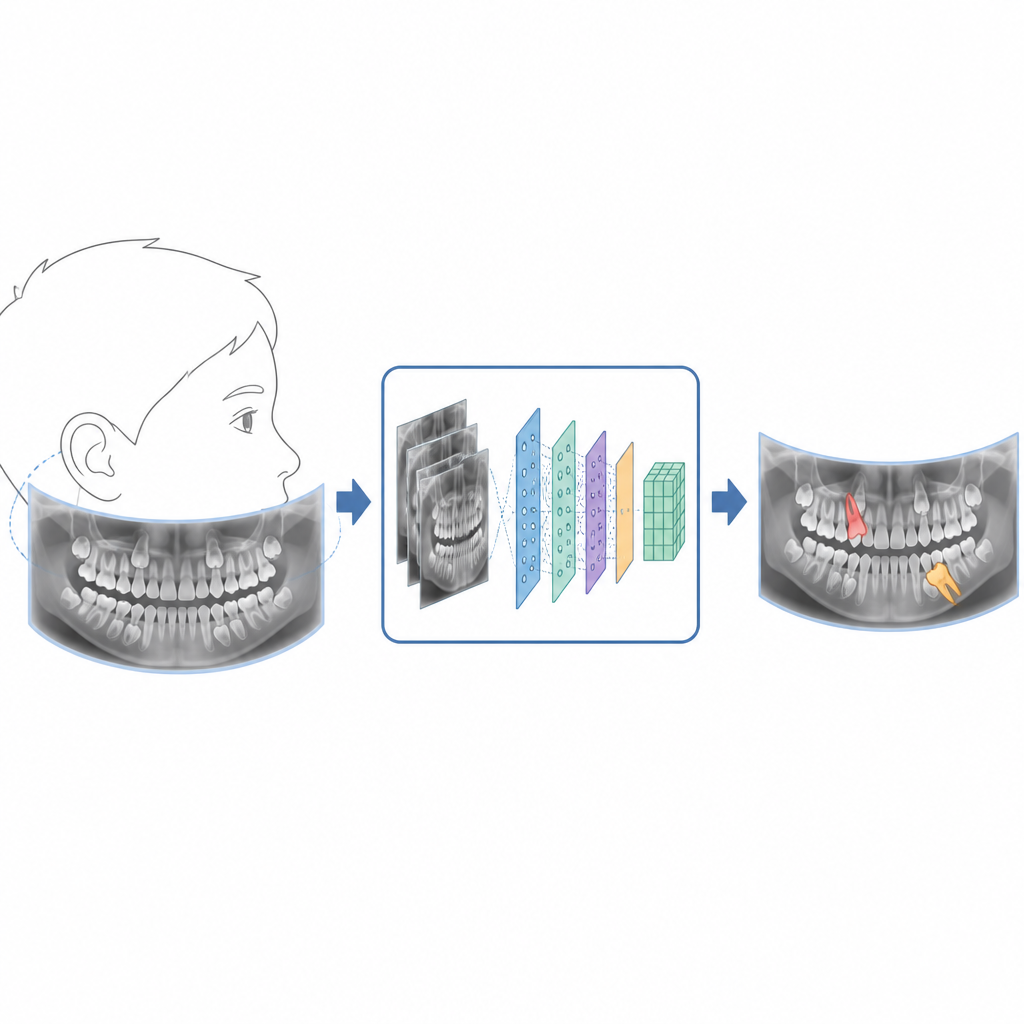
Building a large, carefully checked image collection
To train the system, the team screened almost twelve thousand panoramic X rays from two dental schools and selected just over a thousand that showed clearly misplaced canines or molars. Experienced radiology and pediatric dentistry specialists agreed on which teeth were ectopic using standard angle and position rules. They then traced the outlines of these problem teeth so the computer could learn both where they were and what they looked like. The images were split into separate groups for training the model, tuning it, and finally testing how well it performed on new cases it had never seen before.
How well the computer spotted problem teeth
On the test images, the deep learning system showed strong overall accuracy in recognizing ectopic teeth. It did better with canines than with molars, correctly identifying most of the misplaced eye teeth while making a modest number of false alarms. For the back teeth, it was very cautious when it did signal a problem but failed to detect some truly ectopic molars. This pattern means the tool is less likely to call a normal molar ectopic, but more likely to miss a subtle case. The authors suggest that in real clinics, dentists might use the system as a safety net that flags suspicious teeth for a second look, rather than as a stand alone decision maker. 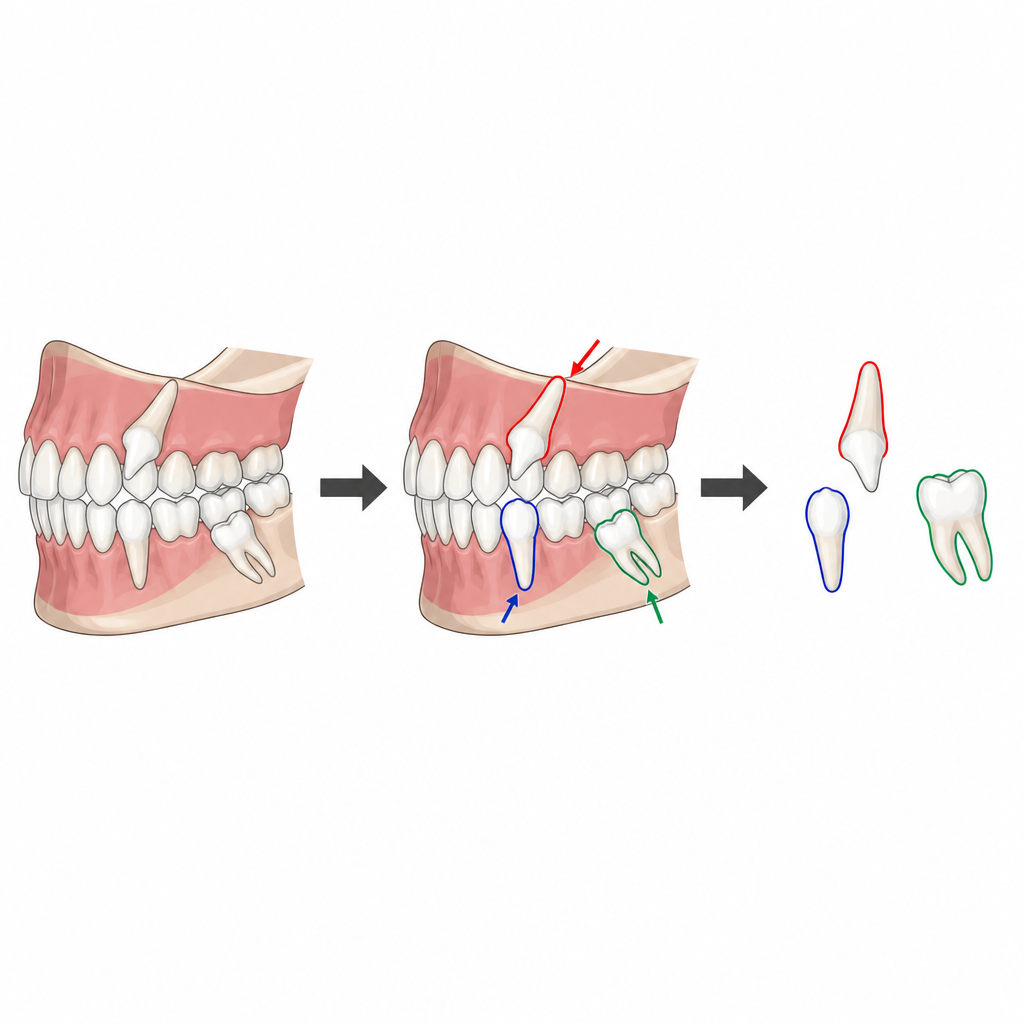
What this could mean for everyday dental care
The study shows that a carefully trained computer program can help dentists scan full mouth X rays of children and highlight teeth growing off course, especially the upper canines that often cause serious problems if ignored. While the tool is not perfect and still misses some ectopic molars, it works on routine images from different clinics and keeps the full jaw view intact. For busy practices and for less experienced dentists, such assistance could support earlier referrals and more timely treatment. In simple terms, this research suggests that smart software may soon act as an extra pair of careful eyes, helping protect children’s future smiles by catching risky teeth before they do lasting harm.
Citation: Gülşen, E., Kızılay, F.N., Aşar, E.M. et al. Deep learning detection of ectopic canines and molars in mixed dentition. Sci Rep 16, 15667 (2026). https://doi.org/10.1038/s41598-026-45912-4
Keywords: pediatric dentistry, ectopic eruption, dental AI, panoramic radiograph, tooth detection