Clear Sky Science · en
Comprehensive evaluation of the environmental performance and durability of biochar-incorporated concrete
Greener, Tougher Concrete for a Warming World
Concrete is everywhere—from bridges and highways to apartment towers—and making its main ingredient, cement, releases huge amounts of carbon dioxide. This study explores a simple idea with big implications: what if we could lock plant-based carbon inside concrete while keeping it strong and long-lasting in harsh winters? By blending a small amount of wood-derived "biochar" into concrete, the researchers set out to see whether we can build structures that are both sturdier against freeze–thaw damage and noticeably kinder to the climate.
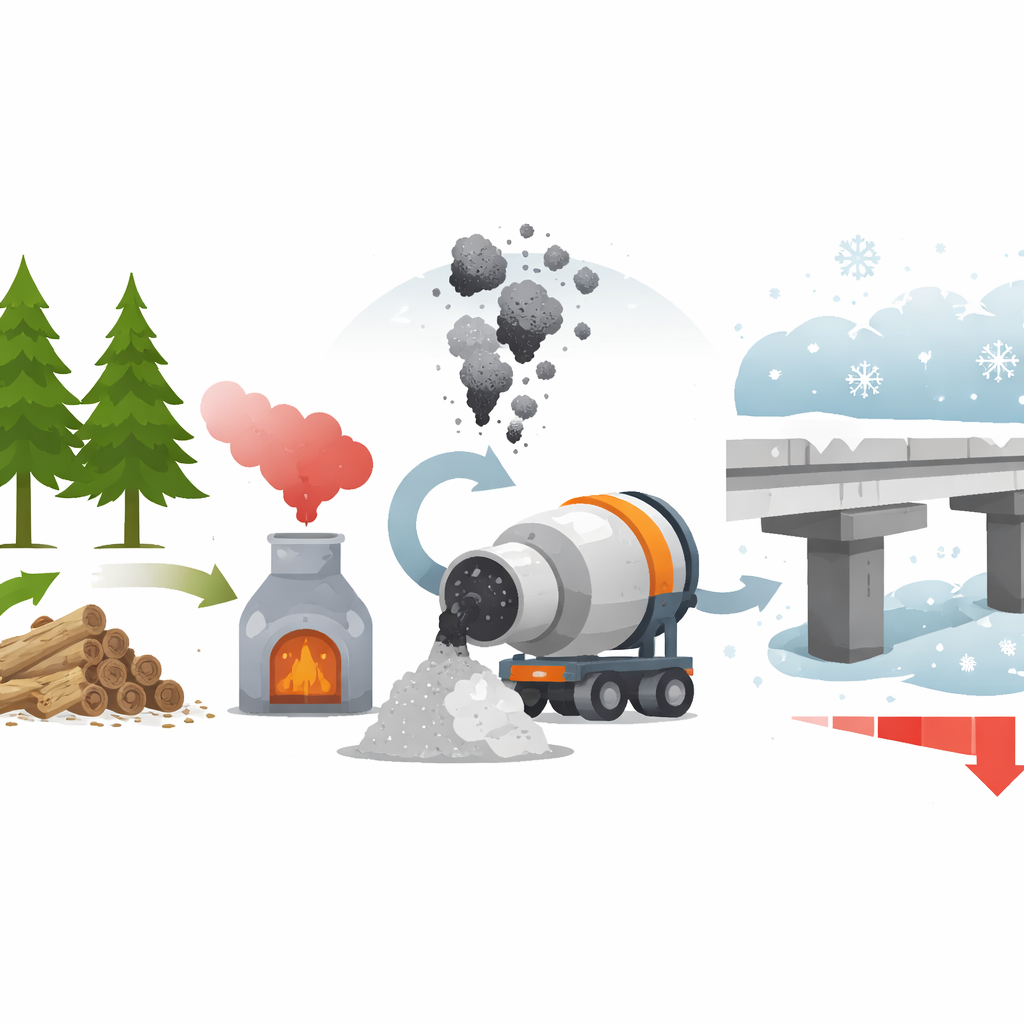
Turning Wood Waste into a Useful Ingredient
Biochar is a charcoal-like material made by heating waste wood under low-oxygen conditions. The team produced a fine powder from wood pellets and examined it in detail using microscopes and instruments that reveal its surface area, pore sizes, and chemical bonds. They found that the ground biochar particles were similar in size to cement grains but riddled with tiny pores and channels. These pores give biochar a high internal surface area and the ability to hold water, while its carbon-rich, chemically stable structure means that the carbon it contains can stay locked away for a long time. Taken together, these traits make biochar a promising candidate to partly stand in for cement in concrete.
How the New Concrete Was Mixed and Tested
To move beyond small lab batches, the researchers produced four full-scale concrete mixes using a real batching plant: a standard control mix and three mixes in which biochar replaced 3, 5, or 7 percent of the cement by weight. All mixes were designed to reach a modest structural strength of 24 megapascals, typical for many buildings and pavements. Cylinders and beams were cast, cured in water for up to a year, and then tested for compression, bending, stiffness, and resistance to 300 rapid freeze–thaw cycles—conditions similar to the repeated winter freezing and thawing found in cold climates. The team also examined the internal pore structure and microcracks using mercury porosimetry and scanning electron microscopy.
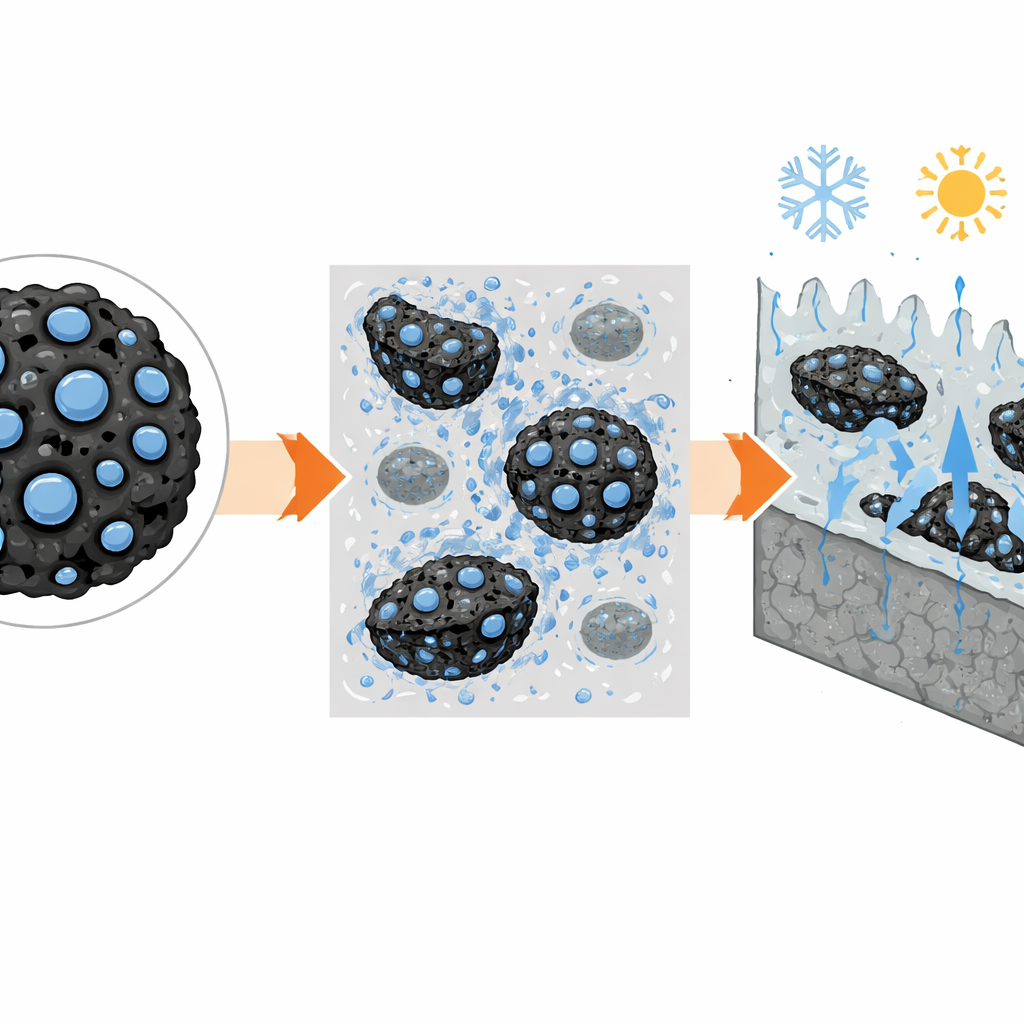
Strength, Cracking, and Winter Durability
The results show a clear sweet spot. When 3 to 5 percent of the cement was replaced by biochar, the concrete still reached or exceeded the design strength and developed further strength over a year, though slightly below the plain mix. At 7 percent replacement, however, compressive strength dropped by more than a third, suggesting too much cement had been removed. Under compression, plain concrete tended to fail abruptly with diagonal shear cracks, while the 3 and 5 percent mixes showed more vertical, distributed cracking—signs of a less brittle failure. In freeze–thaw tests, all mixes performed well, keeping over 90 percent of their initial stiffness after 300 cycles. Notably, the 5 percent biochar concrete matched or slightly edged out the plain mix in a standard durability rating and showed a much smaller increase in visible surface damage over time, even though its surface started with more tiny defects. The porous biochar appears to act like a network of miniature “pressure buffers,” giving freezing water room to expand and reducing the growth of harmful cracks.
Carbon Footprint and Energy Use
Because cement production is so carbon-intensive, every kilogram of cement replaced matters. The team conducted a cradle-to-gate life cycle assessment, looking at emissions and energy use from raw material extraction through concrete production. As the share of biochar increased, the global warming impact per cubic meter of concrete dropped steadily. With 7 percent biochar, the calculated carbon footprint was about 28 percent lower than that of the plain mix, thanks in part to biochar’s ability to store carbon taken up by trees. Energy demand also declined as more biochar was used, since producing biochar at the studied conditions required less nonrenewable energy than producing the same mass of cement. Balancing these environmental gains against the measured loss of strength points to an optimal replacement range of roughly 3 to 5 percent.
What This Means for Future Buildings
For non-specialists, the takeaway is straightforward: by swapping a small portion of cement with finely ground wood-based biochar, it is possible to make concrete that is strong enough for everyday structures, stands up well to repeated freezing and thawing, and carries a notably smaller carbon burden. The study suggests that a modest biochar dose—around 3 to 5 percent of the cement—offers the best trade-off, trimming greenhouse gas emissions without sacrificing durability. If adopted widely and refined further at real construction scales, this approach could help turn concrete from a major climate problem into a more climate-conscious building material, while giving new life to wood waste that might otherwise be burned or discarded.
Citation: Kang, SB., Woo, JS., Pyo, M. et al. Comprehensive evaluation of the environmental performance and durability of biochar-incorporated concrete. Sci Rep 16, 10803 (2026). https://doi.org/10.1038/s41598-026-45887-2
Keywords: biochar concrete, low carbon materials, freeze thaw durability, carbon sequestration, sustainable construction