Clear Sky Science · en
An enhanced energy management framework based on artificial gorilla troops for optimal operation of grid-connected multi-nanogrids
Smarter Power for Everyday Places
Keeping the lights on in homes, schools, and small businesses is getting more complicated as more rooftop solar panels, small wind turbines, and batteries plug into the grid. This study explores how to run clusters of these tiny local power systems, called nanogrids, in a way that keeps electricity reliable while cutting daily energy bills. By borrowing ideas from the social behavior of gorilla troops, the researchers design a new digital “brain” that decides when to use sun, wind, batteries, diesel generators, or the main grid so that buildings get affordable, low-carbon power around the clock.
Small Power Networks Working Together
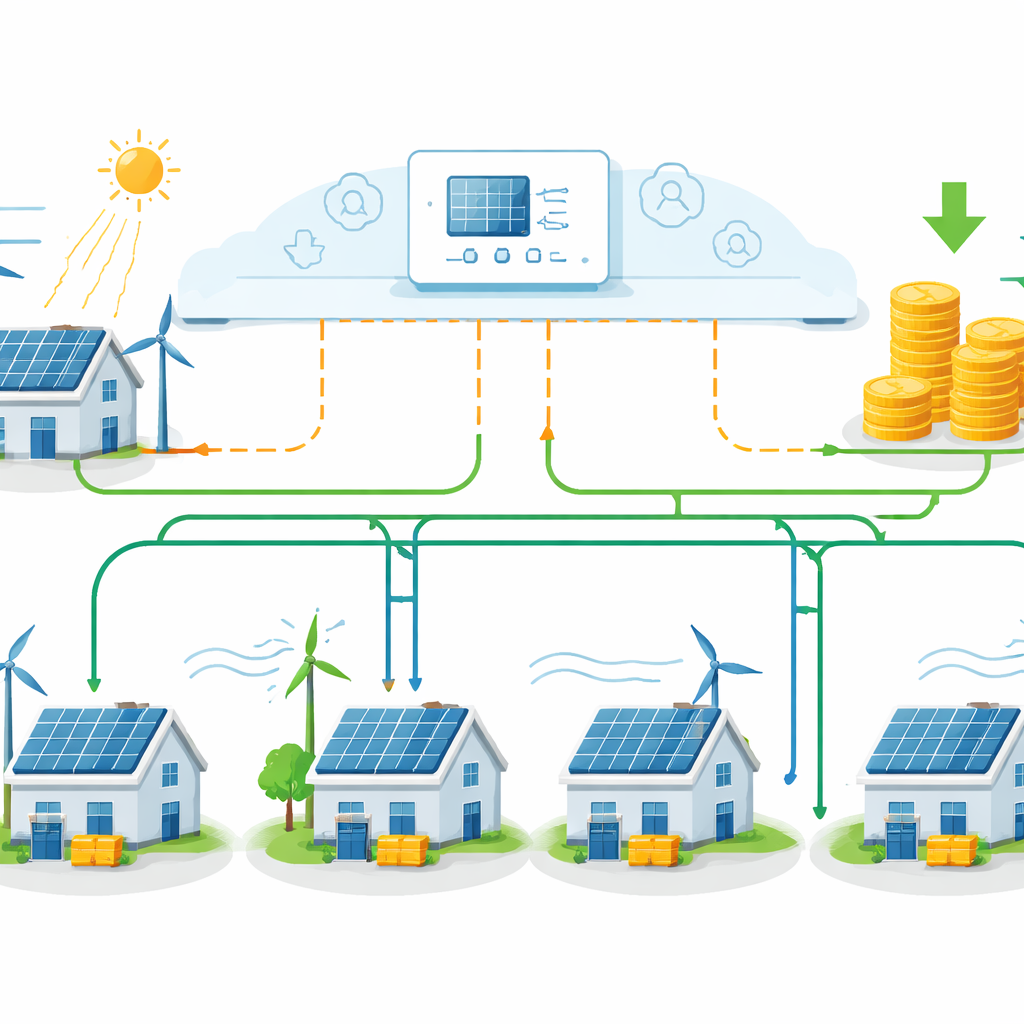
A nanogrid is like a mini power network for a single building or a small site, usually no bigger than 100 kilowatts. It can include rooftop solar panels, small wind turbines, batteries, and a backup diesel generator, all tied together on a direct-current (DC) bus. Several nanogrids can be linked into a multi-nanogrid cluster, sharing surplus power with one another and with the larger utility grid. In the system studied here, four nanogrids—some based on solar, others on wind—are connected through DC lines to each other and through an AC line to the main grid. Each has its own local devices but is coordinated by a central energy management system that continuously balances supply and demand.
Planning Ahead and Adjusting on the Fly
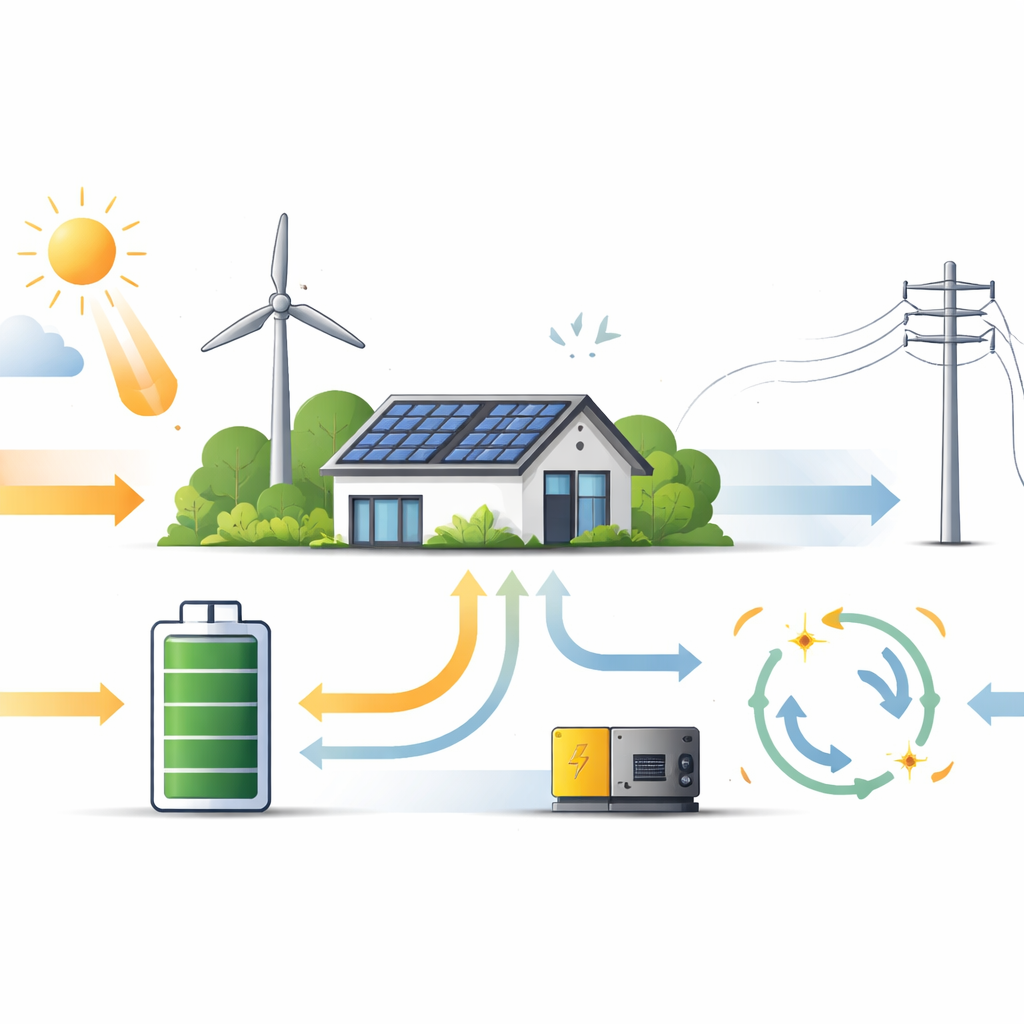
The heart of the work is an enhanced energy management system that operates on two time scales. First, a day-ahead planner uses forecasts of sunshine, wind, electricity prices, and building demand to sketch out an optimal 24-hour schedule. It decides when to shift flexible appliances such as water heaters or washing machines to cheaper hours, when to charge or discharge batteries, how hard diesel generators should run, and when to buy from or sell power to the grid. Second, a real-time controller checks what is actually happening—how bright the sun is, how fast the wind blows, what the grid is charging, and how much electricity people are using. When reality deviates from the forecast, it fine-tunes the power flows each hour to keep costs low while honoring technical limits such as battery state of charge and generator output bounds.
Gorilla-Inspired Digital Problem Solving
Choosing the best combination of actions for dozens of devices over 24 hours is a tough optimization problem with many constraints and uncertainties. Instead of relying on rigid mathematical formulas that may get stuck in suboptimal solutions, the authors turn to a newer class of search method called the Artificial Gorilla Troops Optimizer (AGTO). AGTO imitates how a gorilla troop explores its environment and then rallies around the strongest leader, the “silverback.” In this analogy, each virtual gorilla represents a possible energy schedule. During the exploration phase, the troop spreads out to sample very different operating patterns, like wandering to unfamiliar feeding grounds. In the exploitation phase, candidates move closer to the best-known solutions, much like following the silverback or competing to refine the group’s position. This process is repeated many times until the algorithm converges on a low-cost operating plan.
Lower Bills Through Load Shifting and Sharing
The researchers test their framework on realistic data for a coastal Egyptian city, using hour-by-hour profiles of temperature, solar intensity, wind speed, and grid prices. They compare AGTO to several established optimization tools, including particle swarm optimization and other animal-inspired methods. Across single nanogrids and clusters of four nanogrids, the gorilla-based planner consistently finds cheaper schedules. Shifting flexible loads away from expensive evening peaks toward lower-cost periods reduces operating expenses by about 7 percent on its own, while also smoothing the demand curve. When nanogrids are allowed to cooperate and share power, the total daily energy cost falls by roughly 8 percent compared with isolated operation. Overall, AGTO delivers about 15 to 16 percent cost savings relative to competing algorithms when day-ahead planning and load management are both applied.
Resilient Power in a Changing World
For ordinary users, the takeaway is that smart coordination of local clean energy and storage can quietly trim electricity bills and reduce reliance on fossil fuels without sacrificing comfort or reliability. By combining day-ahead planning, real-time adjustment, and an efficient search strategy inspired by gorilla social behavior, the proposed system keeps multi-nanogrid clusters in balance even when weather, prices, and demand do not follow the script. The study suggests that as more buildings adopt rooftop renewables and batteries, intelligent energy management of this kind could play a key role in making neighborhood-scale power networks both economical and resilient.
Citation: Elsayed, W.T., Abdulnabi, A., Ali, A.A. et al. An enhanced energy management framework based on artificial gorilla troops for optimal operation of grid-connected multi-nanogrids. Sci Rep 16, 12741 (2026). https://doi.org/10.1038/s41598-026-45884-5
Keywords: nanogrids, energy management, renewable energy, optimization algorithms, demand side management