Clear Sky Science · en
Study on floor large deformation and failure mechanism of water-rich soft rock roadway
Why mine tunnel floors can suddenly rise
Deep underground tunnels in coal mines must stay stable to keep workers safe and equipment moving. In some mines, the floor of a tunnel slowly swells upward, warping rails and cracking support frames. This study looks at one such problem in a Chinese coal mine, where the tunnel runs through weak, water‑soaked rock. The researchers set out to understand why the floor rose by several meters and how a new support method could stop it from happening again. 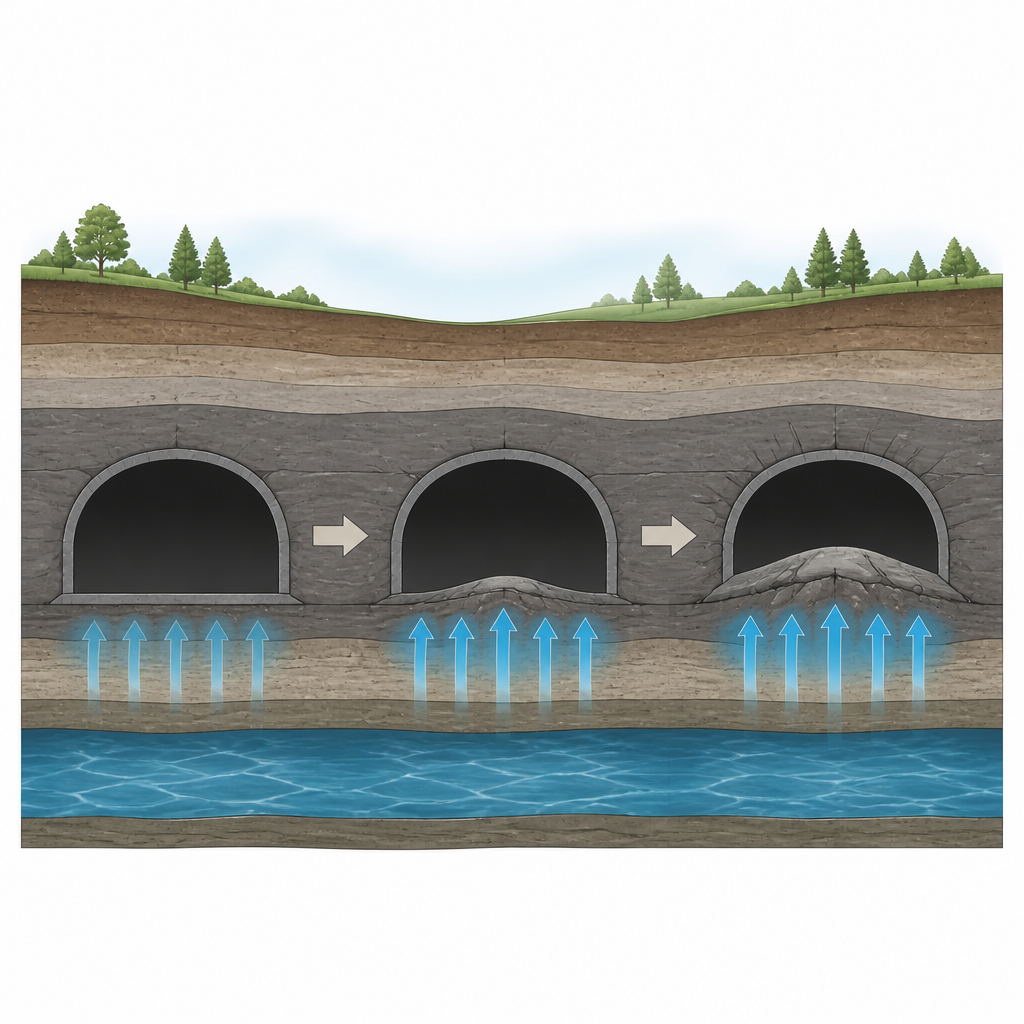
A troubled tunnel deep underground
The team focused on the north wing main roadway in the Hongqi Coal Mine in Shandong, China. This transport tunnel, about four meters wide and high, is cut through a layer of soft mudstone and lies above a limestone layer filled with pressurized groundwater. Field checks showed heavy water seepage where tunnels met, and the tunnel floor near this water source had risen by up to 2.5 meters. Steel rails bent into S‑shapes, concrete linings cracked, and bolts in the walls snapped, showing that the rock around the tunnel could no longer hold its shape.
Soft rock that falls apart in water
To understand why the floor was so vulnerable, the researchers tested samples of the mudstone from the tunnel floor. They found it contained a large amount of clay minerals, which attract water and can swell and weaken when wet. Under the microscope, the rock looked porous and loosely held together, with many small grains and weak cement between them. In simple soaking tests, lumps of mudstone began to crumble after only one minute underwater and kept breaking apart as they absorbed more water. These results showed that the rock was not just soft, but also easily damaged by water, making it especially prone to swelling and loss of strength.
Computer models of water pushing the floor up
Next, the team built a three‑dimensional computer model of the tunnel and the surrounding rock layers. They simulated different water pressures in the deep limestone layer beneath the floor, from dry conditions up to the measured high pressure. The model tracked how much the tunnel roof and floor moved and how far the rock around them was pushed beyond its strength limit. Under dry conditions the floor rose only slightly and damage was shallow. When water pressure was raised to the real underground value, the simulated floor heave grew to about 2.5 meters, and the zone of damaged rock beneath the floor deepened to more than six meters, while the roof barely moved. This showed that water pressure from below, acting on already weak mudstone, was the main driver of the floor failure.
A simple picture of how the floor fails
Using ideas from soil pressure theory, the researchers then drew a mechanical picture of how the floor moves. They divided the floor into a shallow zone, where rock has been weakened by seepage, and a deeper zone, strongly affected by the pressurized aquifer. In this picture, blocks of softened rock on either side of the tunnel floor are squeezed inward and upward under the combined weight of the overlying rock and the upward push of water. Their calculations suggested that the critical failure depth reaches about 4.5 meters. In plain terms, a thick slice of softened rock beneath the tunnel base is being pushed up and in, causing the floor to bulge into the tunnel space. 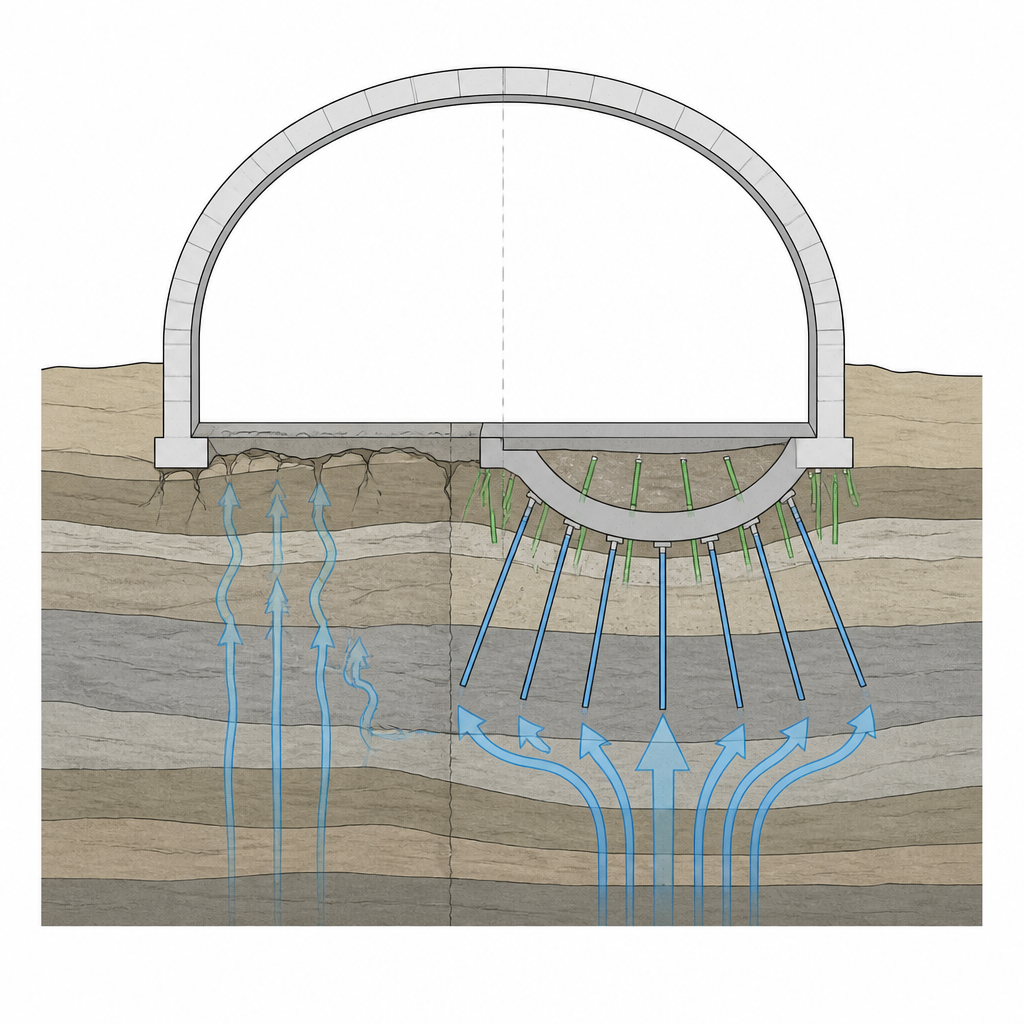
A layered support system that keeps water at bay
Based on this understanding, the team designed a new support system tailored to the two depth zones. In the shallow zone, they installed shorter grouted bolts to tie loose rock together and seal cracks. In the deeper zone, they used long grouted cable bolts to anchor into stronger rock and limit movement where water pressure is greatest. An inverted concrete arch was built in the tunnel floor and joined to U‑shaped steel supports along the walls, turning the whole lining into a closed ring that better resists squeezing from below. This design aims to cut off direct contact between groundwater and the weakest mudstone while sharing loads more evenly.
From rising floor to controlled movement
The new support scheme was put into practice in a nearby connecting tunnel that has the same kind of rock and water conditions. Over two months of monitoring, roof settlement and wall movement stayed small, and the floor rose by only 33 millimeters before stabilizing, instead of meters as seen before. For non‑specialists, the key message is that understanding how water weakens underground rock and how pressurized water pushes on tunnel floors can lead to targeted, layered supports that greatly reduce dangerous ground movement in deep mines.
Citation: Li, L., Zhang, Y., Zhou, R. et al. Study on floor large deformation and failure mechanism of water-rich soft rock roadway. Sci Rep 16, 14952 (2026). https://doi.org/10.1038/s41598-026-45877-4
Keywords: floor heave, soft rock, groundwater, tunnel support, coal mine