Clear Sky Science · en
Application of the Kelvin-Voigt viscoelastic model to hippus reveals major insights into the autonomic nervous system activity
Why tiny pupil pulses matter
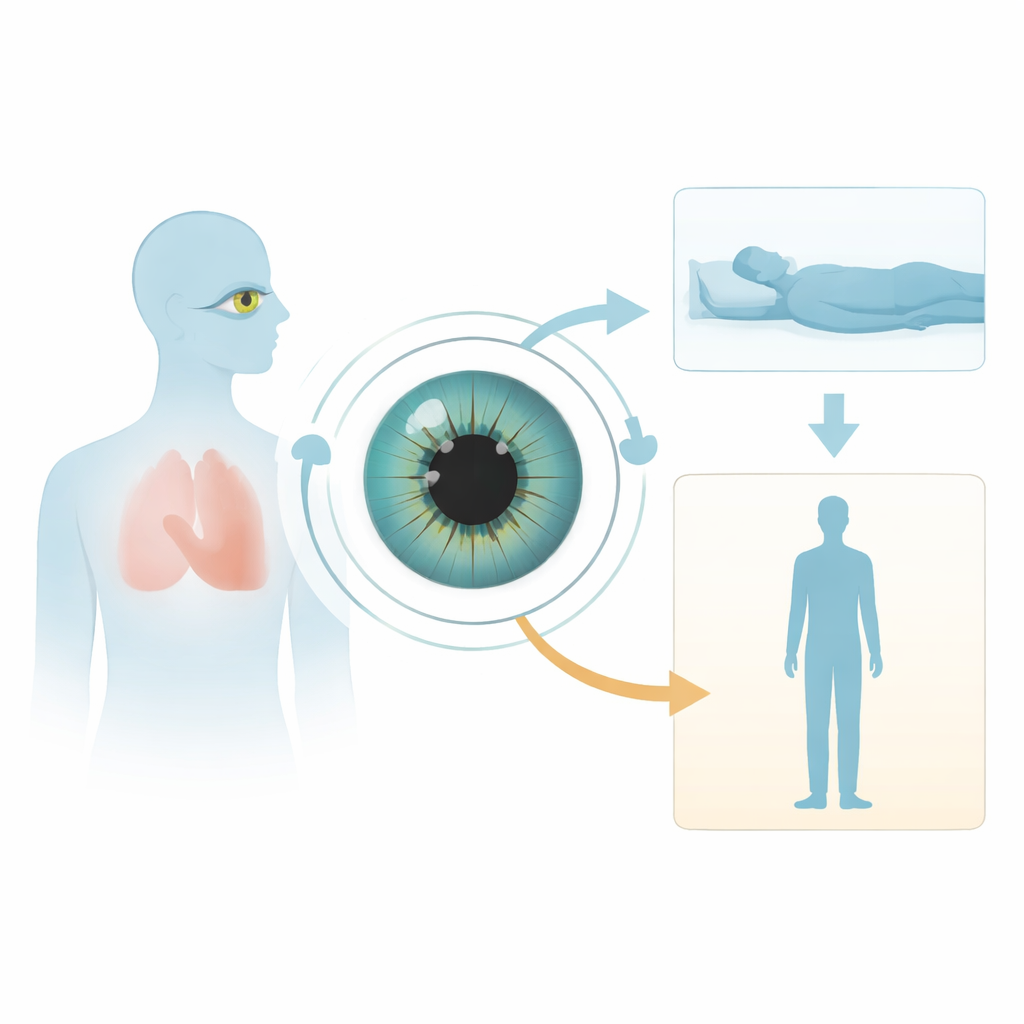
Even when we stare at a steady scene, our pupils quietly and rhythmically grow smaller and larger. This restless motion, called hippus, has long been viewed as harmless background noise. In this study, researchers show that these tiny swings in pupil size actually carry a clear fingerprint of how our automatic “fight‑or‑rest” system is working, and that they can be modeled with tools borrowed from physics to reveal both nerve activity and the mechanical properties of the eye.
A closer look at the pupil’s quiet dance
Hippus is a slow, spontaneous rhythm in which the pupil narrows and widens several times a minute, even in constant lighting. It is driven by two muscle groups in the iris: one that constricts the pupil and another that dilates it, each controlled by different branches of the autonomic nervous system. Past studies mainly measured how big these oscillations were and how long they lasted, but largely ignored the stretchy, spring‑like behavior of the iris tissue itself. The present work combines both aspects, asking not only how the pupil moves, but also how much force is needed to make that motion happen.
Using a physics model to read nerve signals
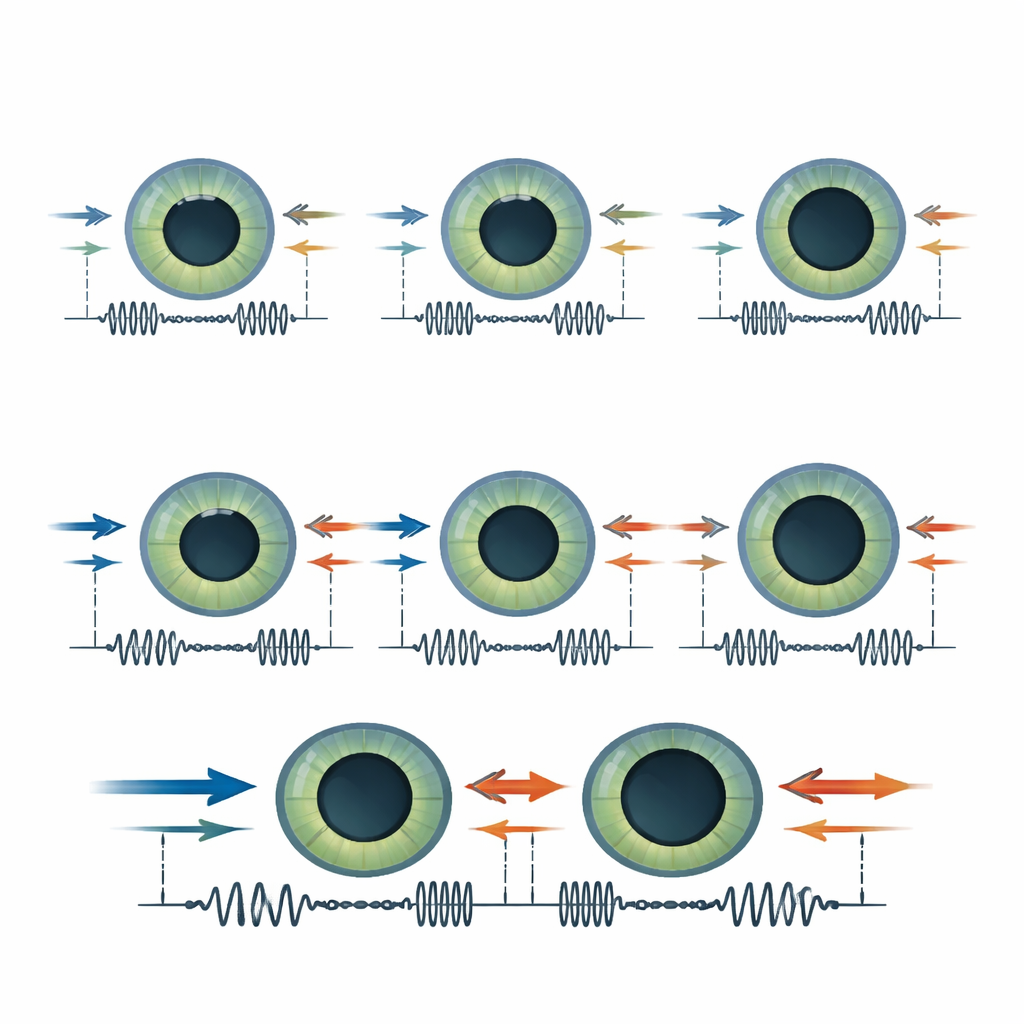
To do this, the authors applied a classic viscoelastic model, known as the Kelvin‑Voigt model, which describes materials that behave like a mix of springs and fluid dampers. They recorded hundreds of hippus cycles in 16 adolescent male athletes, both lying down and standing up, while also tracking heart activity. They then used computer algorithms to fit each pupil trace with the model, separating the contributions from the constricting and dilating muscles and estimating how stiff and how “viscous” the iris tissue was. Only hippus cycles that matched the model well—about one third of all recordings—were kept, ensuring that random noise did not distort the inferred nerve impulses.
Personal patterns in pupil motion
Within these high‑quality recordings, each participant showed a characteristic hippus shape that repeated across cycles, forming an individual “signature.” The cycles clustered into three main duration types—short, intermediate, and long—yet for any given person, the overall pattern was quite reproducible. This suggests that hippus reflects a stable combination of that person’s iris mechanics and the way their autonomic nerves drive the eye muscles at rest. At the same time, the strength of the nerve impulses varied from cycle to cycle, reminding us that the system is alive and adapting, not a rigid machine.
How body position and bright flashes change the story
When the volunteers lay down, the model revealed stronger parasympathetic impulses—the branch associated with rest and recovery—than when they were standing. In other words, the same person’s hippus signature shifted measurably with a simple change in posture, marking a change in baseline autonomic balance. The researchers also compared hippus to the more familiar pupil reaction to a brief burst of light, the photomotor reflex. That reflex required roughly eight times more energy than hippus, with much larger and more stereotyped pupil movements, and it did not change much between lying and standing. Hippus, by contrast, appeared to be a low‑cost, finely tuned background activity, whereas the light reflex behaved like a powerful, protective response designed to shield the retina.
Different windows on the body’s automatic control
Interestingly, the pupil‑based measures from hippus did not closely track standard heart‑rate variability measures, nor did they match the signals extracted from the light reflex. This suggests that these tools capture different facets of the autonomic nervous system rather than redundant information. Hippus seems to reveal the baseline state of this system and how it adapts to context, while the light reflex displays its emergency reserve when the eye is stressed by bright light. By treating the pupil not just as a simple aperture but as a small, living mechanical system, this work opens the door to using quiet eye movements as a sensitive, non‑invasive probe of nervous system function in both athletes and patients.
Citation: Giovannangeli, C.J.P., Borrani, F., Broussouloux, O. et al. Application of the Kelvin-Voigt viscoelastic model to hippus reveals major insights into the autonomic nervous system activity. Sci Rep 16, 10673 (2026). https://doi.org/10.1038/s41598-026-45875-6
Keywords: pupil dynamics, autonomic nervous system, hippus, sports physiology, heart rate variability