Clear Sky Science · en
Quantifying genus-level divergence using 18S rDNA and its application to heterolobosea with discovery of a novel genus from Mombasa Kenya
A hidden shape shifter in coastal sands
Along the shores of Mombasa, Kenya, scientists have uncovered an unexpected resident in the beach sands: a tiny amoeba that constantly changes shape and carries many copies of its DNA. By pairing careful microscopy with modern genetic tools, the researchers not only show that this microbe lives a strange, parasexual-like life but also that it belongs to a completely new genus. Their work also introduces a practical way to use a common DNA marker to tell where one microbial genus ends and another begins, a step that helps make sense of the vast unseen diversity in the microscopic world.
Tiny predators with flexible lives
The newly described amoeba, named Mombasina parasexualis, belongs to a larger group of free-living microbes called heteroloboseans. These organisms are common in soils and waters around the globe and play key roles as predators of bacteria and other microbes, helping recycle nutrients. Many are shape shifters that can switch between crawling, swimming, and resting stages, and some relatives are known to infect humans and animals. Yet because these organisms are so small and so flexible in form, it has been notoriously difficult to decide which ones should be grouped together as the same genus or split apart as distinct lineages.
A new beach dweller with a strange life cycle
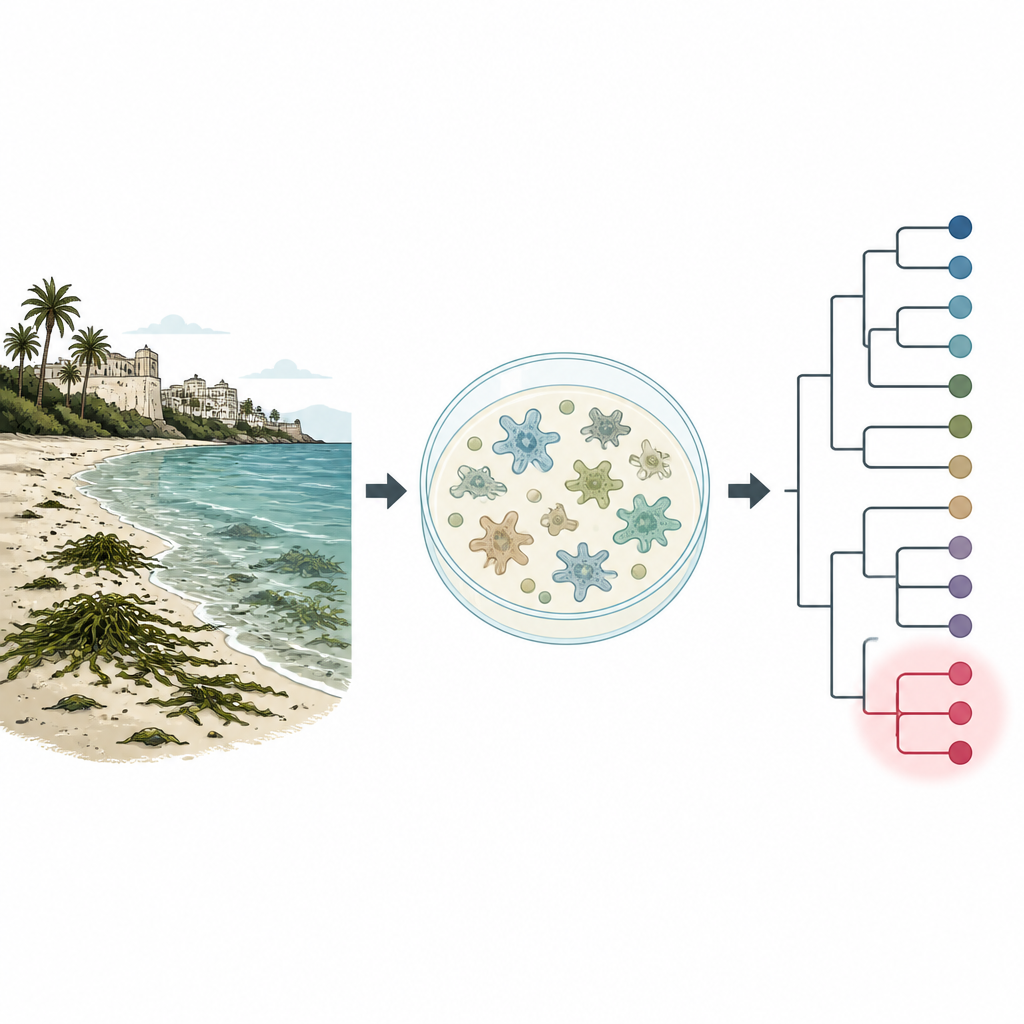
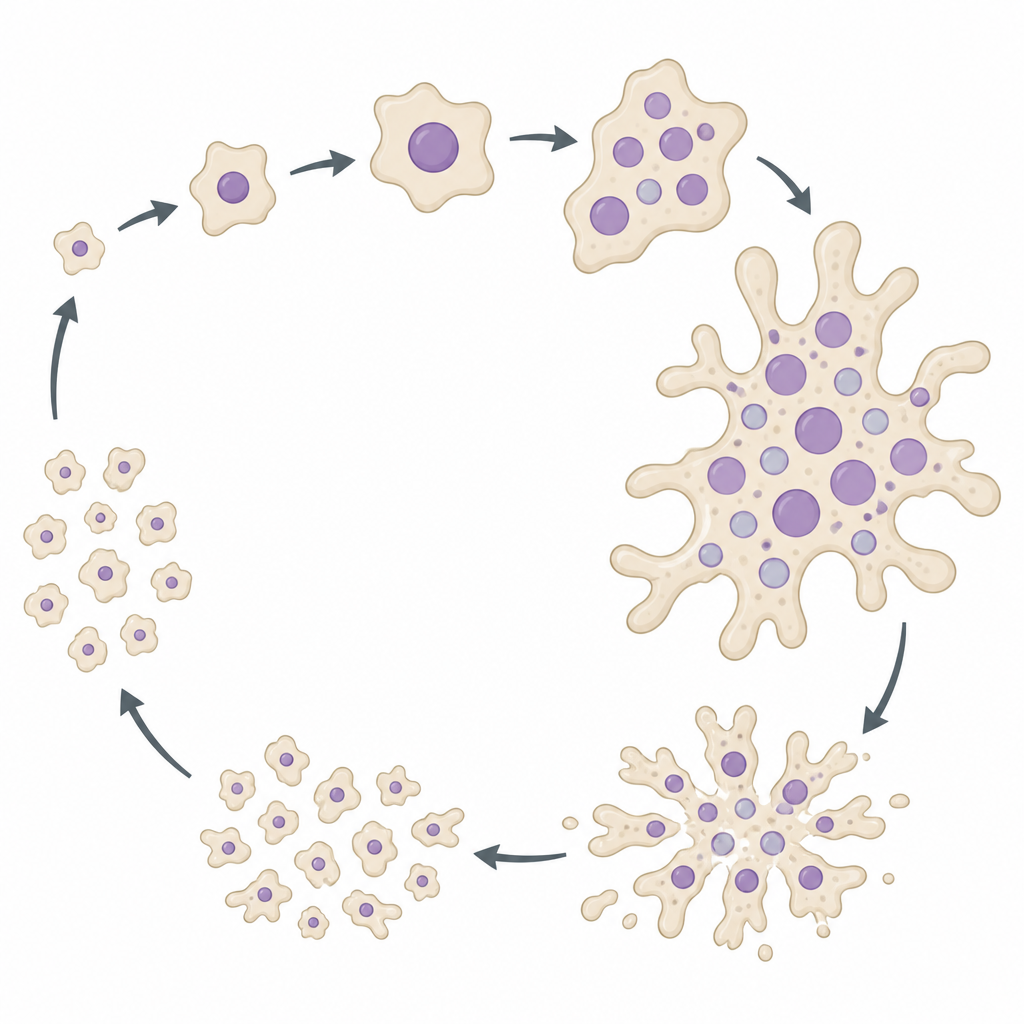
The team collected decomposing seaweed and sand from Bamburi Beach, an intertidal stretch with coral-derived sand and shallow lagoon waters. When they set up cultures in seawater with bacteria as food, a fast-growing amoeba appeared in large numbers. Under the microscope, single cells glided in a sleek, slug-like fashion, with a clear front end and a tapered rear, but frequently broke this smooth motion with sudden side bulges and zigzag turns. As cultures aged, the researchers watched some cells grow into giants, more than three times longer than typical forms, packed with dozens to over one hundred nuclei of different sizes. These oversized cells did not fuse with neighbors; instead, they fragmented into many smaller amoebae, suggesting an unusual, parasexual-like way of reshuffling and distributing genetic material without a classic sexual cycle.
Reading identity from a common genetic barcode
To place the Mombasa amoeba on the tree of life, the researchers focused on a widely used genetic region called 18S rDNA, often treated as a barcode for eukaryotic microbes. Rather than relying on a single alignment and a one-size-fits-all cutoff, they built an automated pipeline that tests how much 18S rDNA sequences differ within each named genus and between genera, under multiple alignment and filtering schemes. Across heteroloboseans, they found a clear bimodal pattern: comparisons within the same genus showed much lower divergence than comparisons between genera. This separation held even when they stripped away ambiguous or rapidly changing parts of the sequence, and saturation tests showed that the relevant differences still lie in an informative range where the DNA changes reflect real evolutionary distance.
Where the newcomer fits on the family tree
When the Mombasa sequence was added to large evolutionary trees, it consistently grouped with two known lineages: a coastal marine amoeba called Orodruina flavescens and an uncultured lineage detected at the Lost City hydrothermal field in the Atlantic. Despite forming a stable three-member branch, the genetic gaps between each of these members were as large as or larger than gaps that separate well-established genera elsewhere in the group. When all three were temporarily treated as if they belonged to one genus, their internal 18S rDNA differences spilled beyond the empirically defined within-genus range. Combined with the Mombasa amoeba’s distinctive multinucleate, polyploid stages and its coastal habitat, the evidence pointed strongly to recognizing it as a separate genus within the same broader family.
Why this tiny discovery matters
By naming Mombasina parasexualis as a new genus and species and placing it within the family Orodruinidae, the study spotlights just how much hidden diversity exists among amoebae in underexplored coastal ecosystems. At the same time, the researchers offer a practical, reproducible way to use a standard DNA marker to draw genus boundaries in groups where visible traits are scarce or misleading. For non-specialists, the take-home message is that even a scoop of beach wrack can harbor lineages as distinct from one another as mammals are from birds, and that careful measurements of DNA differences can help us chart this invisible tree of life with greater clarity.
Citation: Tekle, Y.I., Wang’ondu, V.W., Ghebezadik, S. et al. Quantifying genus-level divergence using 18S rDNA and its application to heterolobosea with discovery of a novel genus from Mombasa Kenya. Sci Rep 16, 15233 (2026). https://doi.org/10.1038/s41598-026-45864-9
Keywords: heterolobosea, amoeba diversity, 18S rDNA, marine protists, microbial taxonomy