Clear Sky Science · en
Lipidomics of prolonged labor duration in African American birthing people
Why some labors last much longer
Anyone who has given birth or supported a loved one in labor knows how stressful a long, stalled labor can be. For African American families, this problem carries added weight, since slow labor often leads to unplanned cesarean surgery and higher risks for infection and heavy bleeding. This study asks a simple but powerful question: can molecules in a pregnant person’s blood months before birth hint at who is more likely to face a very long labor?

A closer look at fats in the blood
The researchers focused on lipids, a broad family of fats that store energy, build cell membranes, and help send signals in the body. Using blood samples from 86 African American pregnant participants, they compared two groups: people whose labors progressed quickly and those whose active labor lasted many hours or ended in cesarean for labor not moving forward. Samples were collected early in pregnancy and again in the late second to early third trimester. Instead of targeting just a few well known fats, the team used lipidomics, a mass spectrometry based approach that scans hundreds of different lipid types at once, and then applied advanced computer methods to see patterns across this complex mix.
Early pregnancy warning patterns
Well before labor began, the blood of those who later developed prolonged labor already looked different. They had lower amounts of certain membrane related lipids, including lysophosphatidylcholines and ceramides, and related molecules called sphingomyelins. These substances help shape cell surfaces and support communication between signaling proteins, including those that help the uterus contract. At the same time, some other lipids carrying highly unsaturated fatty acids, such as specific phosphatidylethanolamines and phosphatidylinositols, were higher. Together, these shifts suggested that the normal balance of fats in cell membranes and in signaling pathways was altered months before labor started.
Late pregnancy buildup of storage fats
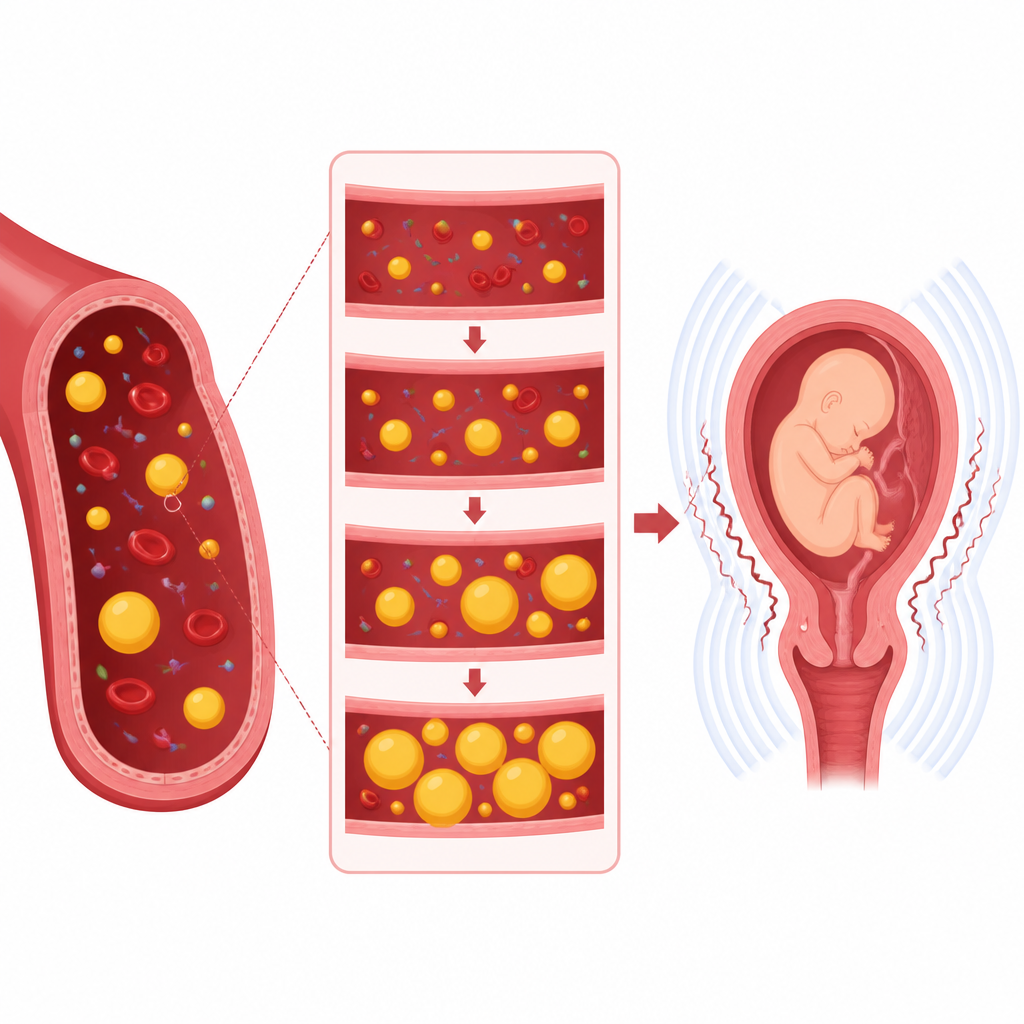
By late pregnancy, the picture shifted toward excess energy storage. People who experienced prolonged labor showed a marked rise in triglycerides, the main storage fats carried in the bloodstream, especially those built from saturated fats and the monounsaturated fat oleic acid. These triglycerides increased more sharply over time than in the rapid labor group. In contrast, some protective phospholipids that help keep membranes flexible rose more slowly, so that by the third trimester the balance had clearly tilted toward storage fats. This pattern fits with the idea that a metabolically stressed environment, similar to that seen in obesity and insulin resistance, might interfere with the muscle function of the uterus.
Hidden networks behind the numbers
Rather than looking at each lipid alone, the team also examined how lipids rose and fell together as networks. In people with rapid labors, these networks contained both positive and negative links, like a system of balances that keeps metabolism in check. In those with prolonged labor, the networks were simpler and lost many of their opposing connections, hinting that important regulatory feedback loops were weakened. Specific clusters tied to lysophosphatidylcholines in early pregnancy and to saturated triglycerides later in pregnancy were closely linked to how long labor lasted and whether dystocia occurred.
Using change over time to foresee risk
When the researchers combined information from both pregnancy visits, including how each person’s lipids changed over time, they could distinguish prolonged labor cases from rapid labor cases more accurately than when they looked at a single time point. Certain patterns, such as stronger rises in oleic acid containing triglycerides and particular phosphatidylcholines, along with drops in other lipids, stood out as potential early markers. While these patterns need to be tested in larger and more diverse groups, they suggest that tracking the trajectory of fats in the blood may one day help identify those at higher risk for long, difficult labors.
What this could mean for parents and providers
For a layperson, the key message is that the length and ease of labor may be influenced not only by the baby’s size or the pelvis, but also by subtle shifts in everyday fats circulating in the blood long before delivery. In this study of African American birthing people, lower levels of some membrane building lipids early in pregnancy and a later buildup of storage fats were tied to slower labors and more interventions. If future research confirms these findings, simple blood tests and nutrition or lifestyle strategies aimed at a healthier lipid balance could one day help reduce the chances of prolonged labor and narrow existing gaps in birth outcomes.
Citation: Carlson, N.S., Chen, CY., Hou, Z. et al. Lipidomics of prolonged labor duration in African American birthing people. Sci Rep 16, 15610 (2026). https://doi.org/10.1038/s41598-026-45859-6
Keywords: labor dystocia, pregnancy lipids, African American birth, triglycerides, uterine contractility