Clear Sky Science · en
Enhancing movie script creation through retrieval-augmented LLMs and stable diffusion scene modeling
Turning Ideas into Scripts and Scenes
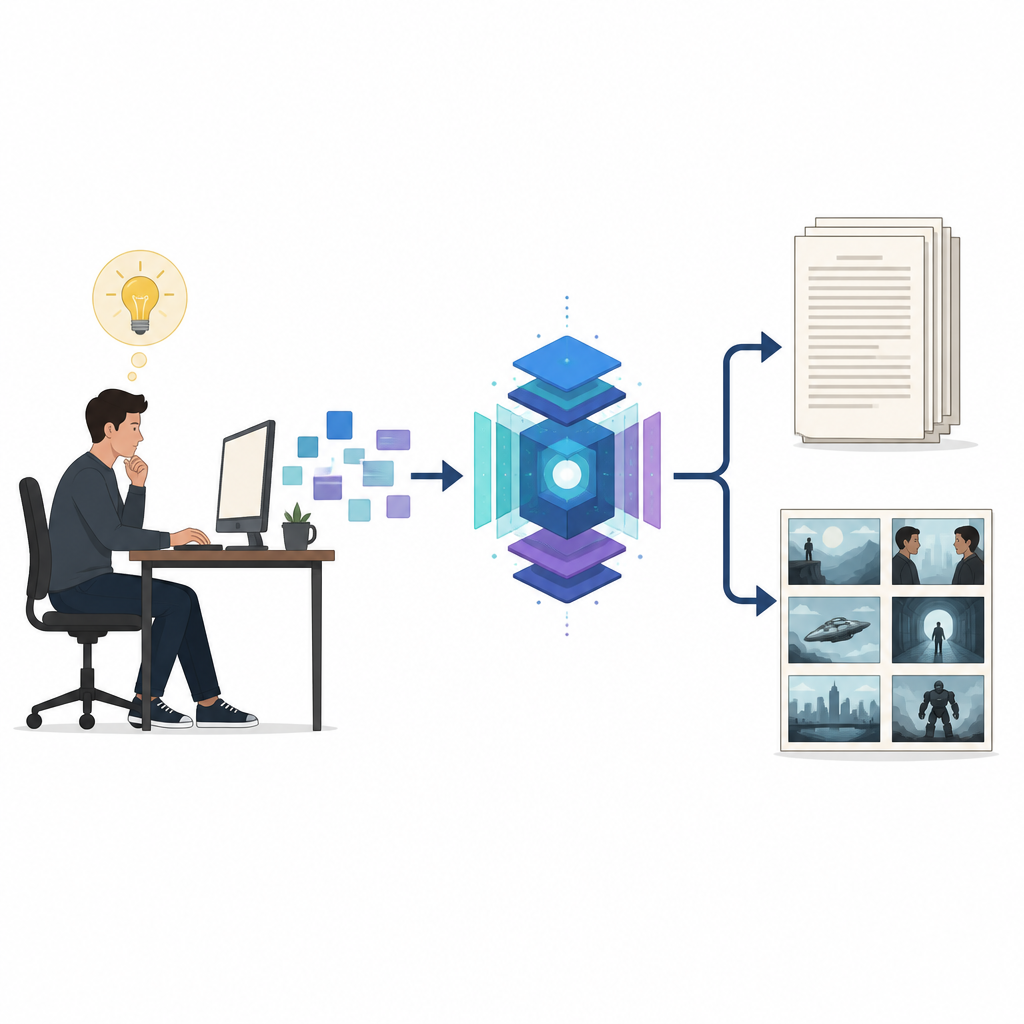
Anyone who has tried to write a movie or game script knows how hard it is to turn a loose idea into rich dialogue and vivid scenes. This study explores how new artificial intelligence tools can help people move from a simple written prompt to a full script and even rough visual scenes, making it easier for more creators to bring their stories to life without needing a big studio behind them.
Why Scriptwriting Needs a Boost
Modern films, shows, games, and ads all rely on carefully crafted scripts that spell out who says what, where they are, and how they behave. Creating this level of detail by hand is slow and demanding, especially when producers want highly tailored content for specific cultures, moods, or brands. The authors argue that automating parts of this process could lower the barrier for new storytellers, letting them focus on the heart of the plot while computers handle repetitive writing tasks and keep track of details across long scenes.
Blending Memory and Imagination in Text
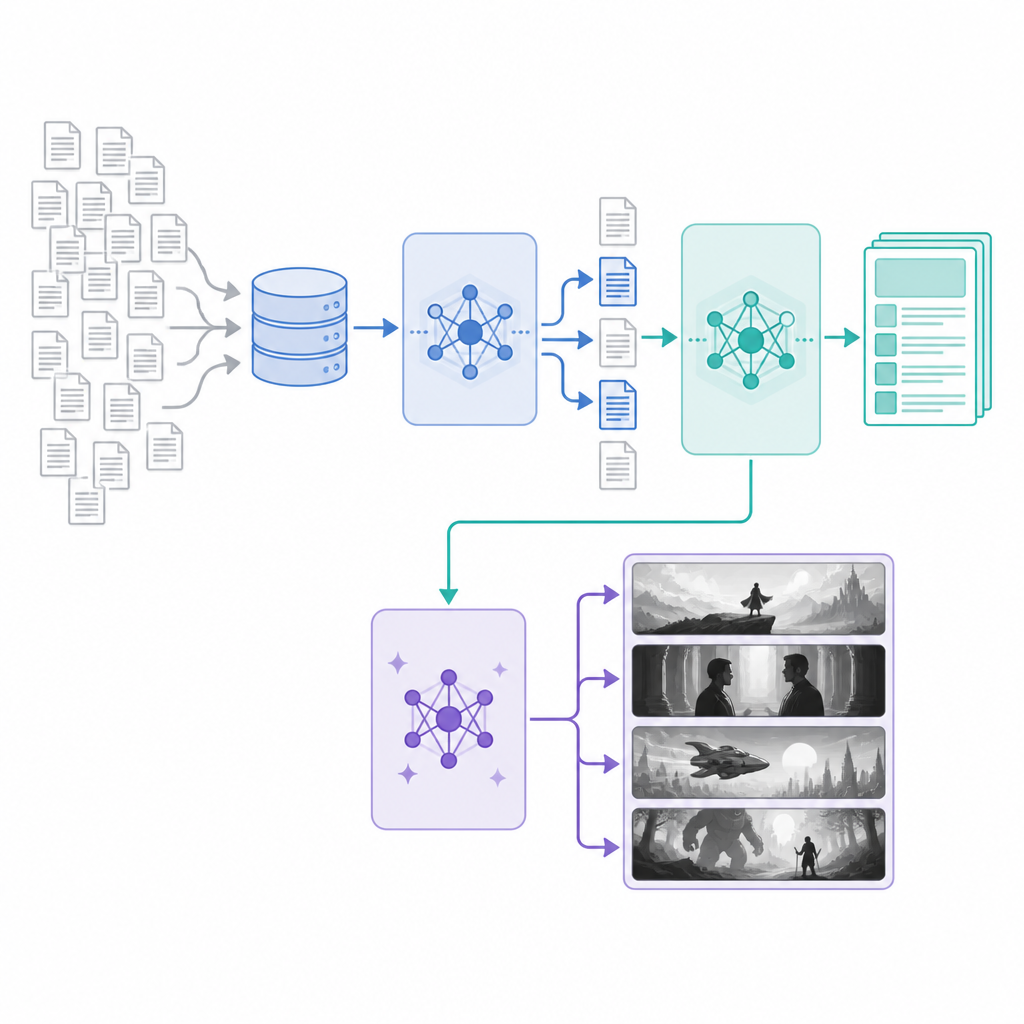
At the center of the work is a pipeline that joins two strengths of current language models. First, a technique called retrieval-augmented generation lets the system search a large library of real movie scripts and pull out passages that resemble the user’s prompt. These snippets act like reference notes, helping the model stay grounded in believable dialogue and structure. Second, standard language models such as GPT-2 and Bloom are fine-tuned on thousands of scripts so they learn patterns of natural conversation, pacing, and scene flow. Together, this pairing aims to keep the output both creative and faithful to what the user asked for, while cutting down on made-up or off-topic content.
From Words on the Page to Pictures on the Screen
The framework does not stop at text. The team connects its script engine to an image generator known as Stable Diffusion, which can turn short scene descriptions into concept art like storyboards. The system first turns a user query into a compact numerical form that captures its meaning, then gradually transforms random visual noise into a clear image that matches the scene. This gives writers and directors a quick way to see how a location, character, or moment might look, making it easier to adjust pacing, mood, and camera viewpoints early in the process rather than waiting for full production.
How Well the System Performs
To judge how useful the system is, the authors compare the input prompts with the generated scripts using two common measures. Cosine similarity checks how closely the meaning of the output matches the prompt, while perplexity reflects how fluent and predictable the text is. On their dataset of 5,000 movie scripts, the retrieval-based model using Gemini-Pro shows the strongest match with user prompts, suggesting that searching real script fragments before writing helps keep the story on track. Fine-tuned GPT-2 and Bloom produce coherent text with low perplexity, meaning the wording and flow feel natural. For images, the team uses a score that checks how well the pictures align with their text prompts, finding moderate success and clear room for sharper visual detail and closer ties to the written scenes.
What This Means for Future Storytellers
In plain terms, the study shows that combining search, smart text models, and image generators can turn a short idea into both a script and a set of rough scenes with reasonable accuracy. The system does not replace human writers, but it can act as a fast assistant that suggests dialogue, keeps track of context, and offers visual sketches. As the visual side improves and the models are trained on more diverse scripts, such tools could help creators across film, games, and marketing experiment more freely, refine their stories faster, and share clear story visions with collaborators from the very first draft.
Citation: Lulla, A., Koul, A., Agni Mithra, R. et al. Enhancing movie script creation through retrieval-augmented LLMs and stable diffusion scene modeling. Sci Rep 16, 15284 (2026). https://doi.org/10.1038/s41598-026-45852-z
Keywords: movie script generation, retrieval augmented generation, large language models, stable diffusion, multimodal storytelling