Clear Sky Science · en
Analytical solution of driven time-dependent mesoscopic circuits
Why tiny circuits can behave in surprising ways
As electronic components shrink toward the size of molecules, the familiar rules of everyday circuits start to blend with the strange rules of quantum physics. This paper explores how a tiny, driven circuit made of a resistor, inductor, and capacitor behaves when both its parts and its power source change in time, revealing how energy loss and external driving reshape quantum fluctuations of charge and current.
From ordinary circuits to quantum circuits
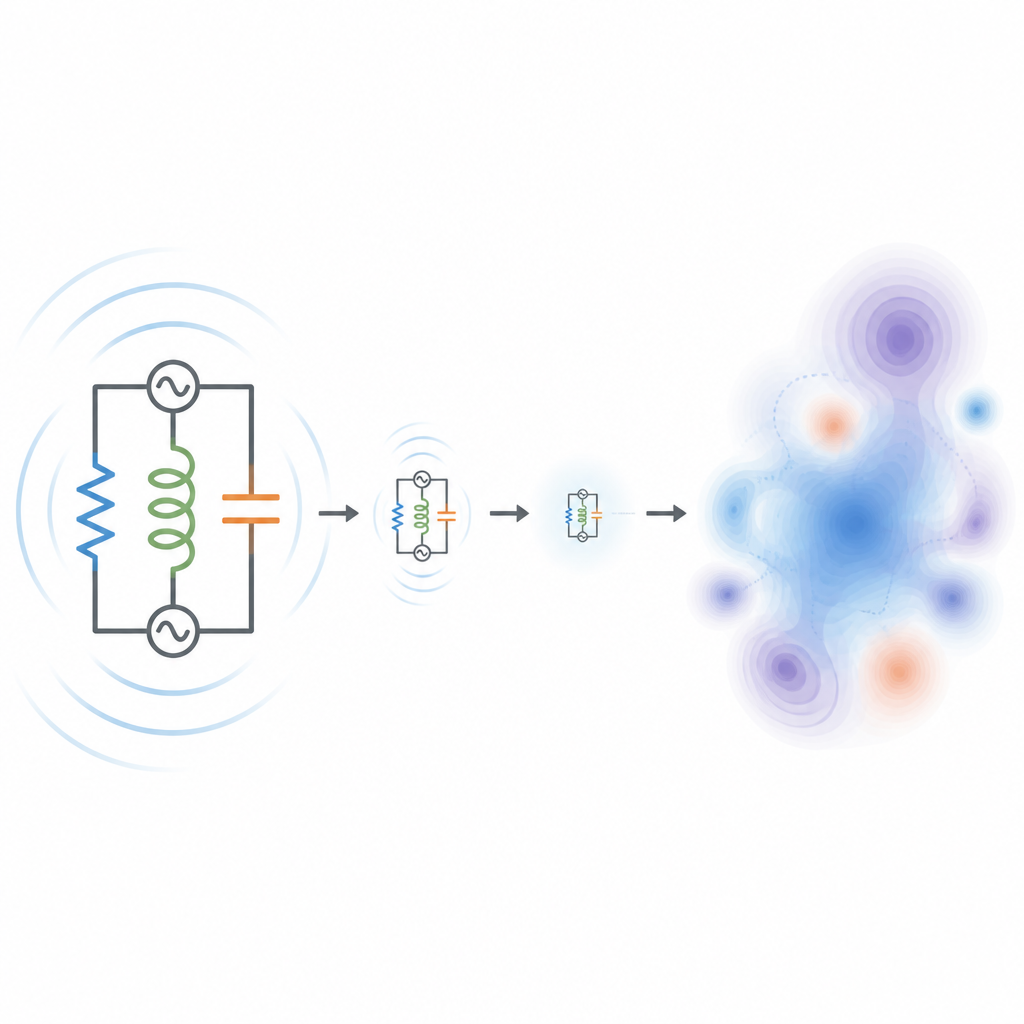
Modern integrated circuits are now so small that they fall into the mesoscopic range, where quantum effects such as fluctuations and coherence cannot be ignored. In this regime, a circuit is no longer just a simple loop of components but a quantum system whose charge and current must be described by wave functions. Researchers have developed several mathematical approaches to treat these circuits, yet handling circuits whose properties vary with time and are simultaneously driven by a power source has remained especially difficult.
A powerful method for changing systems
To tackle this challenge, the authors rely on the Lewis–Riesenfeld invariant method, a technique from quantum mechanics designed for systems whose energy landscape changes with time. Instead of solving the time-dependent Schrödinger equation directly, they build a special operator that stays mathematically “invariant” as the system evolves. By finding the eigenstates of this operator and an associated phase, the full quantum state of the system can be constructed exactly. A key insight is that the equations describing certain mesoscopic circuits mirror those of a harmonic oscillator with time-varying properties, making this method directly applicable.
Capturing dissipation and driving in a single model
The core of the work is a detailed quantum description of a mesoscopic RLC circuit whose inductance and resistance can change over time while an external source drives it. The authors construct a generalized invariant operator that includes both energy loss, encoded through a damping factor related to the resistance, and the effect of the source. This leads to auxiliary equations that describe how two quantities evolve: one sets the overall scale of the quantum state, while the other shifts its position in charge space. By solving these equations, the authors obtain explicit formulas for the wave functions and phases of the circuit’s quantum states. They then show that this general treatment correctly collapses to known results when either the source or the resistance is turned off, providing a strong check on their framework.
Coherent states under an alternating power source
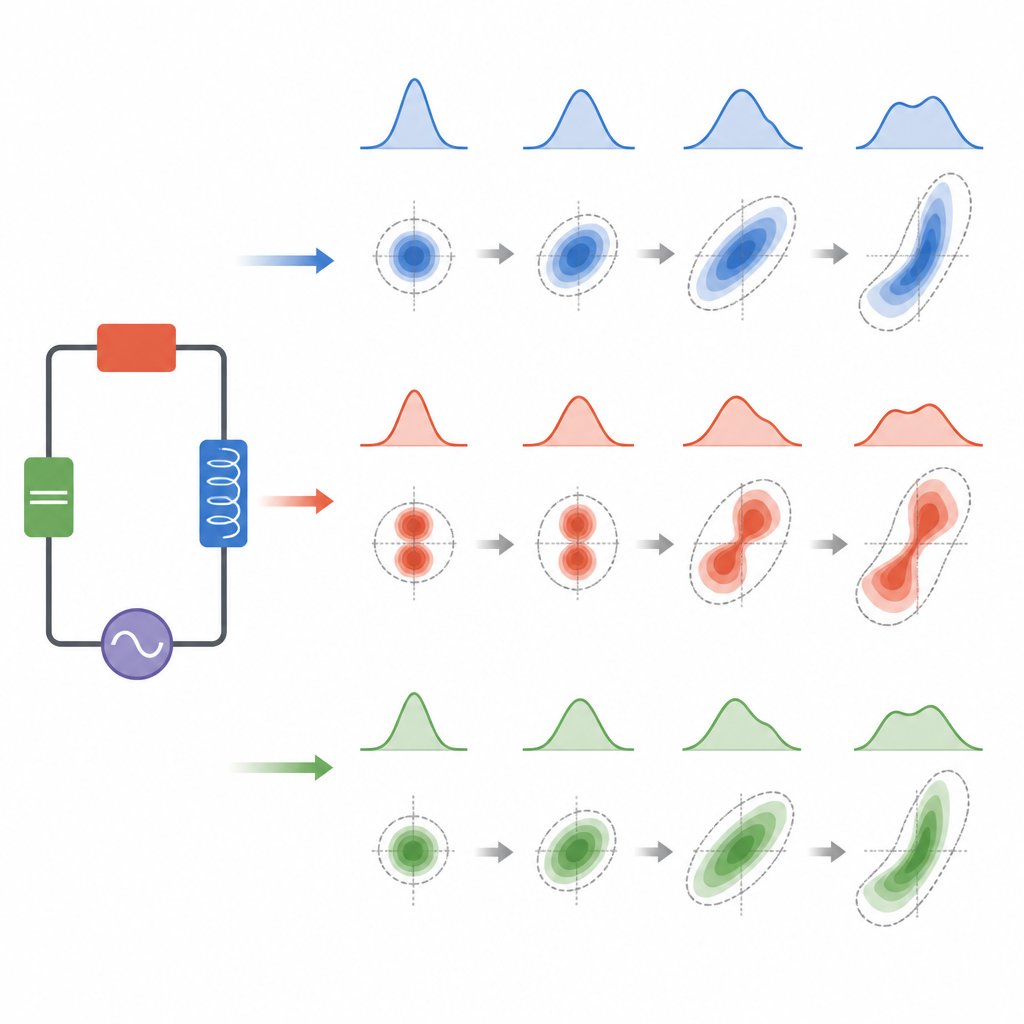
With the general solution in hand, the authors focus on an especially relevant case: a mesoscopic RLC circuit driven by an alternating current voltage source. They build so-called generalized coherent states, which are quantum states that resemble classical oscillations as closely as possible. In more familiar settings, such as light in a stable laser cavity, coherent states achieve the smallest possible joint uncertainty in their basic variables. Here, however, the time-varying inductance and resistance reshape the spread of charge and current over time. The team derives explicit expressions for the average values and fluctuations of charge and current, and from these obtains the corresponding uncertainty relation.
When quantum uncertainty refuses to stay minimal
The calculations reveal that, in this driven and dissipative setting, the product of the uncertainties in charge and current is generally larger than the minimum value familiar from textbook coherent states. Interestingly, this excess uncertainty is controlled by the time dependence of the inductance and resistance, rather than by the alternating source itself. In the special limit where these parameters stop changing and dissipation effectively vanishes, the usual minimum uncertainty of standard coherent states is recovered. The study thus shows how environmental influences, represented here by time-varying components and loss, can degrade ideal quantum behavior even in a carefully prepared state. By providing an exact analytical framework for such realistic mesoscopic circuits, the work offers a foundation for understanding and designing future quantum electronic devices that must operate in the presence of both driving and dissipation.
Citation: Ma, J., Yao, Y., Liu, R. et al. Analytical solution of driven time-dependent mesoscopic circuits. Sci Rep 16, 15660 (2026). https://doi.org/10.1038/s41598-026-45828-z
Keywords: mesoscopic circuits, quantum RLC, time dependent systems, quantum fluctuations, coherent states