Clear Sky Science · en
The patterns of acetylcholinesterases during developmental stages of Aedes aegypti and their susceptibility toward insecticides in egg stage
Why mosquito eggs matter for our health
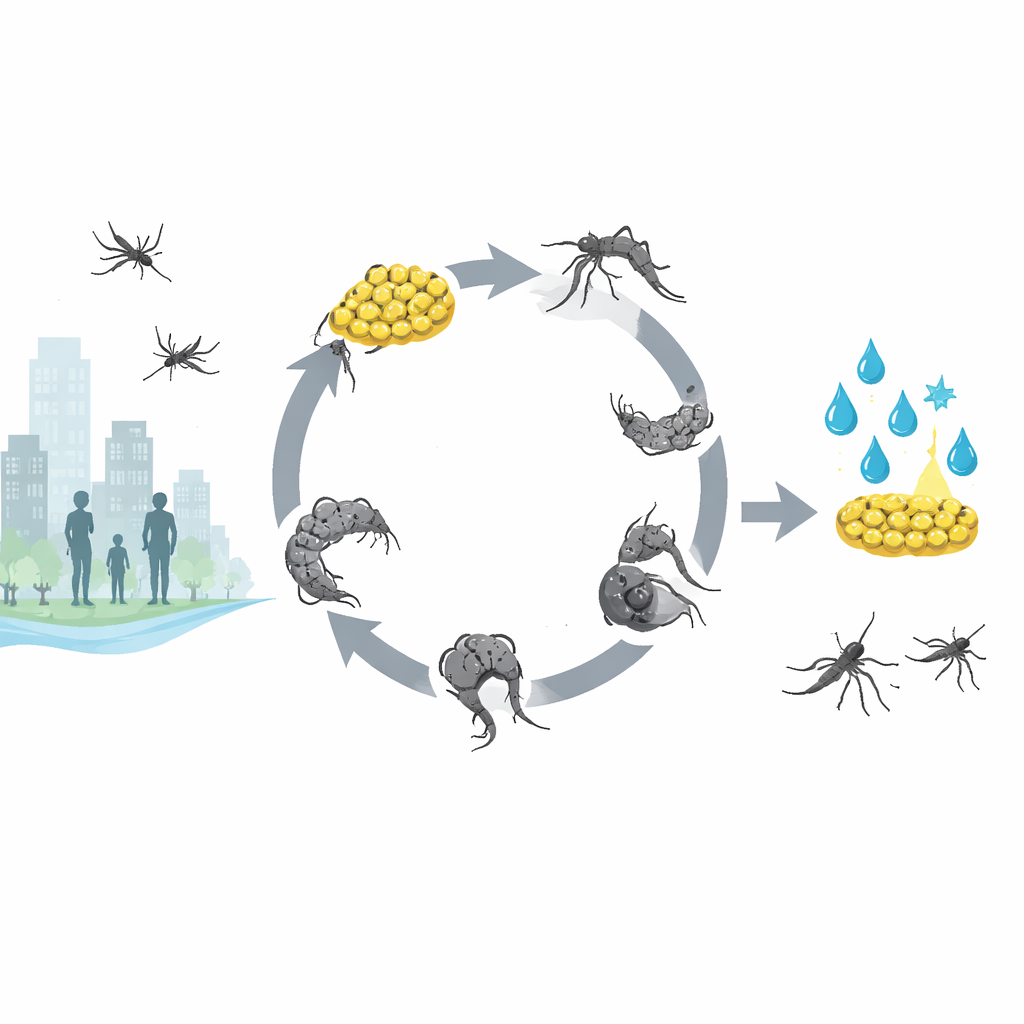
Mosquitoes are notorious for spreading viruses such as dengue, Zika, and chikungunya, which have become major threats in many tropical and subtropical cities. Most mosquito control programs focus on killing larvae and adults, yet every mosquito life starts in a tiny egg that often escapes treatment. This study explores what happens inside those eggs at the chemical level and asks a practical question: can we safely and efficiently stop mosquitoes before they hatch by striking at a key nerve enzyme?
A close look at a tiny nerve switch
The researchers focused on acetylcholinesterase, an enzyme that acts like an off switch for nerve signals. When a nerve cell releases the messenger molecule acetylcholine, acetylcholinesterase quickly breaks it down, allowing the system to reset. If this enzyme is blocked, signals keep firing, leading to paralysis and death in insects. Many common insecticides, including organophosphates and carbamates, work by blocking this switch. Interestingly, mosquitoes carry two versions of the enzyme, called AChE1 and AChE2, while humans and most mammals have only one. That difference offers a way to design control strategies that target mosquitoes more precisely.
How the enzyme changes as mosquitoes grow
To understand when mosquitoes might be most vulnerable, the team measured acetylcholinesterase in different life stages of Aedes aegypti: eggs, four larval stages, pupae, and adults. They separated the enzymes from these stages and tracked the activity of AChE1 and AChE2. Eggs showed the strongest activity of AChE1, which then declined through larvae, pupae, and adults. In contrast, AChE2 was weak in eggs and larvae but rose sharply in pupae and reached its highest levels in adults. This pattern suggests that AChE1 is especially important in the early, pre-nerve development phase, while AChE2 dominates once the nervous system is fully formed and coordinating movement, feeding, and reproduction.
Probing the eggs’ hidden chemistry
The scientists then zoomed in on 36-hour-old eggs, a point in development where the nervous system is still forming but the embryo is well underway. They examined how the two enzyme forms behaved under different conditions, such as substrate type, acidity (pH), temperature, and the presence of metal ions. Both AChE1 and AChE2 worked best at a near-neutral pH and around body-warm temperatures, but they differed in how quickly they lost activity when heated. Several common metal ions partially reduced enzyme activity, and cobalt ions shut both enzymes down completely. These details help paint a picture of how robust or fragile the enzymes are inside eggs and hint at how environmental factors might influence mosquito development.
Which insecticides hit egg enzymes hardest
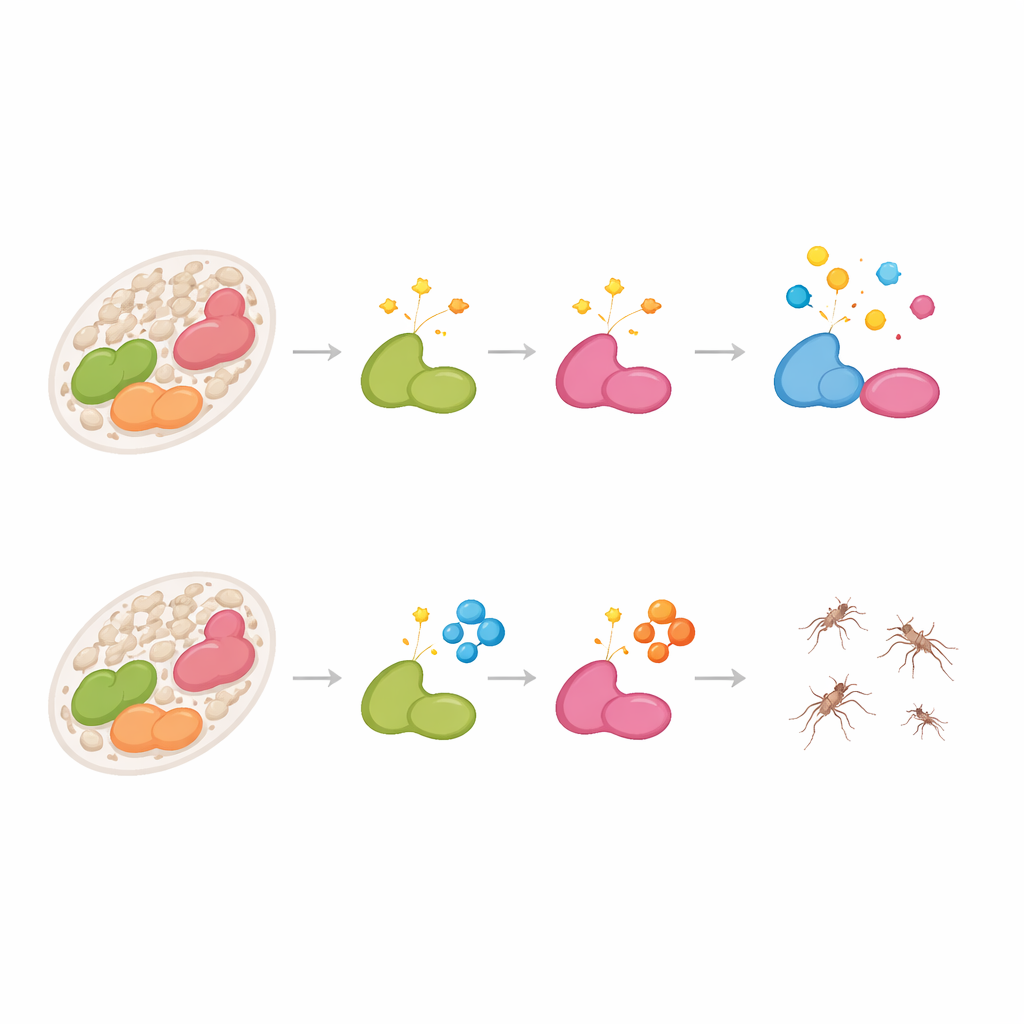
The heart of the study tested how strongly different organophosphate and carbamate insecticides could block AChE1 and AChE2 in egg extracts. By carefully measuring reaction rates in the presence of various doses, the team calculated how tightly each chemical bound to the enzymes. Some compounds, such as methomyl, chlorpyrifos-methyl, and pirimiphos-methyl, were especially effective at inhibiting both forms of the enzyme in eggs. Others, including malathion, fenitrothion, and the natural alkaloid eserine, were less potent under the same lab conditions. These differences suggest that not all products commonly used in mosquito control are equally suited to targeting the egg stage.
From lab bench to mosquito control strategies
Overall, the findings show that the cholinergic system—the network built around acetylcholine and acetylcholinesterase—is already active in mosquito eggs, long before larvae begin swimming. That makes the egg stage a realistic target for control programs. The study points to methomyl, pirimiphos-methyl, and chlorpyrifos-methyl as particularly strong candidates for disrupting egg development by blocking AChE1 and AChE2. If future field trials confirm these lab results, adding egg-focused treatments to existing measures could lower mosquito numbers earlier, reduce reliance on later, heavier insecticide use, and help slow the evolution of resistance. At the same time, the authors stress that real-world factors—such as how long eggs are exposed, local climate, and population differences—must be fully evaluated before these chemicals are widely adopted for egg-stage control.
Citation: Mohamed, S.A., Abdel-Aty, A.A., Al-Talhi, H.A. et al. The patterns of acetylcholinesterases during developmental stages of Aedes aegypti and their susceptibility toward insecticides in egg stage. Sci Rep 16, 12730 (2026). https://doi.org/10.1038/s41598-026-45818-1
Keywords: Aedes aegypti, mosquito eggs, acetylcholinesterase, insecticide resistance, vector control