Clear Sky Science · en
Sol–gel synthesized calcium borate glass and glass–ceramics: effect of CrCl3 doping on structure, mechanics, and gamma-ray shielding efficiency
Stronger Windows Against Invisible Rays
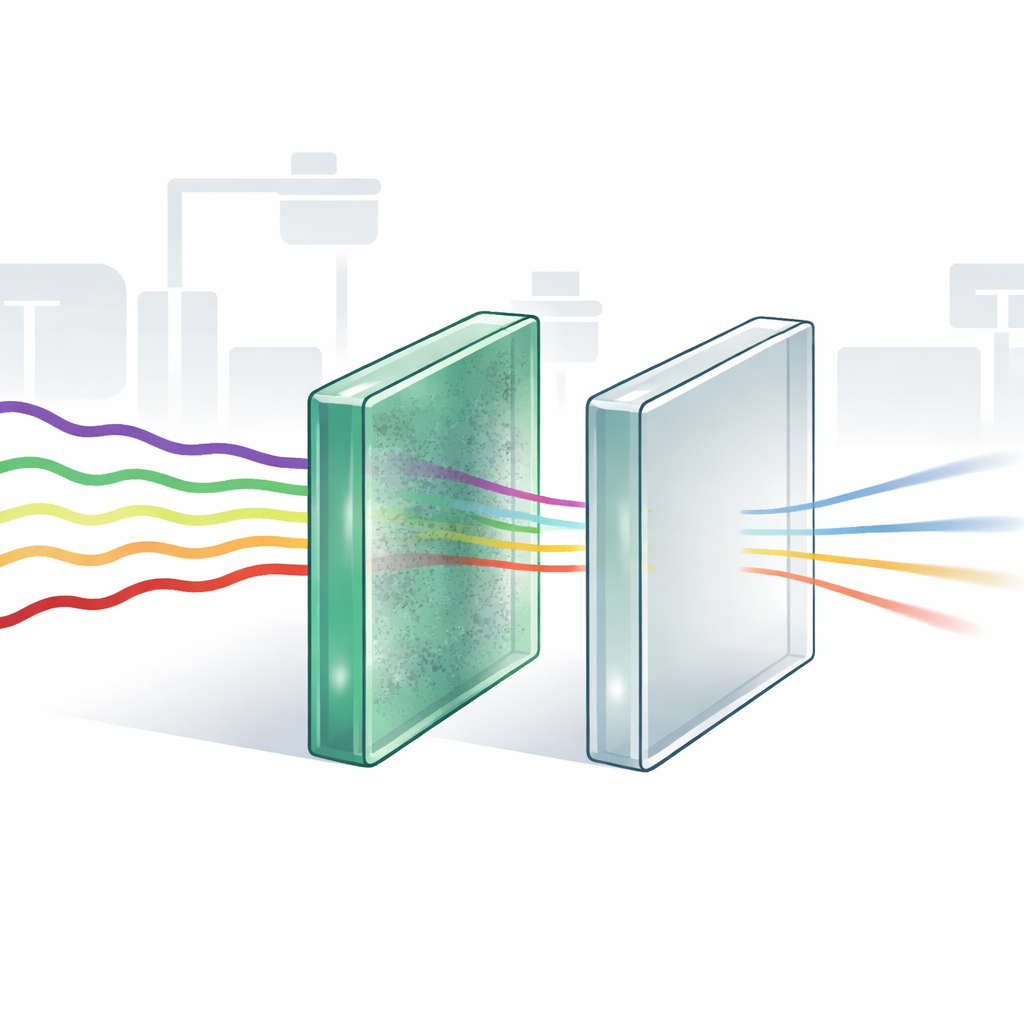
Modern medicine and nuclear technology rely on powerful beams of X-rays and gamma rays, which also pose risks to patients, staff, and equipment. Traditional shields often use heavy, toxic lead or bulky concrete. This paper explores a different approach: specially designed glass and glass–ceramics that can block harmful radiation while remaining transparent and mechanically strong, pointing toward safer viewing windows, protective screens, and eyewear.
Designing a New Kind of Protective Glass
The researchers focused on calcium borate glass, a family of materials already valued for their optical clarity and chemical stability. They used a low-temperature sol–gel route to build glasses with the recipe 55% calcium oxide and 45% boron oxide, gradually replacing part of the boron component with chromium(III) chloride (CrCl₃) at levels up to 3 mol%. After forming a gel and drying it into a fine powder, they heat-treated the material first at 500 °C, then at 700 °C to obtain both glass and glass–ceramic forms. This careful processing allowed them to see how chromium and chlorine change the structure and performance of the base glass.
From Smooth Glass to Tough Glass–Ceramic
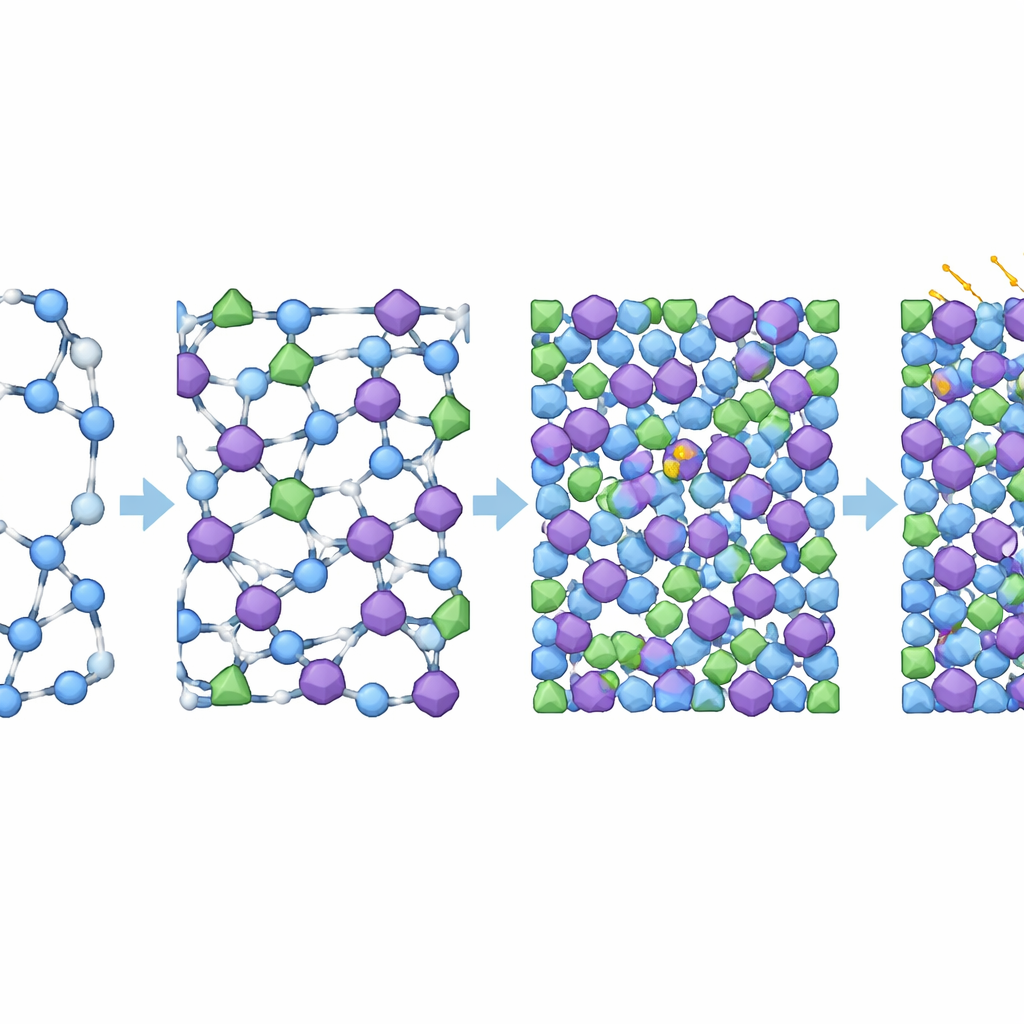
To probe the internal structure, the team used X-ray diffraction and infrared spectroscopy. At 500 °C the samples remained mostly amorphous, typical of glass. Heating to 700 °C, especially with added CrCl₃, triggered the growth of tiny crystalline regions of calcium borate inside the glass. Microscopy images confirmed that undoped samples had smoother, more uniform surfaces, whereas chromium-doped samples developed sharper, faceted particles embedded in the matrix. These newly formed crystals, together with changes in the borate network, increased the amount of tightly bound tetrahedral building blocks and made the material denser and more ordered.
Packing Atoms Tightly to Boost Strength
Measurements showed that adding CrCl₃ steadily increased the density of the glass from 2.57 to 3.11 g/cm³ while shrinking the molar and free volumes, meaning atoms were packed more efficiently with fewer empty spaces. Using a standard theoretical model for glass elasticity, the authors calculated that key mechanical properties rose sharply with chromium content. Young’s modulus, a measure of stiffness, climbed from about 66 to 108 GPa, while bulk and shear moduli and microhardness all improved significantly. The Poisson ratio values indicated a highly cross-linked, mechanically stable network. Together, these trends suggest that Cr-containing units and the associated crystalline phases lock the structure into a more rigid, robust framework.
Stopping Gamma Rays in a Thinner Shield
To evaluate radiation protection, the team used specialized software to calculate how the glasses interact with photons from 0.015 to 15 MeV, covering typical medical X-ray and gamma-ray energies. As chromium content increased, the mass and linear attenuation coefficients rose, especially at lower energies where photoelectric absorption dominates. At the same time, the half-value layer, tenth-value layer, and mean free path all decreased: at 0.04 MeV, the half-value layer dropped from 0.336 cm in undoped glass to 0.252 cm in the highest-doped sample. In simple terms, less material is needed to cut the radiation intensity in half. When compared with specialized concretes and other borate glasses, the chromium-rich composition offered higher attenuation and thinner required shielding, all while retaining glass-like form and potential transparency.
Toward Lead-Free, Transparent Shields
Overall, the study shows that introducing modest amounts of chromium chloride into calcium borate glass can simultaneously increase density, mechanical strength, and gamma-ray blocking power. The best-performing composition, with 3 mol% CrCl₃, combines strong structural rigidity with superior shielding compared with several existing glass and concrete materials. For non-structural barriers such as viewing windows, protective panels, or specialized eyewear, these lead-free, glass-based shields could offer a lighter, safer, and more versatile alternative to traditional materials.
Citation: Alsairy, N., Madshal, M.A. & Althbiti, A. Sol–gel synthesized calcium borate glass and glass–ceramics: effect of CrCl3 doping on structure, mechanics, and gamma-ray shielding efficiency. Sci Rep 16, 10977 (2026). https://doi.org/10.1038/s41598-026-45812-7
Keywords: radiation shielding glass, gamma ray protection, borate glass, chromium doping, glass ceramics