Clear Sky Science · en
Investigation of multi-performance optimization of banana/bark cloth reinforced epoxy composites using grey relational analysis for automotive interior applications
Greener Materials Inside Your Car
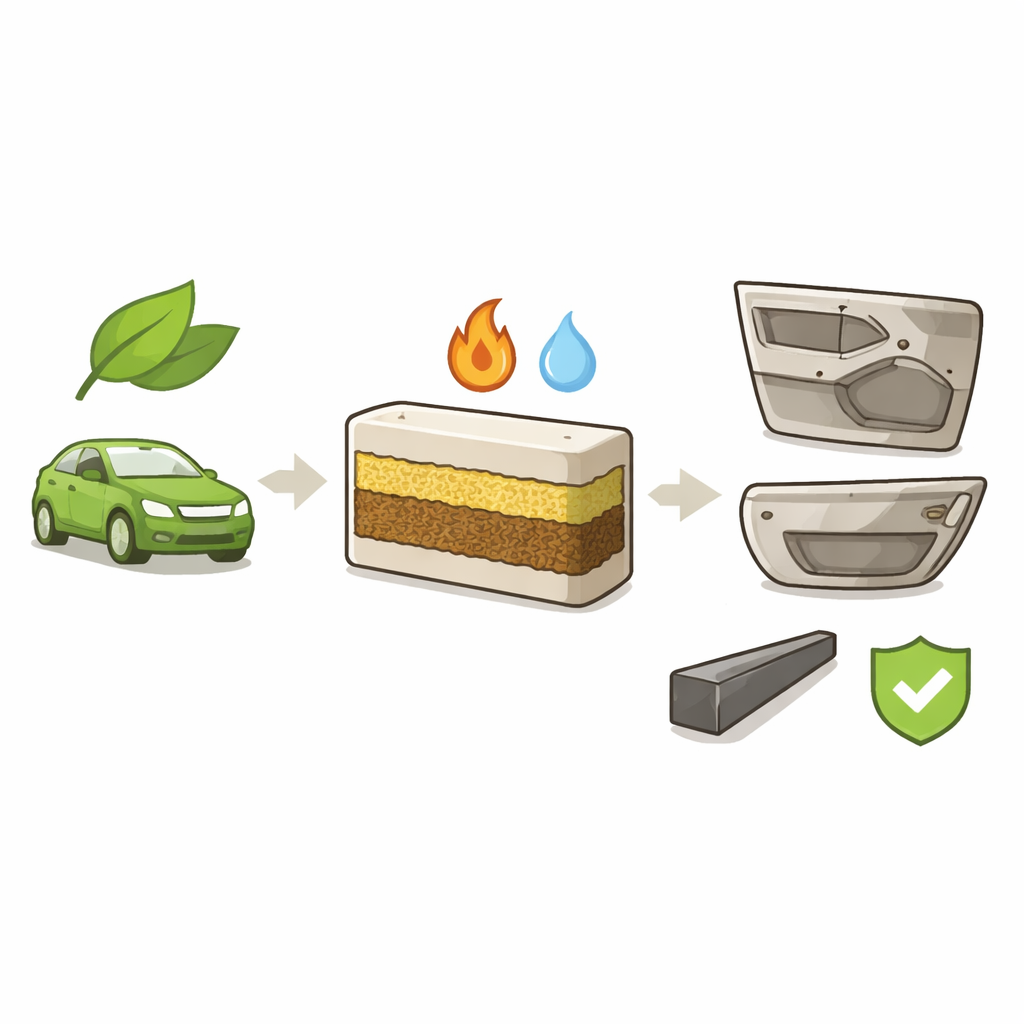
Car makers are under pressure to make vehicles lighter, safer, and more sustainable. One promising route is to replace petroleum‑based plastics and glass fibers with plant‑based materials that can cut weight and carbon footprint. This study explores an unusual pairing—fibers from banana plants and traditional Ugandan bark cloth—blended with epoxy resin and a fire‑retardant additive to create interior panels that are strong, resistant to flames, and less prone to soaking up water.
From Farm Waste to Interior Panels
The researchers focused on so‑called natural fiber composites, which mix plant fibers with a plastic binder to form stiff, lightweight sheets. Banana fibers, taken from the discarded stem of the banana plant, are known for good strength. Bark cloth, peeled and softened from the inner bark of fig trees, is naturally layered, porous, and somewhat fire‑resistant but less studied in engineering. In this work, both fibers were combined with an epoxy resin commonly used in structural parts, plus a small fixed amount of aluminium trihydrate, a halogen‑free fire‑retardant powder that cools and dilutes flames by releasing water vapor when heated.
How the Test Pieces Were Built and Measured
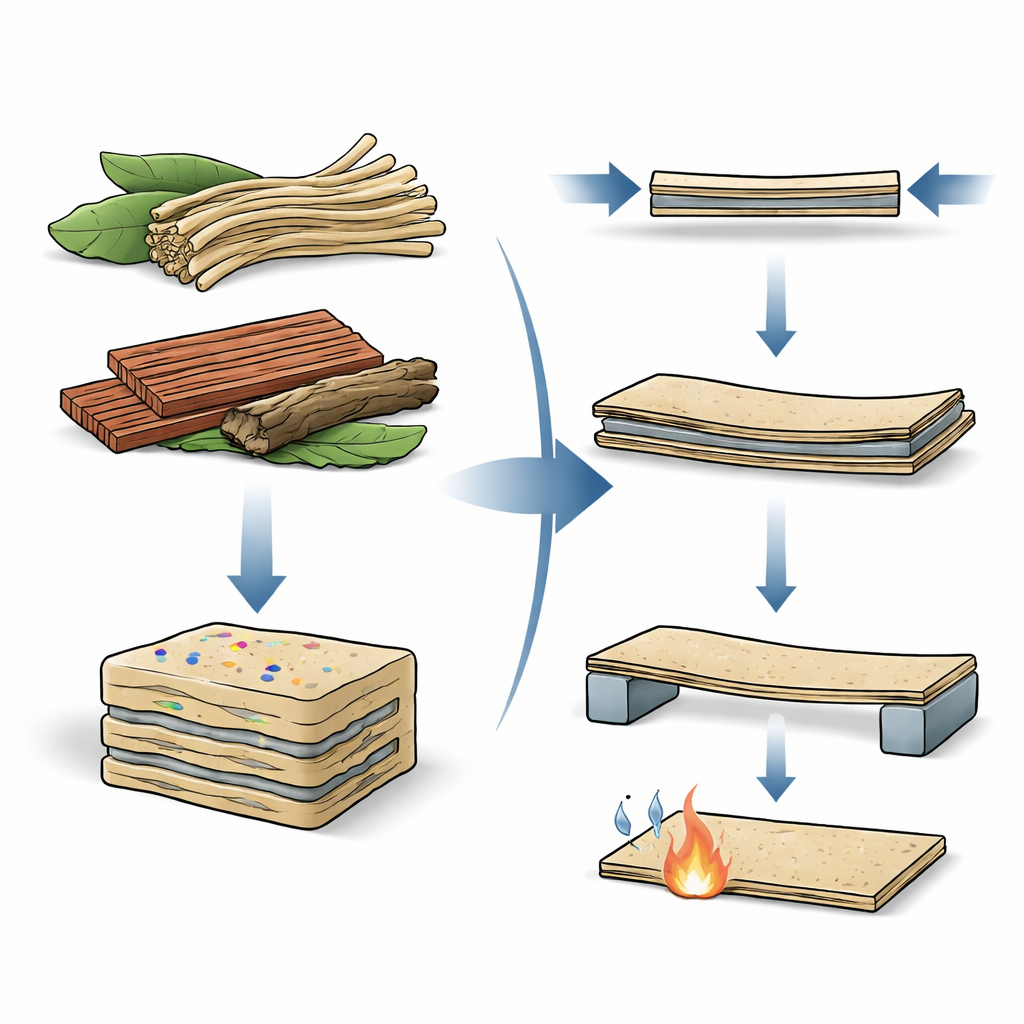
To make the composite plates, the team cleaned and dried the banana fibers and treated them with a mild alkali wash to roughen their surfaces and help them grip the resin. Bark cloth sheets were cleaned but kept chemically unchanged to preserve their natural flame and sound‑damping traits. The fibers were laid by hand into a shallow wooden mold in different stacking patterns and weight ratios, from bark‑heavy to banana‑only. Resin mixed with the fire‑retardant powder was rolled into each layer, and the whole stack was pressed and cured into 3‑millimeter‑thick laminates. Standard tests then pulled, bent, hit, burned, and soaked the samples to mimic the demands faced by door panels and seat backs over time.
Finding the Sweet Spot in Performance
Each recipe showed a different balance of properties. Banana‑rich samples generally carried higher loads when pulled or bent, thanks to the stiff, well‑bonded banana fibers acting as the main skeleton of the material. Bark‑rich samples, with their more open and crimped structure, were better at absorbing impact and tended to slow flame spread, but they sacrificed some stiffness and strength. Moisture tests revealed the downside of high banana content: more banana fiber meant more water uptake, which can slowly weaken a composite. To weigh all these trade‑offs at once, the authors used a ranking method called grey relational analysis, which turns multiple test results into a single score so that no single property dominates the decision.
The Winning Blend and What It Looks Like Inside
The best overall performer was a hybrid labeled C7, containing 40 percent banana fiber and 5 percent bark cloth by weight, with the rest epoxy and fire retardant. This mix delivered the highest tensile and flexural strengths, strong impact resistance, and an acceptable burning rate, along with only moderate water absorption. Under the microscope, C7 showed well‑wetted banana fibers tightly locked into the resin, with bark cloth fibers forming a more tangled network that helped blunt cracks and spread out impact energy. Chemical and elemental scans confirmed that the surface treatment, epoxy, and fire‑retardant particles were all well integrated throughout the material.
What This Means for Future Car Interiors
For a non‑specialist, the key takeaway is that carefully blended plant fibers can be tuned to give car interiors a useful mix of strength, fire safety, and durability while relying on low‑cost, locally available resources. The banana–bark cloth composite will not replace every synthetic material, but at the right recipe it offers a lighter, greener alternative for panels that do not bear extreme loads. With further work on long‑term aging and large‑scale production, this kind of hybrid could help shift everyday vehicles toward materials that are safer for passengers and kinder to the planet.
Citation: Turyahabwe, A., Dennison, M.S. & George, O.S. Investigation of multi-performance optimization of banana/bark cloth reinforced epoxy composites using grey relational analysis for automotive interior applications. Sci Rep 16, 14615 (2026). https://doi.org/10.1038/s41598-026-45783-9
Keywords: natural fiber composites, banana fiber, bark cloth, automotive interiors, flame retardant materials