Clear Sky Science · en
Phase behavior and reservoir fluid classification of the deep Permian Jiamuhe formation gas condensate in Zhongjia area, Junggar Basin
Why this deep gas story matters
Far beneath northwestern China, a little known rock layer is quietly storing huge volumes of natural gas and valuable light oil. This study explores how those underground fluids behave as wells start to drain them. For energy planners and engineers, getting this behavior right can mean the difference between tapping a major new resource and leaving much of it trapped in the rock.
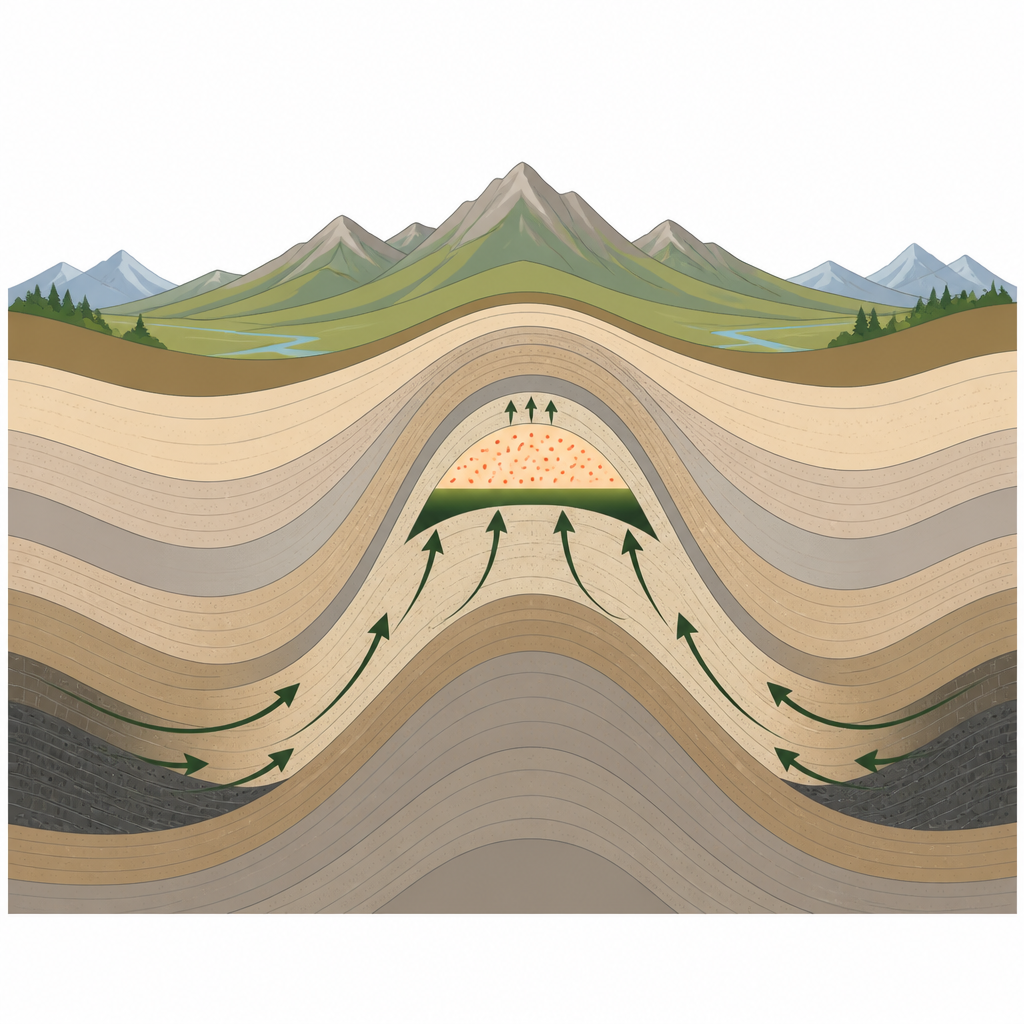
A hidden treasure under ancient rocks
The research focuses on the Jiamuhe Formation, a deep rock sequence more than four kilometers below the surface in the Junggar Basin. In a structural high called the Zhongguai Uplift, several wells have recently hit very productive zones, with one key well, ZJ14, flowing large volumes of gas and liquid hydrocarbons. The rocks there are tight, meaning their pores are small and poorly connected, yet natural fracturing and mineral dissolution have created "sweet spots" where fluids can move. Because the area is surrounded by multiple source regions that have generated oil and gas over long periods, the uplift has become a natural gathering point where different fluids mix and settle into complex vertical layers of gas and oil.
Gas that turns to liquid on the way out
Unlike familiar oil fields or dry gas fields, ZJ14 taps what is known as a gas condensate system. Under reservoir conditions, the fluid is mostly gas enriched in light molecules, with only a small share of heavier components. The authors used high-pressure, high-temperature laboratory tests to recreate the true underground conditions. They found an extremely high gas to oil ratio and measured the pressure at which droplets of liquid begin to form out of the gas. Above that threshold, the fluid behaves as a single gas phase; once pressure falls below it, droplets of condensate appear inside the rock, even though the wellhead may still produce both gas and liquid at the surface.
When pressure drops, trouble begins
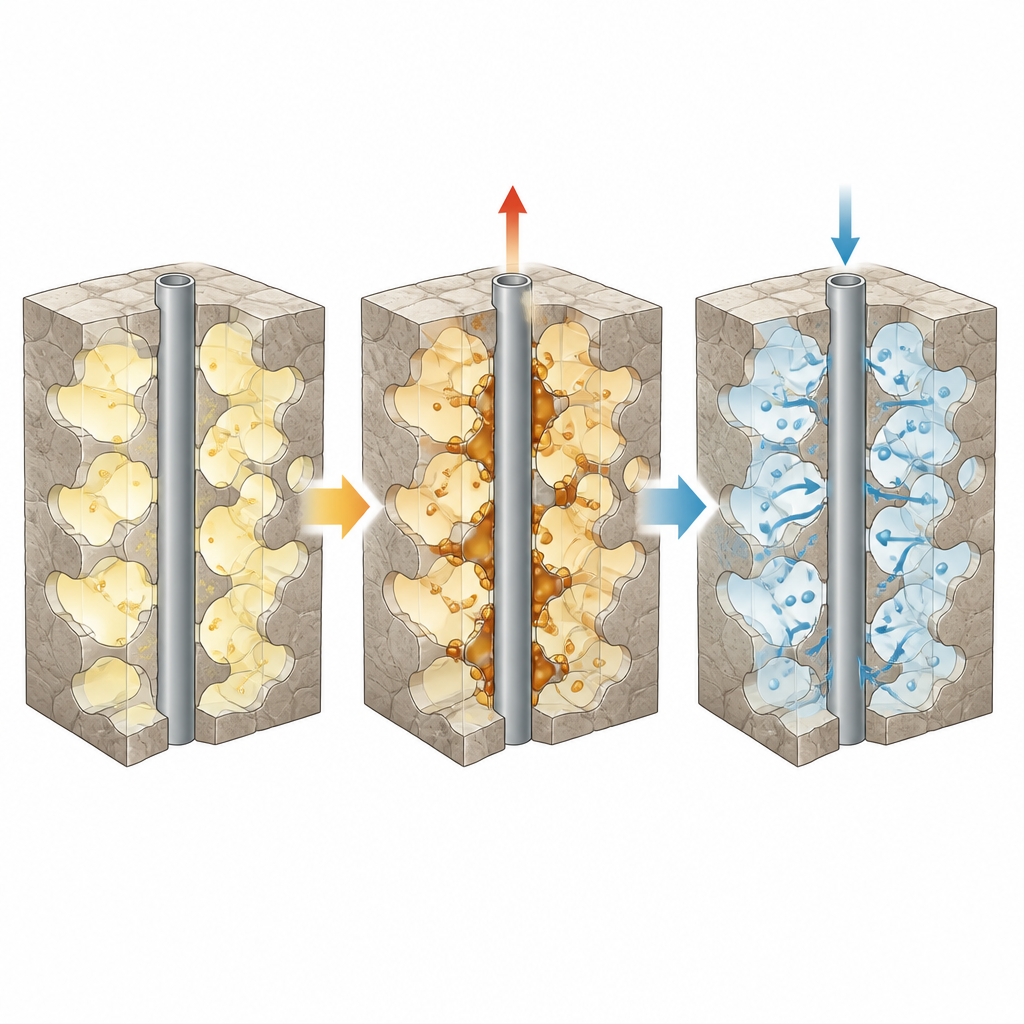
Detailed experiments that slowly lowered pressure showed how this change unfolds step by step. Just below the key pressure, only a small amount of liquid appears. As pressure continues to decline, more condensate drops out and gathers in the tiny passages between grains, especially near the well. This buildup can block flow paths and sharply cut gas productivity, a problem known as condensate banking. At still lower pressures, some of that liquid revaporizes, but by then damage to flow capacity may already be serious. The tests also showed that cooler temperatures make the problem worse, raising the pressure at which droplets appear and increasing the maximum amount of liquid that can clog the rock.
Proving there is an oil rich layer
To work out exactly what kind of reservoir they were dealing with, the team combined several lines of evidence. Chemical analysis of the gas stream showed that light components dominate, but with enough heavier molecules to classify the fluid as a rich gas condensate rather than a lean gas. Empirical formulas based on component ratios, as well as statistical plots, all pointed to a gas reservoir that includes an oil rim, a relatively thin oil rich zone beneath the main gas cap. Nuclear magnetic resonance logging, which senses how fluids respond to magnetic fields, backed this up by revealing a gas dominated upper interval and an oil dominated lower interval in the same formation.
How best to tap this deep resource
The authors conclude that the Jiamuhe Formation in the ZJ14 area is a condensate gas reservoir with an oil rim that sits close to the boundary between gas condensate and more oil like systems. That position makes it especially prone to condensate banking as pressure and temperature change during production. To protect flow capacity and recover both gas and liquids efficiently, the study recommends managing pressure carefully and using gas injection to keep pressure above the critical threshold or to wash out trapped liquids. In practical terms, that means thoughtfully spaced horizontal wells and early start of gas recycling, turning a tricky deep reservoir into a more controllable energy source.
Citation: Yang, F., Wang, F., Liu, H. et al. Phase behavior and reservoir fluid classification of the deep Permian Jiamuhe formation gas condensate in Zhongjia area, Junggar Basin. Sci Rep 16, 15551 (2026). https://doi.org/10.1038/s41598-026-45754-0
Keywords: gas condensate, Junggar Basin, reservoir fluids, retrograde condensation, gas injection