Clear Sky Science · en
Garcinia derived adsorbents for efficient ammonium removal from wastewater in fixed bed column systems
Why Cleaning Ammonium from Water Matters
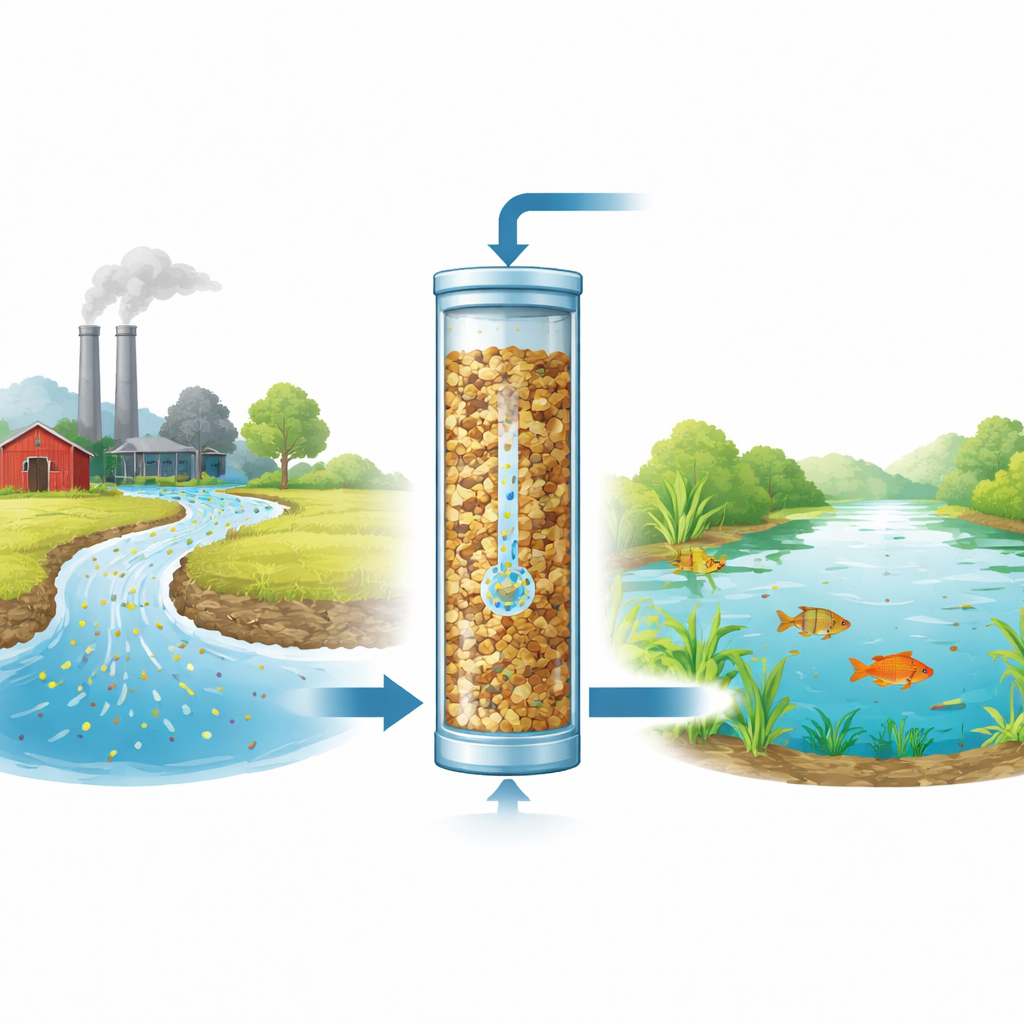
Across the world, rivers, lakes, and coastal waters are quietly being overloaded with ammonium, a form of nitrogen that leaks out of farm fields, factories, and sewage systems. When too much ammonium enters the water, it can trigger algal blooms, rob fish of oxygen, and disrupt fragile aquatic ecosystems. This study explores a simple but promising idea: using processed peel from a common tropical fruit, Garcinia cambogia, as a low-cost filter material to strip ammonium from polluted water as it flows through a column, much like water moving through a household filter.
Turning Fruit Waste into a Water Filter
The researchers start with the rind of Garcinia cambogia, a fruit already used in food and supplements. Instead of discarding the peel, they wash, dry, grind, and chemically treat it to create a porous solid that can grab dissolved substances from water. This treated plant material is packed into a glass column to form a fixed bed, through which ammonium-containing water is pumped at a controlled rate. Unlike simple batch tests where water and adsorbent just sit together in a beaker, this setup mimics the way real treatment plants operate: water flows continuously over a solid medium, and engineers must know how long the filter will work before it needs replacement.
Probing the Material at Multiple Scales
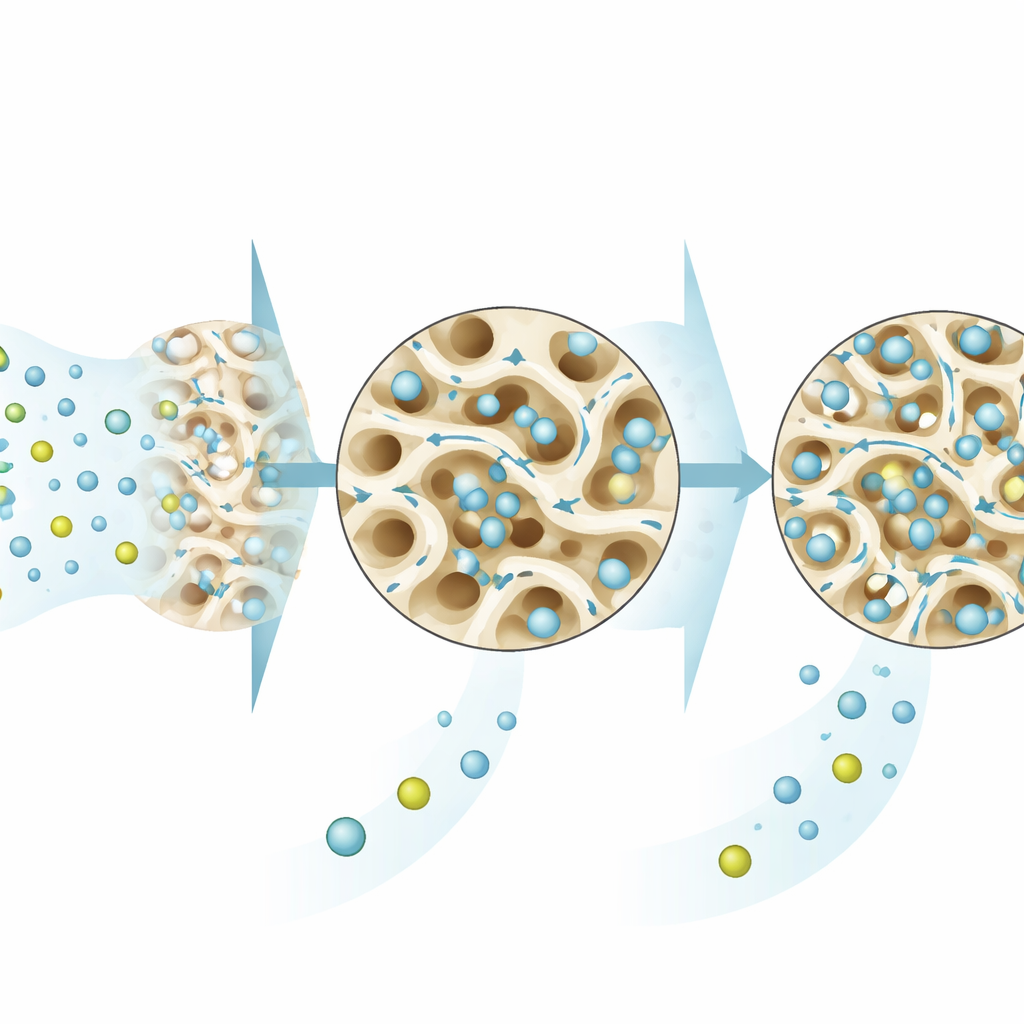
To understand why Garcinia works as a filter, the team uses several imaging and surface-analysis techniques. Infrared spectroscopy reveals that the material’s surface is rich in oxygen-based chemical groups, such as hydroxyl and carboxyl groups, which can carry negative charge in water and attract positively charged ammonium ions. Electron microscopes show a rough, channelled surface with many pores that offer pathways for water and dissolved ions to move inward. Measurements of surface area and pore volume confirm that, although the material does not have as much area as some commercial carbons, it offers enough porosity and reactive sites to act as a practical sorbent. Together, these tests suggest that ammonium is captured both on the outer surface and inside the pore network through electrostatic attraction and ion exchange.
How the Column Performs Under Different Conditions
The heart of the study is a series of column experiments where the researchers vary three key operating conditions: how fast the water flows, how much ammonium it contains, and how tall the packed bed of Garcinia material is. At lower flow rates, water spends more time in contact with the sorbent, so ammonium breakthrough is delayed and the column can treat more water before it becomes saturated. Higher flow rates, in contrast, rush water through too quickly, causing earlier breakthrough and lower effective capacity. When the incoming ammonium concentration is modest, the column removes it efficiently for a long period. At higher concentrations, the stronger driving force speeds up removal but also fills surface sites more rapidly, shortening the filter’s useful life. Increasing the bed height—using more Garcinia material in the same column diameter—gives the water a longer path and more active sites, extending the operating time and boosting the total amount of ammonium removed per gram of sorbent.
Using Mathematical Models to Predict Filter Lifetimes
To move from laboratory trials toward design rules for real systems, the team fits the experimental data with widely used column models, known as the Thomas and Yoon–Nelson equations. These models describe how the ratio of outlet to inlet concentration climbs over time and yield parameters that summarize how quickly the column approaches saturation and how much ammonium it can hold. Across a wide range of conditions, both models reproduce the measured "breakthrough curves" with high statistical agreement, although the Yoon–Nelson model gives a slightly better match in some cases. Additional analysis of the "mass transfer zone"—the region inside the bed where the actual removal is happening—shows how its length and shape depend on flow rate and bed height, offering further guidance for scaling up.
How Garcinia Stacks Up Against Other Materials
When the results are compared with other fixed-bed studies that use materials like biochar, zeolites, or mineral-based composites, the Garcinia sorbent holds its own. Its maximum working capacity for ammonium in continuous flow is similar to or better than many alternatives, even though its measured surface area is relatively modest. This suggests that the particular arrangement of pores and the abundance of reactive surface groups matter as much as raw surface area. The authors emphasize that they did not yet test how well the material can be regenerated and reused, so questions about long-term cost and performance remain. Still, as a plant-derived, readily available material, Garcinia shows strong promise as a sustainable option for polishing ammonium-laden wastewater, especially in smaller or decentralized treatment systems.
A Simple Idea with Practical Promise
In everyday terms, this work shows that processed fruit peel can act as an effective "sponge" for ammonium when water is passed through it in a filter-like column. By carefully measuring how flow rate, pollution level, and bed depth affect the time before the filter "breaks through," and by validating models that predict this behavior, the researchers provide engineers with tools to design practical systems. While more work is needed to test regeneration and real-world durability, Garcinia-based adsorbents emerge as a credible, bio-based component in future wastewater treatment schemes aimed at protecting rivers and lakes from nitrogen overload.
Citation: Soliman, M.S.S., Mubarak, M.F. & Hosny, R. Garcinia derived adsorbents for efficient ammonium removal from wastewater in fixed bed column systems. Sci Rep 16, 12585 (2026). https://doi.org/10.1038/s41598-026-45752-2
Keywords: ammonium removal, wastewater treatment, biosorbent, fixed-bed column, Garcinia cambogia