Clear Sky Science · en
Crystallographic snapshots of Trypanosoma cruzi aspartate transcarbamoylase including catalytic intermediates suggest an ordered Bi–Bi reaction mechanism
Why this parasite enzyme matters
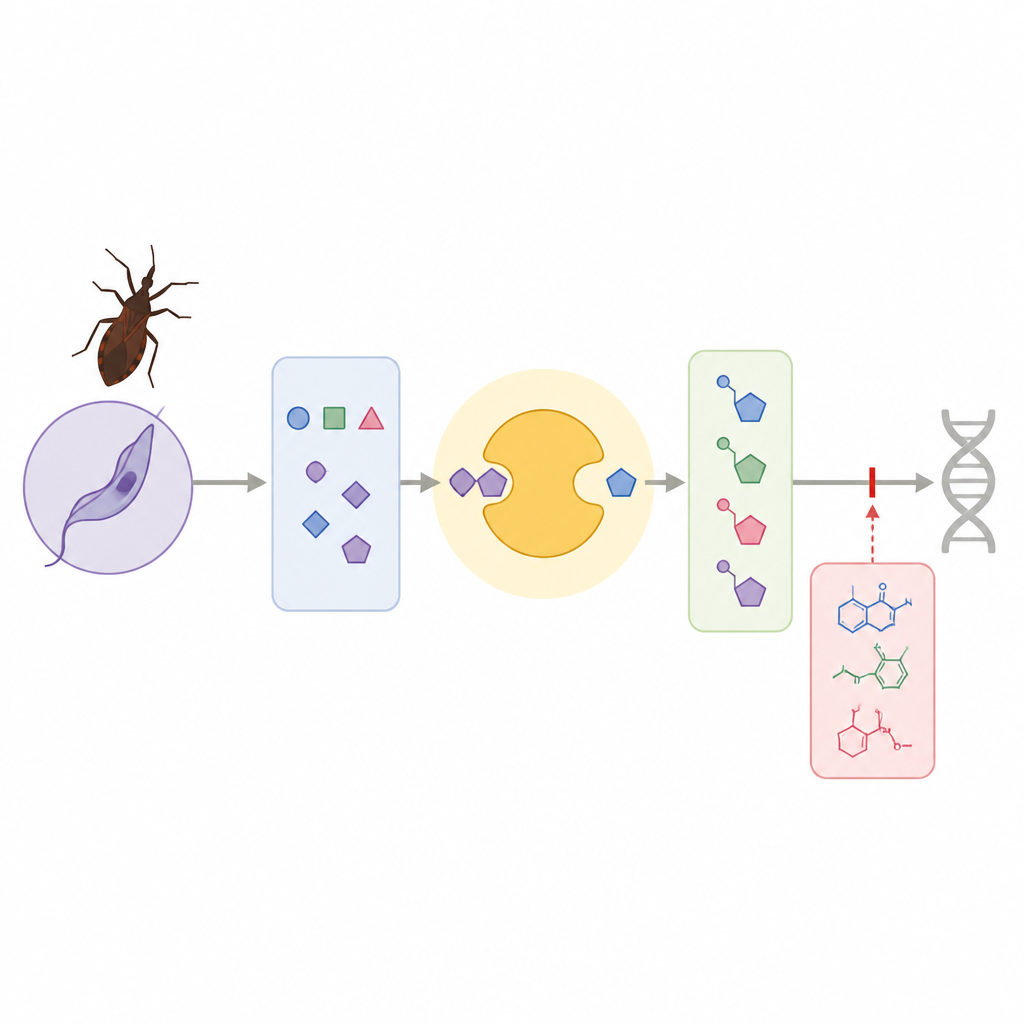
Chagas disease, spread by so called kissing bugs, affects millions of people, mostly in Latin America, and current drugs are often toxic and not very effective, especially in long lasting infections. The parasite that causes the disease, Trypanosoma cruzi, depends on a specific chemical assembly line to make the building blocks of its DNA and RNA. This study zooms in on one key enzyme in that line, capturing it in action at atomic detail, with the goal of opening new routes to safer, more precise treatments.
A fragile lifeline for the Chagas parasite
Unlike humans, which can recycle many of the components needed to build genetic material, T. cruzi lacks an important recycling step and must rely almost entirely on making these components from scratch. One of the early steps in this pathway is carried out by an enzyme called aspartate transcarbamoylase, or ATCase, which links two small molecules to form a larger precursor for the pyramidine bases in DNA and RNA. Because the parasite depends so heavily on this route, and because similar enzymes in humans are organized and controlled differently, ATCase has emerged as an attractive target for drug development.
Seeing the enzyme frozen in motion
The researchers used X ray crystallography to determine three dimensional structures of the T. cruzi ATCase at resolutions as fine as about two angstroms, roughly the width of a small atom. They grew crystals of the enzyme alone and then soaked them with various natural partners and with a known ATCase blocker called PALA. By carefully varying soaking times and temperatures, they were able to trap the enzyme in several distinct states: empty, bound to the first substrate, bound to both substrates, bound to the reaction products, and even bound to a reaction intermediate that usually exists only fleetingly.
A step by step chemical dance
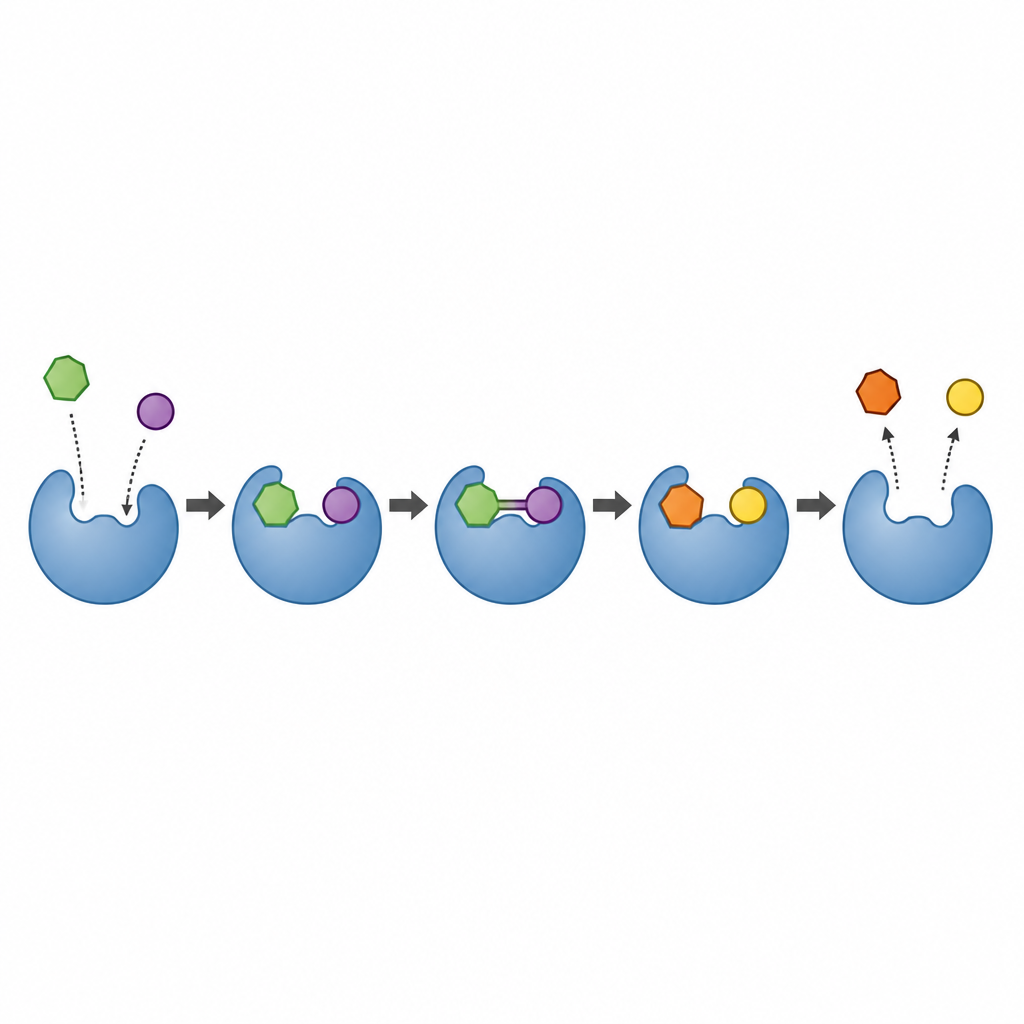
The snapshots reveal that the enzyme follows a very strict order in how it welcomes and releases molecules. First, carbamoyl phosphate binds to a positively charged pocket, which also triggers a local shift in two flexible loops that helps shape the active site. Only after this first partner is in place does the second, aspartate, bind in the neighboring pocket in a near attack position that is almost ready for bond making. Subtle shifts in a few key amino acids, including arginine, histidine, and lysine side chains, then stabilize a high energy, tetrahedral intermediate before it breaks apart into the product N carbamoyl aspartate and free phosphate. The structures also show that the product that contains the carbon backbone leaves before the phosphate does, completing what chemists call an ordered Bi Bi mechanism.
Why a standard drug fails here
The team also explored why PALA, a transition state mimic that powerfully blocks the same enzyme in bacteria and humans, barely affects the T. cruzi version. When they overlaid the structures, they found that spots that are neutral or slightly oily in the human and bacterial enzymes are replaced by negatively charged amino acids in the parasite enzyme. Because PALA itself carries several negative charges, it experiences electrostatic repulsion in this altered pocket, explaining its weak binding. This difference suggests that parasite selective drugs will need to exploit the unique charge pattern and subtle shape changes seen in the T. cruzi structure rather than simply copying existing PALA like compounds.
What this means for future treatments
Taken together, these structural snapshots provide the clearest view so far of how T. cruzi ATCase binds its partners, reshapes itself, forms a short lived intermediate, and releases its products in a strict sequence. For a lay reader, the key message is that scientists have watched a crucial parasite enzyme at work in such detail that they can now see precisely when and where a drug could best jam the machine. By designing molecules that either lock the enzyme in the pre reaction state, mimic the unstable intermediate, or freeze the loop movements triggered by binding, researchers hope to create new, more selective medicines against Chagas disease that spare the human counterpart of this enzyme.
Citation: Matoba, K., Nara, T., Aoki, T. et al. Crystallographic snapshots of Trypanosoma cruzi aspartate transcarbamoylase including catalytic intermediates suggest an ordered Bi–Bi reaction mechanism. Sci Rep 16, 15823 (2026). https://doi.org/10.1038/s41598-026-45751-3
Keywords: Chagas disease, Trypanosoma cruzi, aspartate transcarbamoylase, enzyme mechanism, structure based drug design