Clear Sky Science · en
Deep learning image generation technology for enhancing the presentation effect of image art based on artificial intelligence
Why smarter AI art matters
Digital tools that turn words into images are changing how we create pictures, posters, games, and even gallery artworks. Yet anyone who has tried them knows their limits: they can miss the mood of a reference painting, muddle brushstrokes, or blur details when you enlarge the image. This study introduces a new AI framework, called StyleDiffusion-HD, designed to give artists and designers finer control over look and feel while still producing large, crisp images suitable for professional use.
From idea and style to finished picture
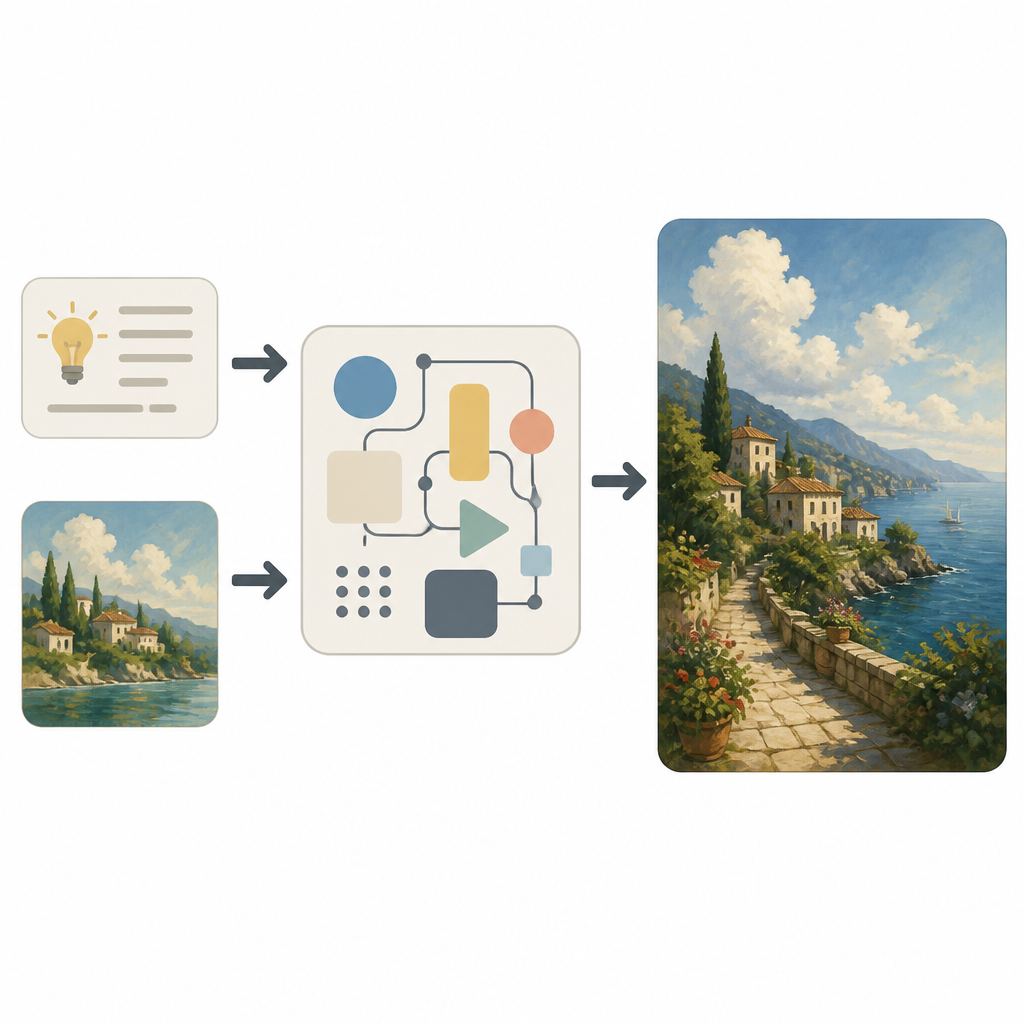
In human art, there is usually both an idea and a visual reference: what to paint and how to paint it. StyleDiffusion-HD copies this process by taking two inputs at once: a text description that spells out the scene, and a reference image that defines the artistic style. A vision-language model first translates both the words and the example artwork into a shared, abstract space where their meanings can be compared and combined. This fused "blueprint" guides the whole image-making process so that content and style are treated as partners rather than rivals.
Guiding every brushstroke in the image
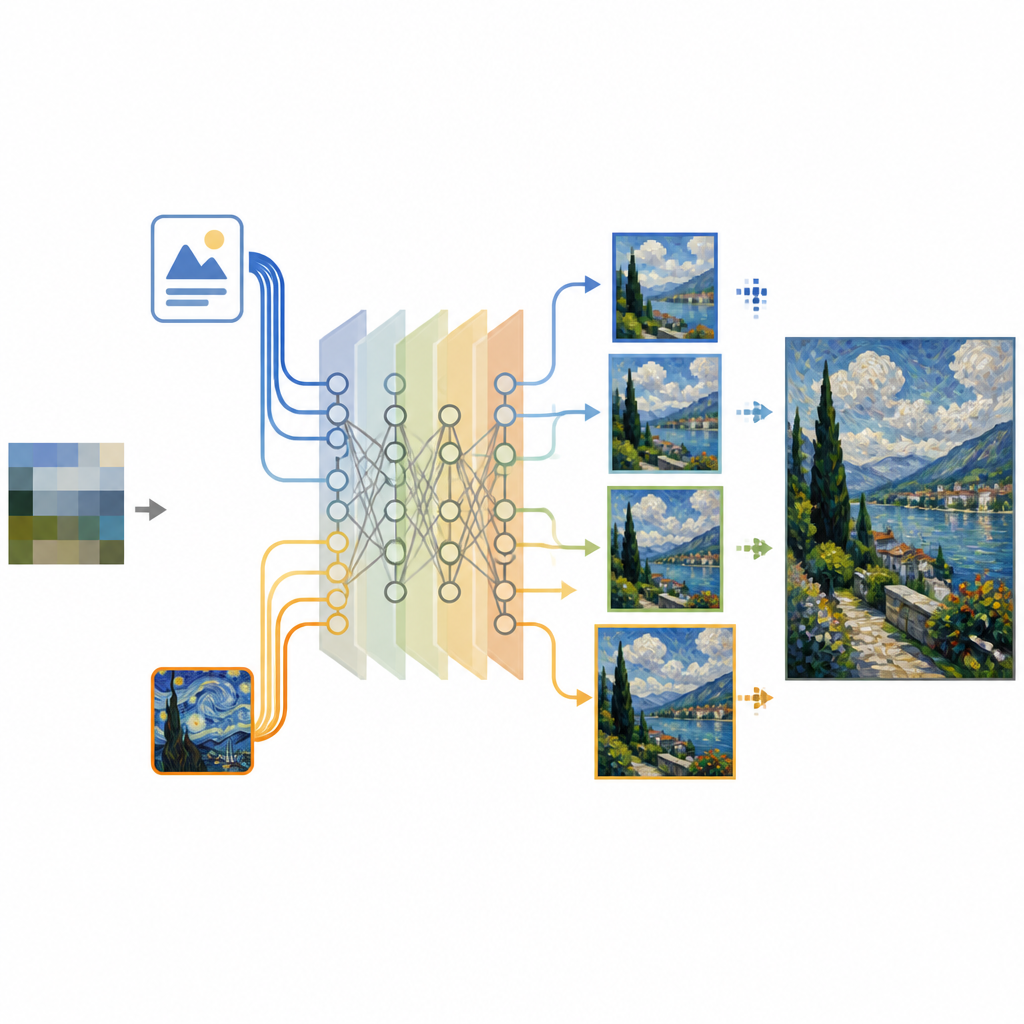
The heart of the system is a diffusion model, a type of deep network that gradually turns random noise into a coherent picture. The authors add a new module called Style Injection Attention that feeds the combined text-and-style blueprint into several layers of this network. Early in the process, the system leans more on the text to lock in the overall layout of the scene. Later, it increasingly follows the reference artwork, shaping colors, textures, and brushstroke-like patterns. Because this guidance is applied at multiple depths in the network, the final image tends to be consistent from global composition down to fine detail.
Sharpening images without losing character
Most AI art tools create medium-sized images that look good on a phone but fall apart when printed large. To tackle this, the team adds a second module that enlarges the image fourfold in each direction, from 512×512 up to 2048×2048 pixels. Instead of the usual step-by-step noise removal methods, they use a flow-based approach that learns a direct "path" from low-resolution to high-resolution images. This one-step process sharply enhances edges and textures while preserving the style it inherited from the diffusion model, avoiding the plastic or patchy look seen in many upscaling tools.
Putting the model to the test
The researchers do not rely on visual examples alone. They compare StyleDiffusion-HD against widely used systems, including Stable Diffusion and commercial tools, using three key measures: how natural the images look, how well they match the input text, and how closely they follow the style of the reference artwork. Across large test sets spanning dozens of art movements, the new framework produces images that are closer to real artworks, better aligned with prompts, and more faithful to style than the alternatives. Blind tests with professional artists, curators, and everyday viewers echo these findings, giving the new system the highest marks for style consistency, detail quality, and overall appeal.
What this means for creators
For non-specialists, the takeaway is that AI image tools are moving beyond clever toys toward more reliable creative partners. StyleDiffusion-HD shows that it is possible to combine clear control over content and style with print-ready resolution, making AI outputs more usable in illustration, exhibition, and design work. While the model still struggles with very abstract or heavily mixed styles and is costly to train, it outlines a practical path toward AI systems that respect both an artist’s idea and their chosen visual language, instead of sacrificing one for the other.
Citation: Gao, Y., Zhang, L. & Kim, J. Deep learning image generation technology for enhancing the presentation effect of image art based on artificial intelligence. Sci Rep 16, 14982 (2026). https://doi.org/10.1038/s41598-026-45739-z
Keywords: AI art generation, image style control, diffusion models, super resolution, digital illustration