Clear Sky Science · en
Gestalt laws enhance the representation of figures over backgrounds in the visual cortex and influence contrast perception
Why some shapes pop out from the crowd
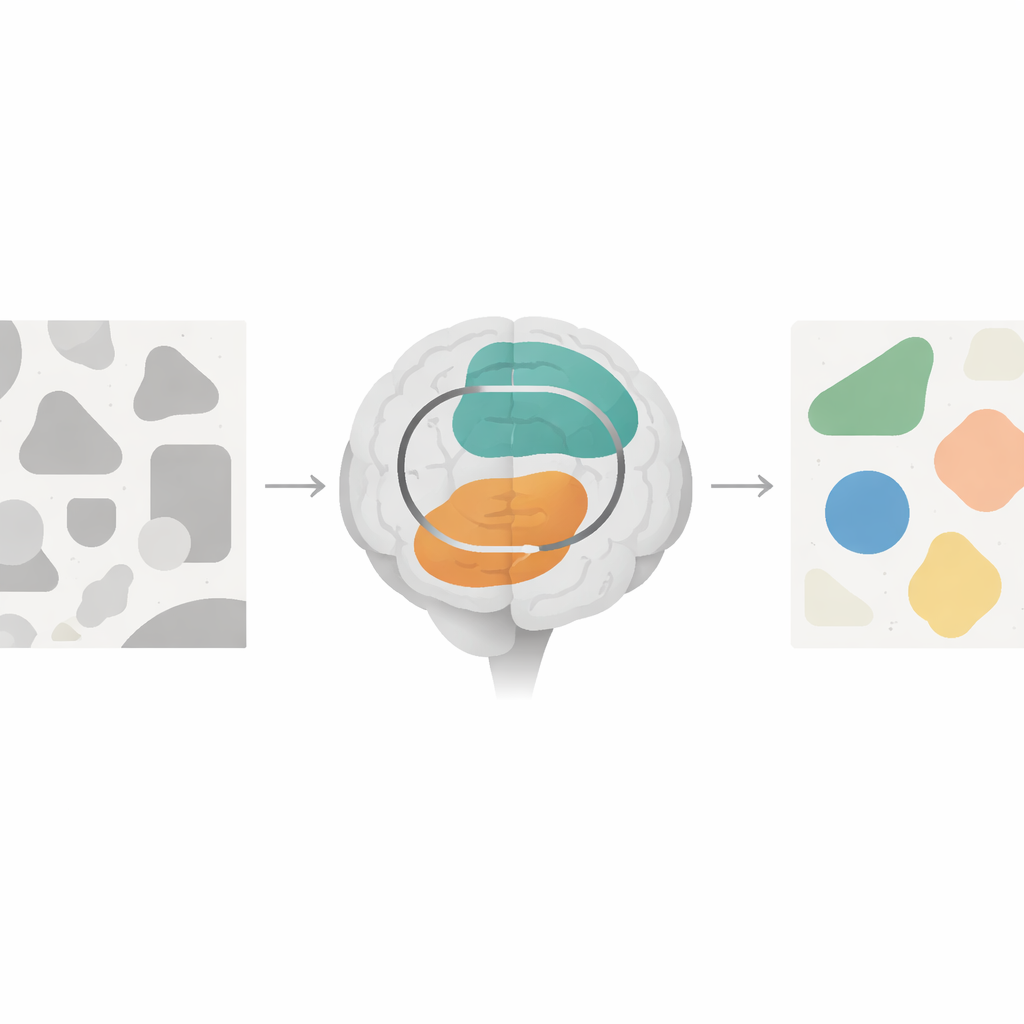
When you look at a busy scene, certain shapes instantly stand out as "things" while others recede into the background. A curved handle on a mug, a closed outline of a face, or a symmetrical leaf can feel like solid objects against a more formless backdrop. This study asks how simple shape hints—known as Gestalt cues—change both what we see and how early visual areas of the brain respond, in humans and monkeys.
The brain’s challenge of sorting objects from clutter
The visual system first breaks an image into many tiny pieces, with early brain areas responding only to local edges and textures. To understand the world, the brain must decide which patches belong together as objects and which form the background. Classic Gestalt psychology describes simple rules that bias this decision: regions that are small, enclosed, convex (bulging outward), or symmetric are more likely to be seen as figures than as ground. The authors focused on three such cues—closure, convexity, and symmetry—to test how they influence both perception and neural activity when figure and background are the same size and not relevant to the task at hand.
Testing which regions feel like “things”
The researchers built striped textures made of six side-by-side regions filled with angled lines. Some regions were designed to follow a Gestalt cue: closed shapes versus open ones, convex versus concave, symmetric versus asymmetric, or all three cues combined. Human volunteers fixated a point and reported whether the region directly below it looked like a figure or part of the background. Convex and closed regions were judged as figures much more often than chance, and especially so when all cues were combined. Symmetry, however, barely tipped the balance under these conditions, suggesting it was a relatively weak signal in this display setup.
When figures look higher in contrast
To avoid simply asking people about figure and ground—which can pull attention toward certain regions—the team used contrast judgments as an indirect probe. Participants compared which of two faint striped patches (Gabor elements) looked higher in contrast. One was placed on an ambiguous background strip; the other on a strip containing Gestalt-defined figures. On average, Gabors sitting on convex regions or on regions defined by all cues combined appeared slightly higher in contrast than those on background regions, even though their physical contrast was the same. Similar tests in macaque monkeys revealed the same general pattern for one animal, while another monkey showed the opposite bias. This inter-individual variability hinted that small differences in how the brain boosts figure regions could flip the perceived contrast advantage.
How early visual areas favor figure over background
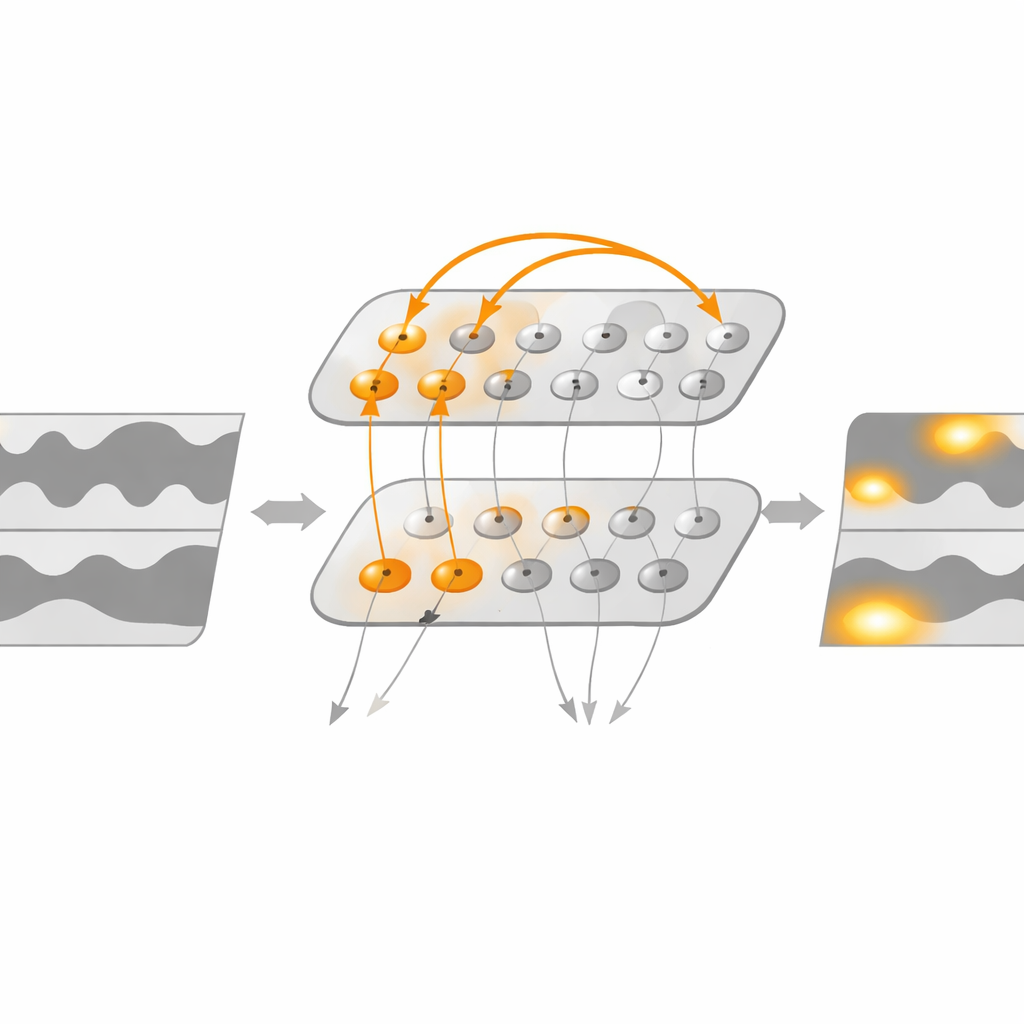
The authors next recorded neural activity from two visual brain areas in monkeys: V1, the first cortical stage of visual processing, and V4, a mid-level area important for shape. They presented the same textured strips while the animals performed a contrast task that did not require judging figure or background. Even though the local line patterns inside each region were the same for figure and ground, neurons in both V1 and V4 fired more strongly when their receptive fields landed on regions defined as figures by convexity or closure, and especially when all cues were combined. This effect, called figure–background modulation, was consistently stronger in V4 than in V1. For symmetry-defined regions, neural differences were small, mirroring the weak perceptual effect.
Linking neural boosts to what we see
The team also examined how responses to the contrast probe itself changed depending on whether it appeared on a figure or on the background. In V4, activity evoked by the probe was essentially added on top of the ongoing figure–background modulation. In the monkey who perceived Gabors on figures as higher contrast, neural responses to probes on figures were larger; in the monkey with the opposite perceptual bias, responses were smaller on figures. By fitting standard response curves for contrast, the researchers could predict these shifts in perceived contrast from the neural data alone, suggesting that modest, context-dependent changes in firing are enough to tilt conscious appearance.
What this means for everyday vision
These results support the idea that higher visual areas like V4 detect object-like shapes using Gestalt cues such as convexity and closure, then send feedback to earlier areas like V1 to sharpen where figures end and backgrounds begin. Even when you are not trying to judge figure and ground, this feedback quietly enhances neural responses to figural regions and can make them look slightly higher in contrast. In essence, the brain’s built-in rules for what “looks like an object” do not just help group image parts together; they literally change the strength of the signals that reach awareness.
Citation: van Ham, A.F., Jeurissen, D., Self, M.W. et al. Gestalt laws enhance the representation of figures over backgrounds in the visual cortex and influence contrast perception. Sci Rep 16, 11685 (2026). https://doi.org/10.1038/s41598-026-45730-8
Keywords: Gestalt perception, figure-ground, visual cortex, contrast perception, neural feedback