Clear Sky Science · en
In-situ magnetic field-controlled synthesis of SnO2-SnO nanoparticle films for enhanced photovoltaic self-cleaning and anti-soiling
Keeping Solar Panels Working Their Best
Solar panels promise clean power, but in the real world their glass surfaces lose efficiency as dust, mud, and simple reflections send valuable sunlight away. This study explores a new, fast way to add an ultra-thin coating to solar glass so that panels both reflect less light and clean themselves whenever it rains or is washed, helping them deliver more electricity with less maintenance.
Why Dirty Glass Costs Us Sunlight
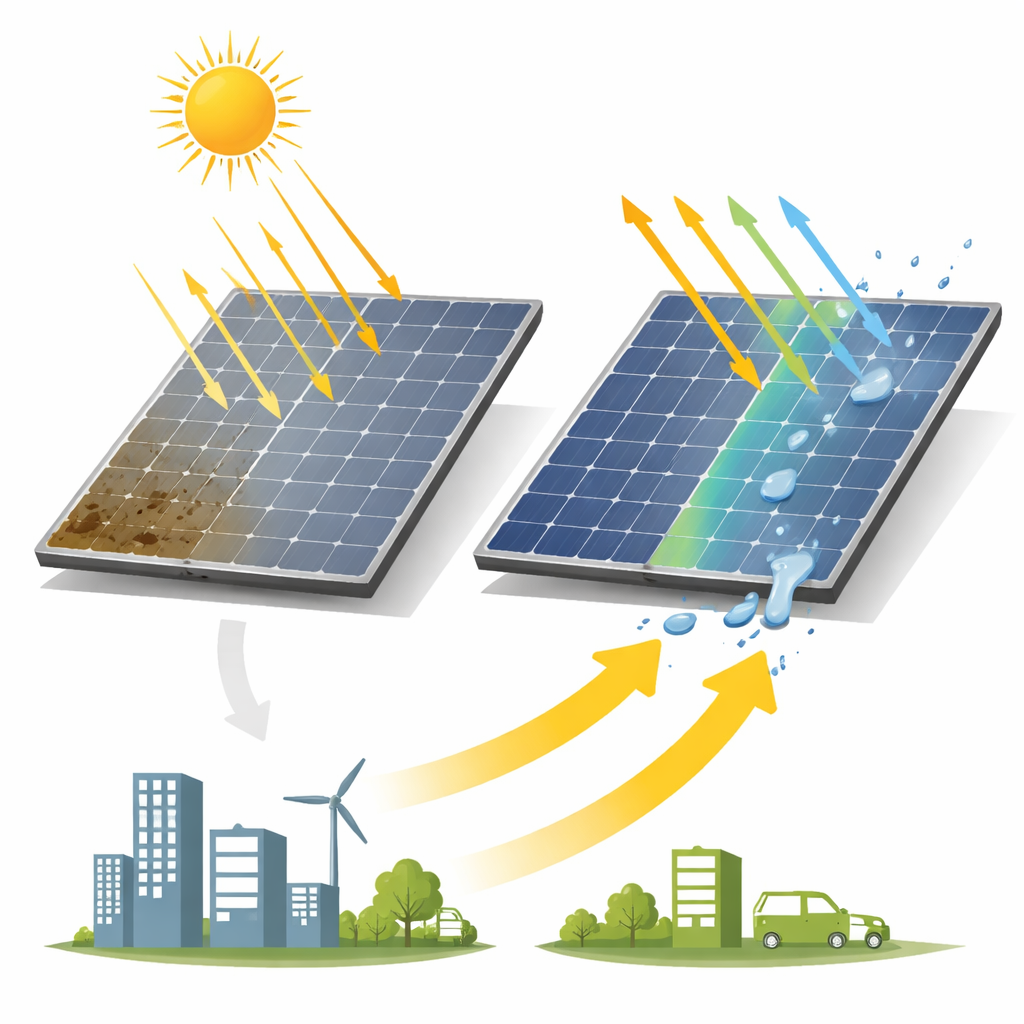
Modern solar farms are often built in dry, dusty regions where sunlight is abundant. Over time, tiny particles and oily residues from pollution build up on the glass, blocking light and forcing operators to clean panels frequently with water and labor. Even on well-maintained systems, this “soiling” can quietly remove several percent of the power a solar array should produce, and in harsh desert conditions the loss can exceed 15%. On top of that, every bare sheet of glass reflects a portion of incoming light back into the sky before it ever reaches the solar cells. The combination of reflection and dirt steadily erodes the real-world payoff of solar installations.
A Faster Way to Make Smart Glass
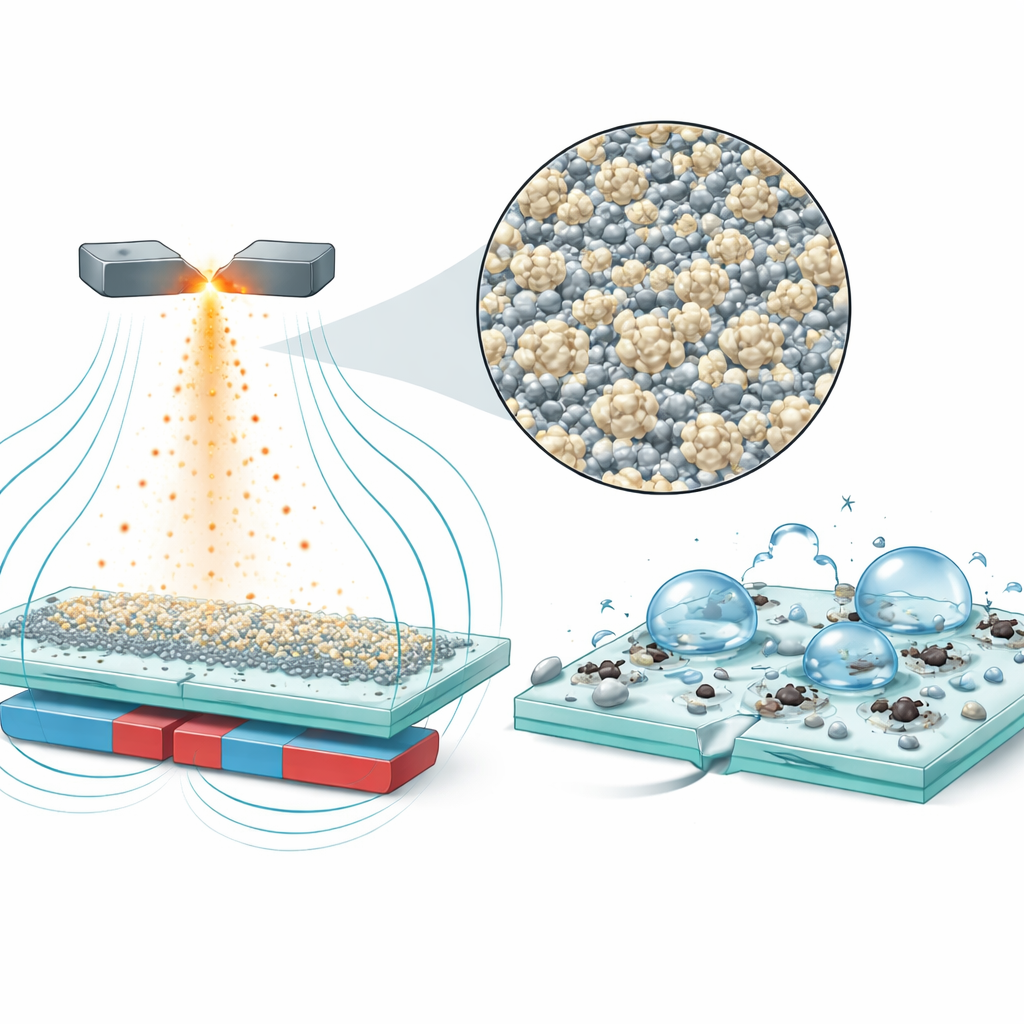
The researchers tackle this problem by developing a dry, one-step process to coat solar glass with a film made from tin-based nanoparticles. They use a technique called spark ablation: short, high-voltage sparks between metal wires vaporize tiny amounts of metal, which then cool in air to form nanoparticles that land on the glass below. Traditionally, titanium dioxide has been the go-to material for self-cleaning surfaces, but it is slow to evaporate in sparks, making large-scale coating inefficient. Tin, by contrast, melts and vaporizes more easily, allowing tin oxide particles to form and cover glass much more rapidly. The team further boosts the process by placing permanent magnets beneath the glass, shaping the hot plasma and charged particles so that more of them are steered onto the surface.
Building a Dual-Phase Nanoparticle Skin
Using X-ray and electron microscopy tools, the authors find that the magnetic field does more than just speed up coating. It also subtly changes how the tin atoms cool and react with oxygen, leading to a mixed layer containing two closely related forms of tin oxide. At the nanoscale, this coating looks like a tightly connected network of particles with slightly different colors and structures interwoven. This “two-phase” arrangement helps separate electric charges created when sunlight hits the surface, making it easier to generate highly reactive oxygen species. These reactive molecules can slowly break down oily and organic grime that normal rinsing leaves behind, turning stubborn films into easier-to-remove residues.
From Lab Film to Tough, Self-Cleaning Glass
The coated glass shows several practical benefits that matter directly for solar panels. First, it becomes superhydrophilic: water droplets no longer bead up but instead spread into thin sheets that quickly wash across the surface, carrying dust and particles away. Second, the nanoparticle layer slightly reduces reflection and even raises the amount of visible light transmitted through the glass. In tests, solar modules treated with the optimized coating produced about 4% more power than uncoated panels under clean conditions. When the team sprayed panels with muddy water and let them dry, the coated modules lost less power and recovered more quickly, ending up with a net 6% performance gain compared to bare glass. Durability tests, involving up to 10,000 high-speed water impacts, showed that the nanoparticle network stayed firmly attached and kept its wetting behavior.
What This Means for Everyday Solar Power
To a non-specialist, the key outcome is that the researchers have devised a rapid, solvent-free way to give solar panels a “smart skin” that both captures more light and helps the panels clean themselves. By switching from titanium to tin and steering the sparks with magnets, they increased coating speed more than fivefold while preserving strong self-cleaning action. The resulting tin-oxide films slightly brighten glass, shed mud and dust more easily, and remain tough under repeated water impact. If scaled up, this approach could lower cleaning costs and boost the long-term energy yield of solar farms, making solar electricity a bit more reliable and affordable without changing the panels themselves.
Citation: Jhuntama, N., Kumpika, T., Intaniwet, A. et al. In-situ magnetic field-controlled synthesis of SnO2-SnO nanoparticle films for enhanced photovoltaic self-cleaning and anti-soiling. Sci Rep 16, 10741 (2026). https://doi.org/10.1038/s41598-026-45717-5
Keywords: solar panels, self-cleaning coatings, tin oxide nanoparticles, anti-soiling surfaces, spark ablation