Clear Sky Science · en
Single-step bioconversion of cow rumen-based agroindustrial waste to bioethanol via enzyme-assisted processes
Turning Slaughterhouse Leftovers into Clean Fuel
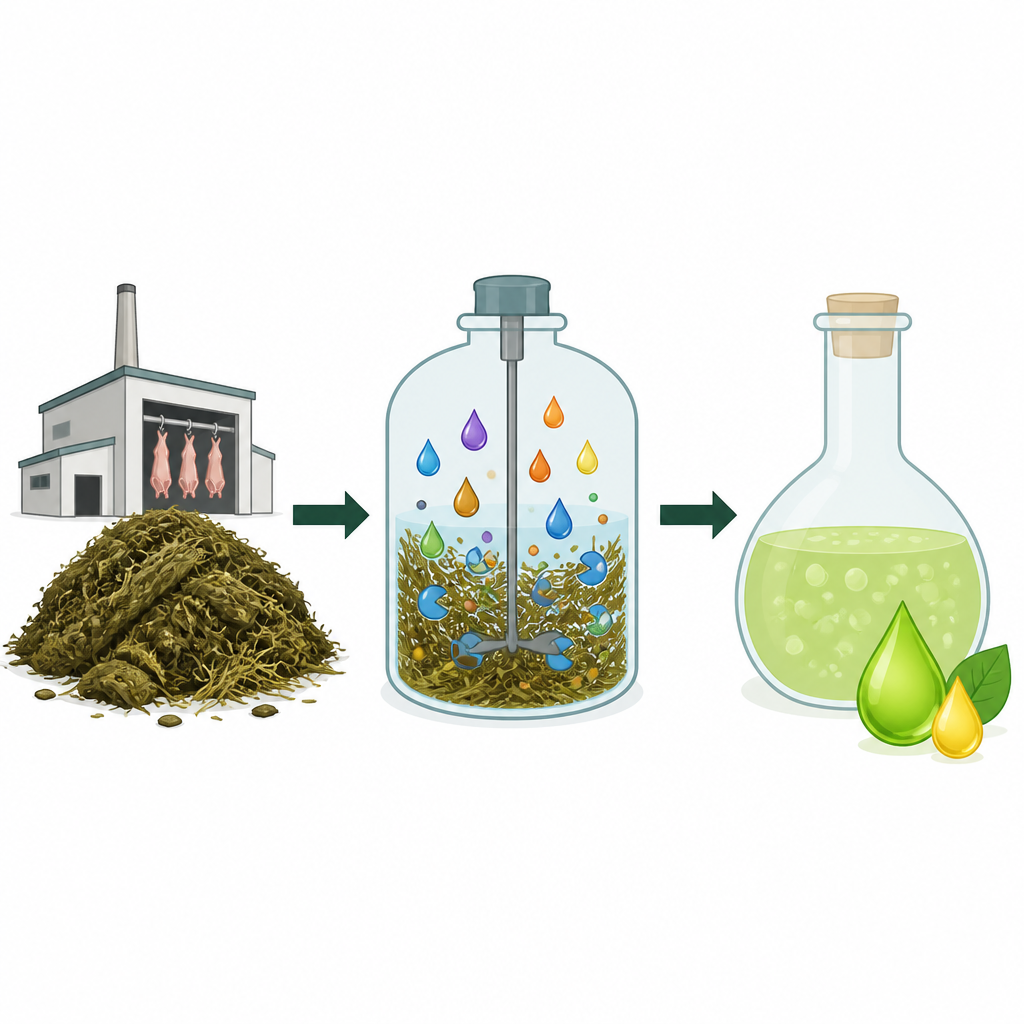
Cow stomach contents are usually seen as an unpleasant waste from slaughterhouses, but this material is actually packed with plant fibers that once grew in fields under the sun. This study shows how those leftovers can be transformed directly into bioethanol, a cleaner-burning fuel for cars and industry, using a gentle process built around natural enzymes and yeast instead of harsh chemicals.
Why Rumen Waste Matters
Today most fuel ethanol comes from crops like corn and sugarcane, which can compete with food production and demand large areas of farmland. The fibrous material in a cow’s largest stomach, called rumen waste, is different. It is made of partly digested grasses and feed that would otherwise be discarded. The authors highlight that this waste stream is produced in huge amounts at slaughterhouses and already has a structure that makes it easier to break down than raw crop residues, turning a disposal problem into a potential source of renewable energy.
Finding the Sweet Spot in the Fibers
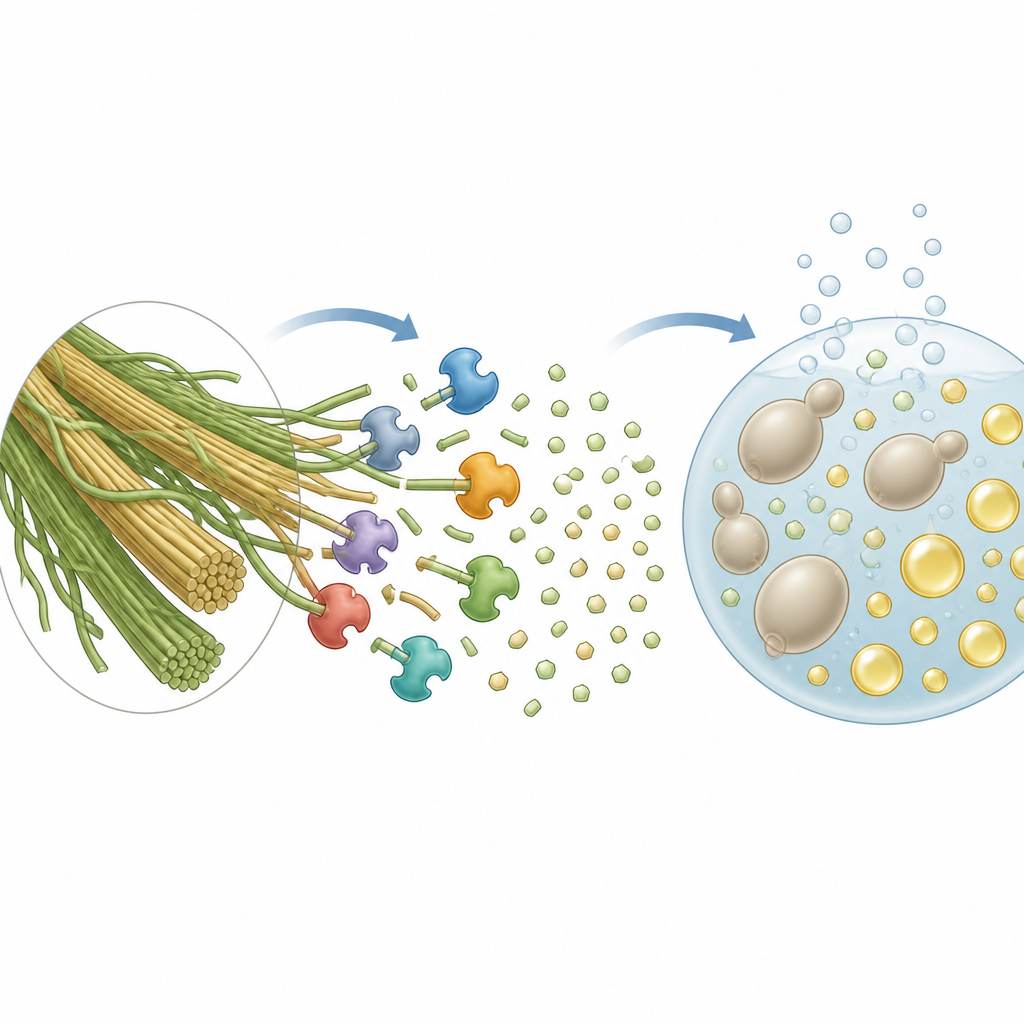
The team first collected rumen waste from a local slaughterhouse, washed, dried, and ground it to a uniform powder. They analyzed its composition and found it rich in cellulose and related plant fibers that can be turned into simple sugars. Instead of blasting this material with acids or high heat, they used a commercial enzyme blend tailored to fibrous plant matter. By carefully adjusting enzyme dosage, the amount of rumen waste in water, and the acidity of the mixture, they identified conditions that released the most sugar: a moderate enzyme level, a mid-range amount of solid material, and slightly acidic conditions. These settings balanced effective breakdown with practical issues like thickness of the mixture and enzyme cost.
Helping Yeast Turn Sugar into Fuel
Once the enzymes had freed sugars from the rumen fibers, the researchers added a familiar workhorse of baking and brewing: the yeast Saccharomyces cerevisiae. They tested how much yeast to add, as well as the best temperature and acidity, to turn sugar into ethanol. With a modest yeast dose at a temperature similar to a warm room and mildly acidic conditions, the yeast consumed nearly all of the sugar and produced measurable levels of ethanol. The study reports that higher yeast amounts and a temperature around 35 degrees Celsius gave the best combination of ethanol concentration and efficient use of sugar.
A Simpler One-Pot Approach
Compared with many existing methods for making ethanol from tough plant materials, the authors’ process is notably simple. It avoids strong acids, bases, or lengthy pre-treatment steps and does not need live rumen microbes. Instead, it uses a short warm-up period, a controlled enzyme treatment, and then fermentation, all under gentle conditions. Tests showed that this streamlined sequence still achieves competitive sugar release and ethanol production, while cutting down on energy use, corrosion risk, and unwanted byproducts that can hinder yeast.
What This Means for Future Energy
In plain terms, the study demonstrates that what comes out of a cow’s stomach at the slaughterhouse can be turned into useful fuel using tools very similar to those found in a brewery, only tuned to handle fibrous waste. Although the ethanol levels achieved so far are suitable mainly for laboratory-scale work, the approach shows that a cleaner, low-cost route is possible. With further improvements and scaling, this method could help slaughterhouses and nearby communities turn a messy waste into a local source of renewable bioethanol, contributing to a more circular economy where less is thrown away and more is reused as energy.
Citation: Bahlawan, Z.A.S., Megawati, Desiriani, R. et al. Single-step bioconversion of cow rumen-based agroindustrial waste to bioethanol via enzyme-assisted processes. Sci Rep 16, 15073 (2026). https://doi.org/10.1038/s41598-026-45706-8
Keywords: bioethanol, cow rumen waste, lignocellulosic biomass, enzymatic hydrolysis, renewable energy