Clear Sky Science · en
Euler simulation of hydrocyclone pre-separation before oily wastewater membrane treatment based on Population balance model
Cleaning up dirty water from oil fields
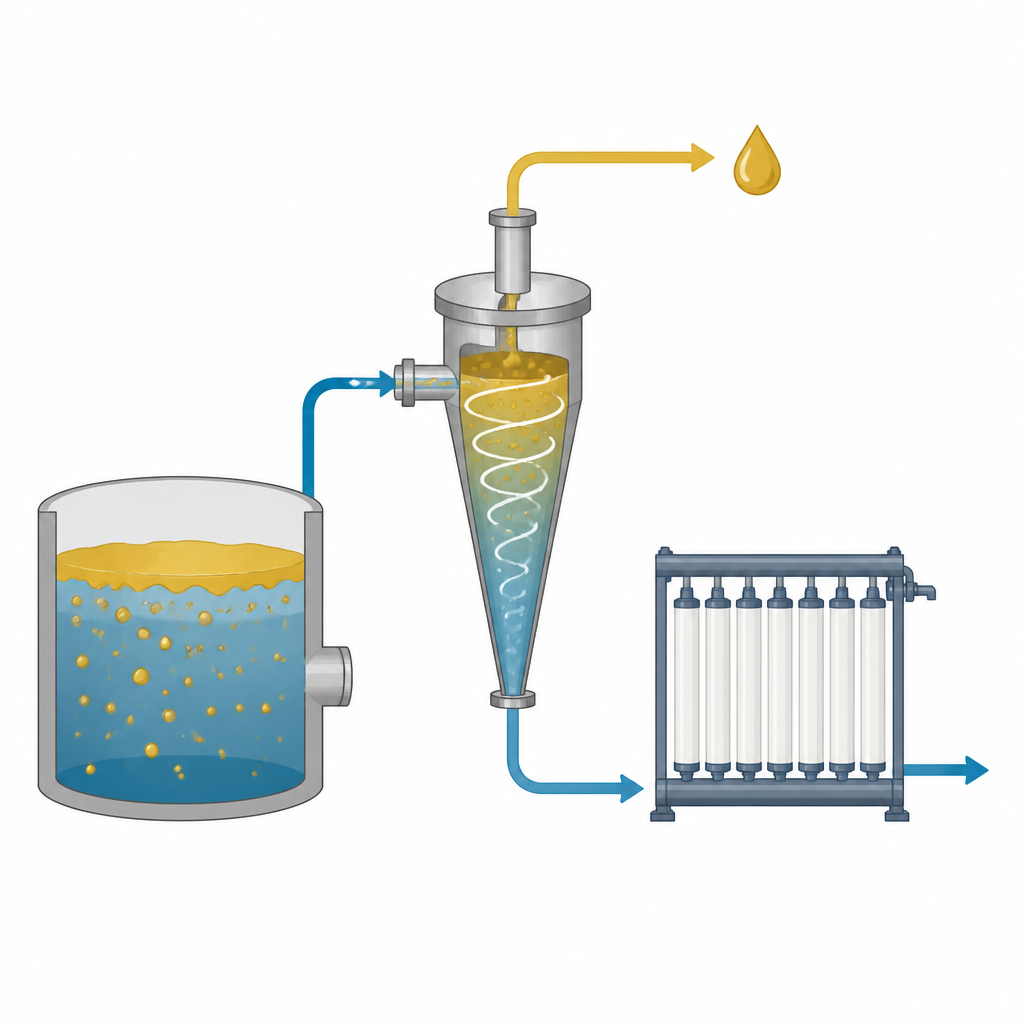
Oil production creates huge volumes of wastewater that still carry tiny droplets of oil. Before this water can be reused or safely released, the oil must be removed. The study behind this article explores how to use a spinning device called a hydrocyclone to strip out much of the oil before the water is polished by fine filters, helping protect the filters from clogging and cutting treatment costs.
Why spinning water helps separate oil
Oil and water naturally separate if left alone, but in oilfields the mixture is often stabilized by chemicals and broken into very small droplets, so gravity works too slowly. A hydrocyclone speeds up the job by forcing the oily water to swirl at high speed inside a cone shaped chamber. Heavier water is flung outward toward the wall and leaves from one outlet, while lighter oil gathers near the center and exits from another. This work looks at how well such a device can perform as a first clean up step before the water enters delicate membrane filters.
Using computer models to see inside the swirl
Because it is nearly impossible to measure every detail of the fast, chaotic flow inside a hydrocyclone, the researchers relied on advanced computer simulations. They modeled a single inlet, single cone hydrocyclone treating wastewater with oil contents between 10 and 30 percent and inlet speeds between 5 and 20 meters per second. The model did not just track the flow of water and oil; it also followed how oil droplets collide, merge into larger drops, or break into smaller ones. By combining fluid mechanics with a population balance for droplet sizes, the team could predict both the paths and the size distribution of the oil droplets as they moved through the device.
How flow speed and oil content change the outcome
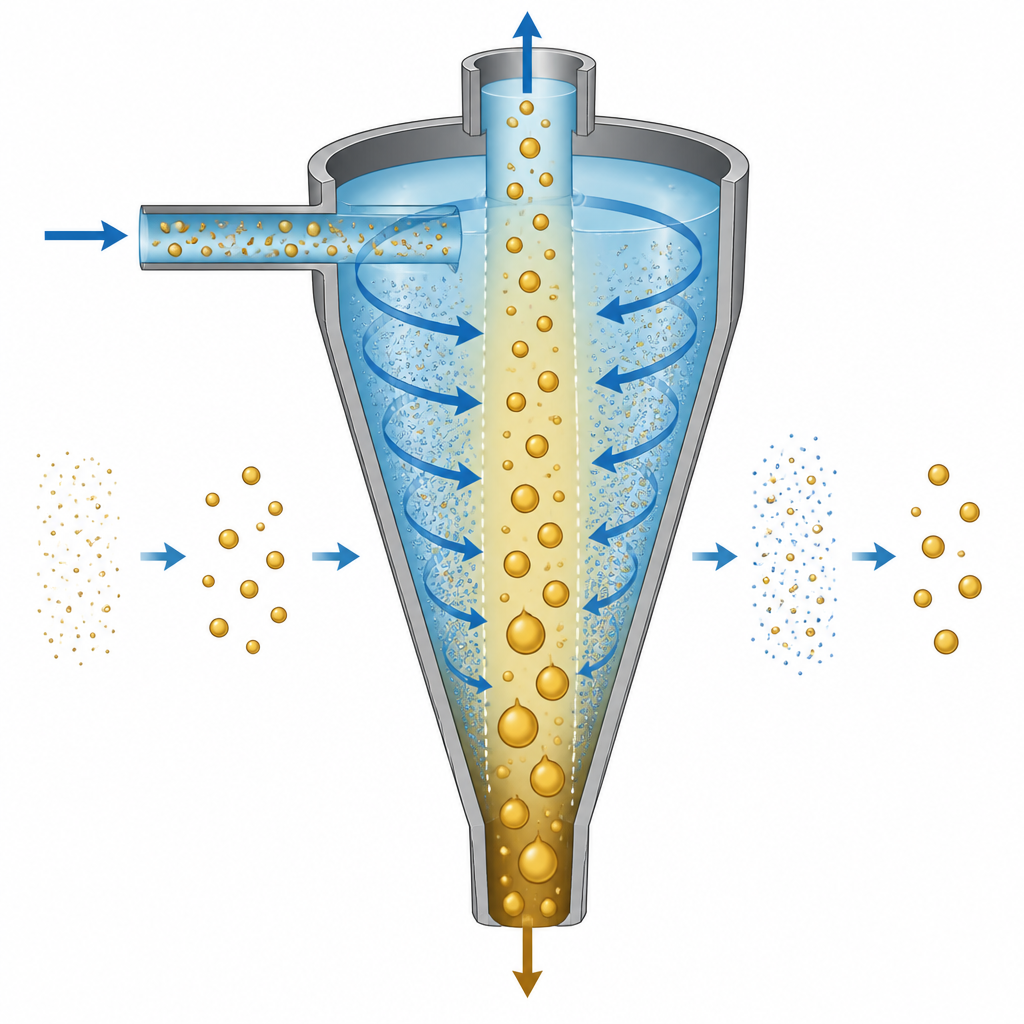
The simulations show that the pattern of motion inside the hydrocyclone is strongly shaped by the inlet speed, the amount of oil, and structural details such as the cone angle and the depth of the overflow pipe. At low to medium speeds, between 5 and 15 meters per second, the spinning motion creates a strong centrifugal field that drives oil toward the central core. In this regime, droplets tend to bump into each other and merge, so the average droplet size grows and the oil stream is cleanly directed to the top outlet. The water leaving from the lower outlet carries only a small fraction of the oil.
When faster is not always better
As the inlet speed is pushed up to 20 meters per second, the picture changes. The stronger swirl raises the pressure difference and in principle could move droplets more effectively, but it also increases the shear forces that tear droplets apart. The model predicts that many droplets then break into smaller ones, some of which are carried off course and leave with the bottom water stream. At the same time, raising the overall oil content thickens the fluid, which helps droplets find each other and merge but also slows their sideways motion. This longer residence time inside the device raises the chance of both helpful merging and harmful breakup, and causes the oil content at the top outlet to fluctuate more.
What this means for cleaner water and sturdier filters
By examining droplet paths and sizes in detail, the study clarifies how a hydrocyclone can act as a smart pre filter for oily wastewater. Under well chosen operating conditions and with suitable geometry, the device can intercept most droplets larger than about 80 micrometers and even coax some smaller ones to merge into drops in the 140 to 170 micrometer range. Sending this pre cleaned water to membrane filters greatly reduces the risk that large droplets will cake on the surface or that very small droplets will lodge inside the pores. In practical terms, tuning the inlet speed and handling mixtures with moderate oil content allows operators to strike a balance between strong separation and gentle treatment of droplets, leading to more reliable, efficient cleanup of water from oil production.
Citation: Shuai, Z., Liqiu, X., Laiyuan, D. et al. Euler simulation of hydrocyclone pre-separation before oily wastewater membrane treatment based on Population balance model. Sci Rep 16, 14853 (2026). https://doi.org/10.1038/s41598-026-45695-8
Keywords: oily wastewater, hydrocyclone, oil water separation, membrane fouling, droplet coalescence