Clear Sky Science · en
Molecular epidemiology and structural diversity of O101/O162 O-antigen variants among Escherichia coli bacteremia isolates
Why this study matters for everyday health
Escherichia coli is often known as a cause of food poisoning, but some types invade the bloodstream and can be life threatening, especially when they no longer respond to many antibiotics. This study looks closely at one such group of E. coli that shares a particular sugar coating on its surface. By tracing how common these strains are around the world and how their outer layer changes, the researchers explore why they are so often drug resistant and what this means for future vaccines and treatments. 
Global spread of a troublesome E. coli group
The team examined more than 7,400 E. coli isolates taken from adult patients with bloodstream infections in hospitals across 30 countries between 2011 and 2023. They focused on strains with a shared outer sugar signature called the O101/O162 O-serogroup. Although this group made up only about 2.6 percent of all blood isolates, it appeared in most regions of the world and was especially common in countries with high antibiotic use and resistance, such as Argentina, Mexico, China and India. Alarmingly, nearly three quarters of these O101/O162 strains were resistant to three or more classes of antibiotics, with very high resistance to fluoroquinolones and measurable resistance even to last-resort carbapenem drugs.
Lineages linked to high drug resistance
By comparing whole genome sequences, the researchers found that most of these O101/O162 strains belonged to a related family of E. coli known as clonal complex 10. Within this family, several sequence types dominated, including a high-risk clone called ST167 that has already been tied to resistance to carbapenems. In this study, almost all ST167 isolates were multidrug resistant, and many carried a gene that produces the NDM-5 enzyme, which breaks down carbapenem antibiotics. These genetic patterns suggest that the O101/O162 surface type has become attached to lineages that are particularly successful at spreading resistance and causing invasive disease in humans.
Fine details of the bacterial sugar coat
The outer surface of these E. coli strains is covered by a chain of sugar units called the O-antigen, which helps them evade the immune system and survive in blood. The instructions for building this chain lie in a DNA region called the rfb locus. The researchers discovered that almost all clinical O101/O162 isolates actually carried a version of this locus termed Onovel32, rather than the classic O101 or O162 reference forms. About 30 percent of these Onovel32 loci had damage in a gene that encodes a methyltransferase enzyme, which adds a small chemical group to the end of some sugar chains. Using biochemical and structural tools, including nuclear magnetic resonance and mass spectrometry, the team showed that strains with an intact methyltransferase produced a “hybrid” sugar coat that contained two related repeat units and a single methyl group at the nonreducing end of long chains, acting like a terminal cap. Strains with a disrupted methyltransferase lacked one of these repeat units and the methyl cap, and their chains had a different length pattern.
How these differences shape the immune response
To see how such subtle structural changes affect immunity, the scientists turned these polysaccharides into experimental conjugate vaccines by linking them to carrier proteins. In rats, both versions triggered strong antibody responses that recognized the bacterial surface sugars in laboratory tests. However, when the antibodies were tested in an opsonophagocytic assay, which measures how well they tag bacteria for engulfment and killing by immune cells, clear differences emerged. Antibodies raised against the hybrid, methylated polysaccharide could promote killing of both main O101 variants. In contrast, antibodies raised against the simpler, unmethylated variant could efficiently kill only the matching variant and not the hybrid form, even though both share a common sugar backbone. 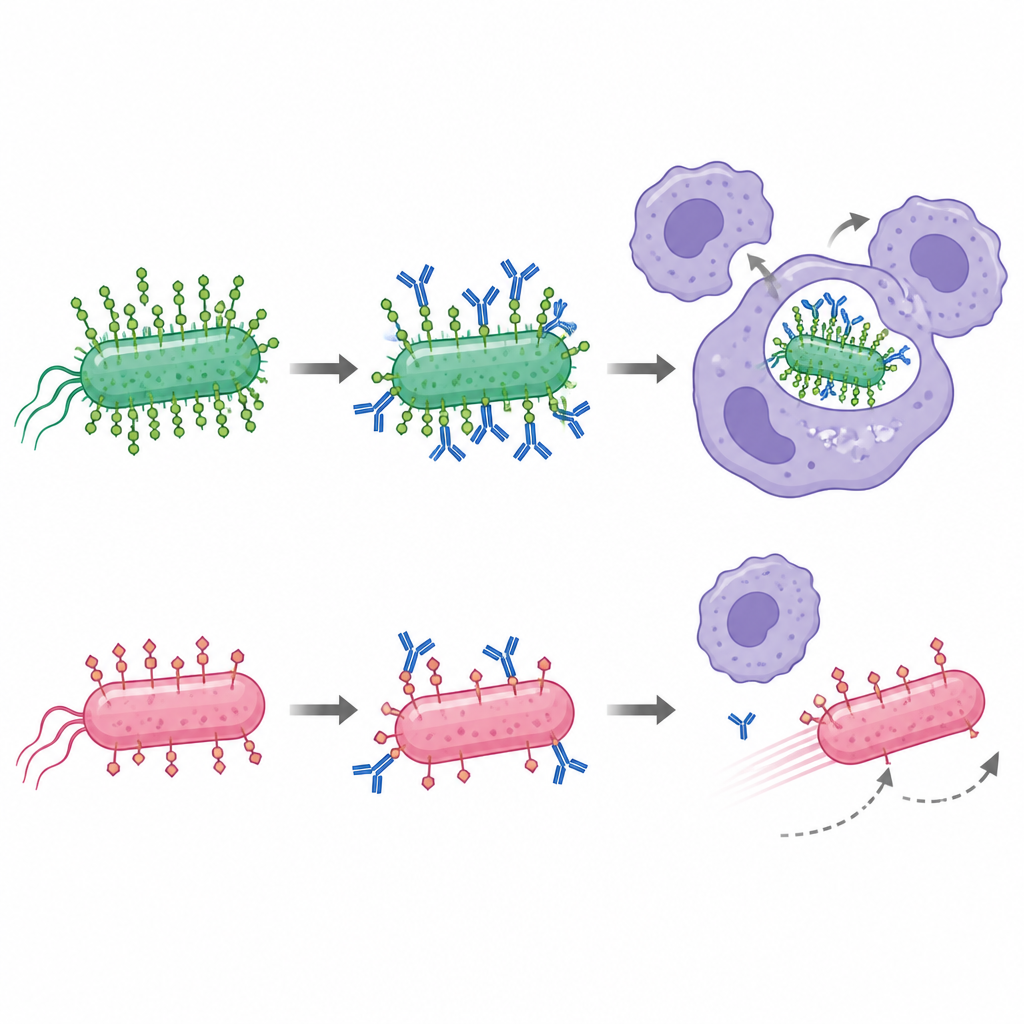
What this means for vaccines and resistance control
In everyday terms, this work shows that a tiny tweak in the sugar coat of E. coli can have a big impact on how well our immune system, or a vaccine, can target the bacteria. The O101/O162 strains studied here are widely distributed, frequently multidrug resistant and often belong to high-risk genetic lineages. Their outer sugar chains come in at least two main versions, controlled by a single gene that can be intact or disrupted, and these versions differ in how they are seen and cleared by immune cells. For vaccine developers, this means that choosing which sugar structure to include may determine whether a vaccine protects against just part of this group or against most of the dangerous strains. For public health, the findings highlight how closely tracking surface structures and resistance genes together can help anticipate and respond to emerging E. coli threats.
Citation: Weerdenburg, E., de Been, M., Zomer, A. et al. Molecular epidemiology and structural diversity of O101/O162 O-antigen variants among Escherichia coli bacteremia isolates. Sci Rep 16, 14777 (2026). https://doi.org/10.1038/s41598-026-45688-7
Keywords: Escherichia coli, multidrug resistance, O-antigen, bacteremia, vaccine development