Clear Sky Science · en
Microstructural insights into the functional morphology and formation logic of spherulitic–fibrous prismatic architecture in the shell–like eggcase of the argonaut octopods
A Delicate Shell with a Big Story
The paper nautilus, a free‑swimming octopus, is famous for the fragile, porcelain‑like shell carried by its females. This “shell” is actually an eggcase, built to cradle hundreds of eggs and help the animal float in the open ocean. At first glance it looks like any other spiral seashell you might find on a beach, but this study shows that the argonaut eggcase is something quite different: a separately evolved structure with its own construction rules, growth stages, and repair tricks.
The Ocean Drifter and Her Portable Home
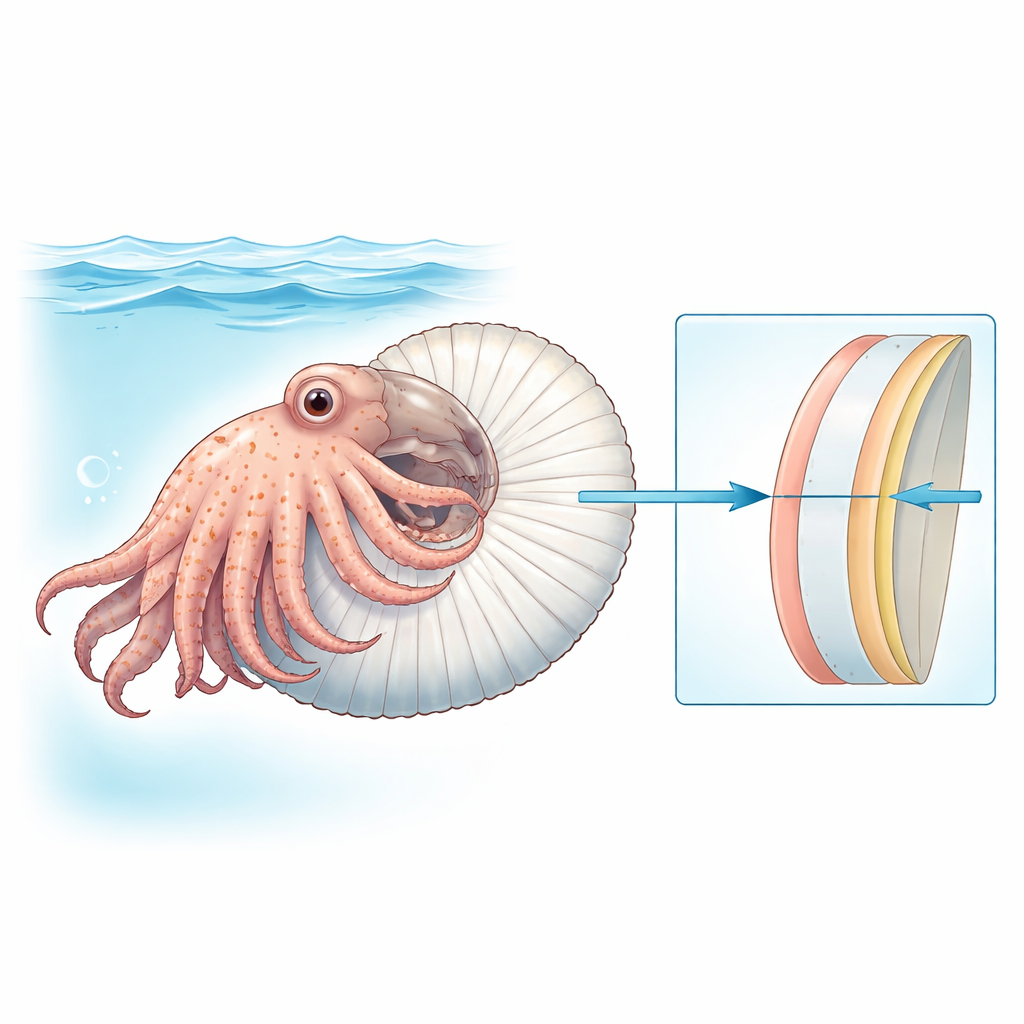
Female argonauts live far from the sea floor, drifting in the open water where there is nowhere to hide and nowhere to attach their eggs. To cope, they build a thin, coiled eggcase that acts as both life jacket and nursery. Only females make this structure, which helps explain why it is so lightweight and brittle compared with the sturdy shells of clams or snails. The eggcase controls buoyancy, giving the animal near‑weightless suspension, and its inner surface serves as a secure surface where strings of eggs can be attached and protected as the mother travels.
Layers Within Layers: How the Eggcase Is Built
Under powerful microscopes, the researchers found that each eggcase is built as a sandwich of five layers. On the outside and inside are very thin organic skins, like clear films. Between them sit two rigid mineral layers, separated by a middle organic sheet. The two mineral layers are made of tightly packed microscopic columns of calcite, each only a few micrometers wide, that interlock like a honeycomb. Strikingly, these mineral columns grow outward in both directions from the central organic sheet, rather than from one side only as in typical mollusk shells. This two‑sided growth pattern links the argonaut eggcase to very different structures such as cuttlebones, coral skeletons, and bird eggshells, hinting at convergent solutions to the problem of rapidly building a strong but light mineral framework.
Local Reinforcements and Protective Bumps
The team also discovered that the eggcase is not uniform. At the tight center of the spiral, the inner and outer mineral layers join around the middle sheet, forming a closed ring that likely adds strength where forces are concentrated. Along the ventral ridge, rows of small external bumps—tubercles—jut from the surface. These bumps are absent from the inside and become fully developed only away from the growing edge, suggesting careful biological control rather than random roughness. The outer skin over much of the case is relatively thick, especially in regions hard for the animal’s arms to reach, and appears to protect the mineral interior from dissolving in seawater and from physical impacts, while also helping the fresh eggcase remain slightly flexible rather than brittle.
Self‑Repair: Patching and Regrowing
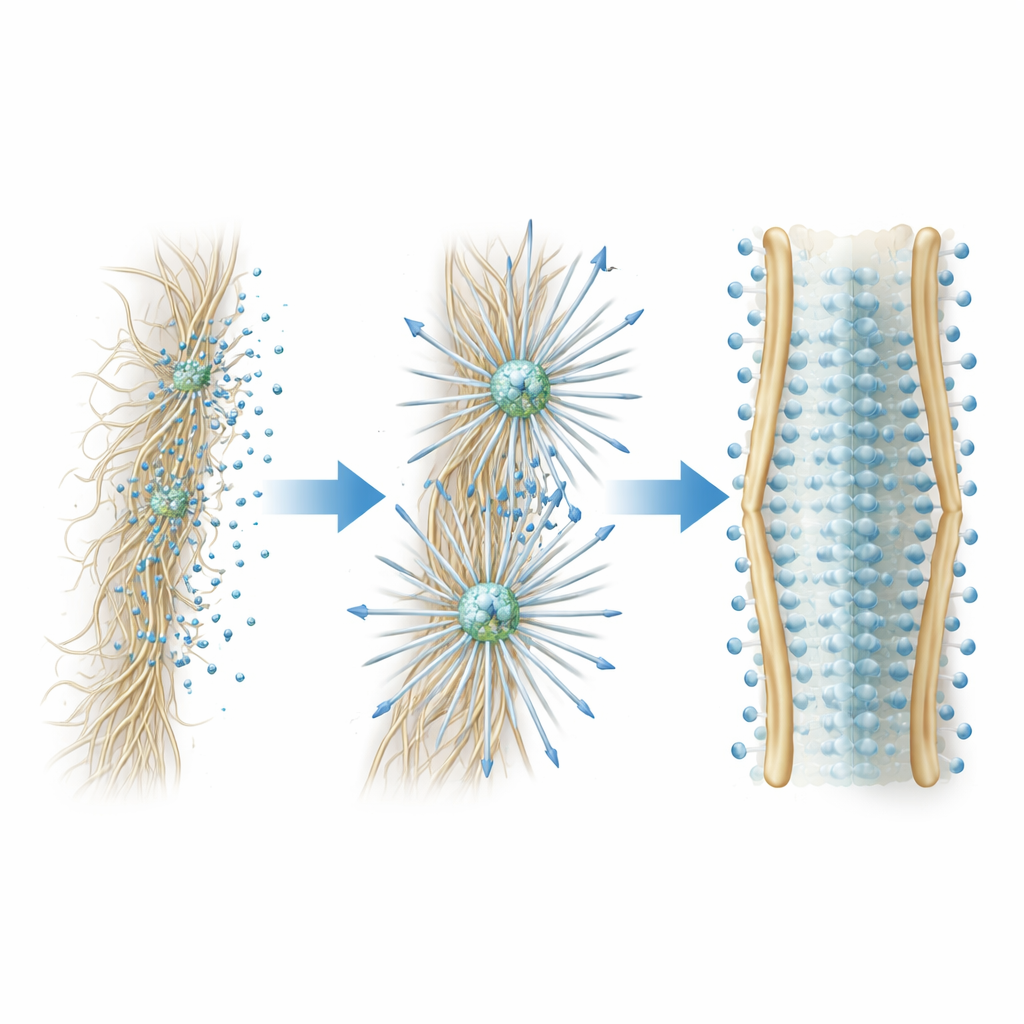
Broken eggcases tell another part of the story. By examining natural scars, the researchers identified two ways argonauts fix damage. In one, they physically wedge detached fragments back into the gap from the inside and glue them in place with a fresh organic coating. In the other, when pieces are missing, they seal the hole from within by laying down new organic layers and mineral granules that grow into a simpler, two‑layered patch. These repairs reuse the same basic steps as initial construction—starting with tiny calcified particles on organic fibers that then sprout radiating crystals—but do not completely recreate the original five‑layered wall. This distinction between “puzzle‑piece” reattachment and “plug and fill” regrowth shows that the animal can adjust its strategy depending on the type of damage.
Rethinking Who Builds the Shell‑Like Home
For nearly two centuries, it has been widely believed that the argonaut’s first dorsal arms actively sculpt and calcify the eggcase, based on early aquarium observations of females handling and repairing their cases. The new microstructural evidence challenges this simple picture. The way layers mature a short distance from the opening, the continuity of crystal growth, and the presence of extensive organic skins suggest that arm movements mainly position and support the case, while hidden tissues and secretions do most of the building. Because argonauts evolved from shell‑less octopuses and their eggcase is made of a different mineral form and built in a different way from true shells, the authors argue that it is not a resurrected ancestral shell but a newly evolved “extended phenotype”: an external structure shaped by the animal’s genes and behavior to solve the demands of a drifting, open‑ocean life.
Citation: Hirota, K., Sasaki, T., Yoshimura, T. et al. Microstructural insights into the functional morphology and formation logic of spherulitic–fibrous prismatic architecture in the shell–like eggcase of the argonaut octopods. Sci Rep 16, 12372 (2026). https://doi.org/10.1038/s41598-026-45670-3
Keywords: argonaut eggcase, biomineralization, cephalopod shells, convergent evolution, extended phenotype