Clear Sky Science · en
Comparative analysis of soil microbial diversity and chemical properties in different Phallus dongsun habitats
A rare mushroom and the hidden world beneath it
Many food lovers prize exotic mushrooms for their flavor and health benefits, but behind every harvest lies a complex world of soil and microbes. This study looks at Phallus dongsun, a rare edible mushroom popular in southwest China, and asks a simple question with big implications for farmers: what makes some soils produce lots of mushrooms while others produce none at all?
Four soils, one mushroom
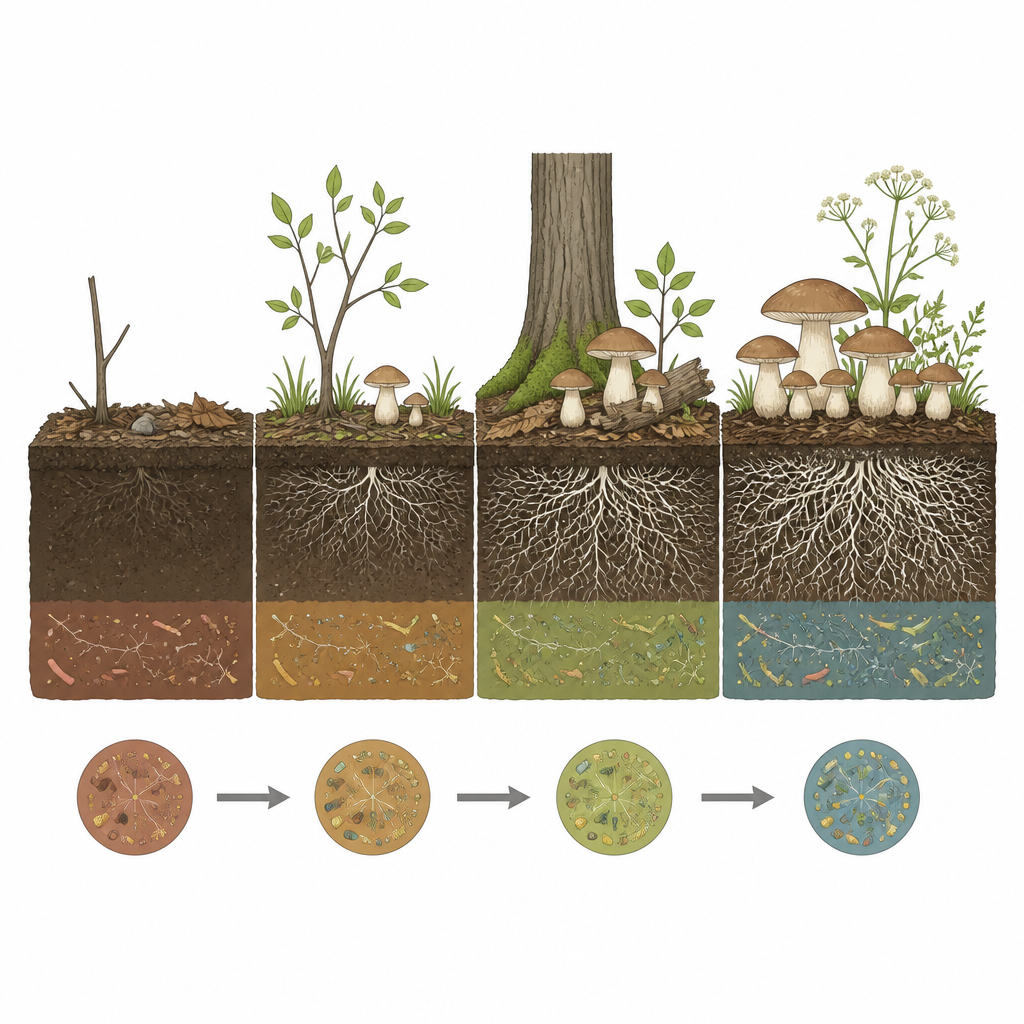
The researchers compared four types of soil from the same region in Guizhou Province: natural wild habitat where P. dongsun grows on its own, high yielding farmland, medium yielding farmland, and fields that produced no mushrooms. They sampled each soil carefully at the same growth stage of the mushroom and measured its basic chemistry, including acidity, organic matter, and the main nutrients nitrogen, phosphorus, and potassium. At the same time, they used DNA based sequencing to catalog the bacteria and other microbes living around the mushroom roots.
Soil chemistry that favors good harvests
All four soils were somewhat acidic, but the wild and high yielding soils were slightly less acidic than the low or no yield soils. These productive soils also contained more phosphorus and potassium in both total and plant available forms. In contrast, the less productive soils held more organic matter and nitrogen. The authors suggest that this pattern reflects more active breakdown and use of organic matter and nitrogen in the wild and high yielding soils, likely driven by their microbial communities.
Friendly microbes as hidden helpers
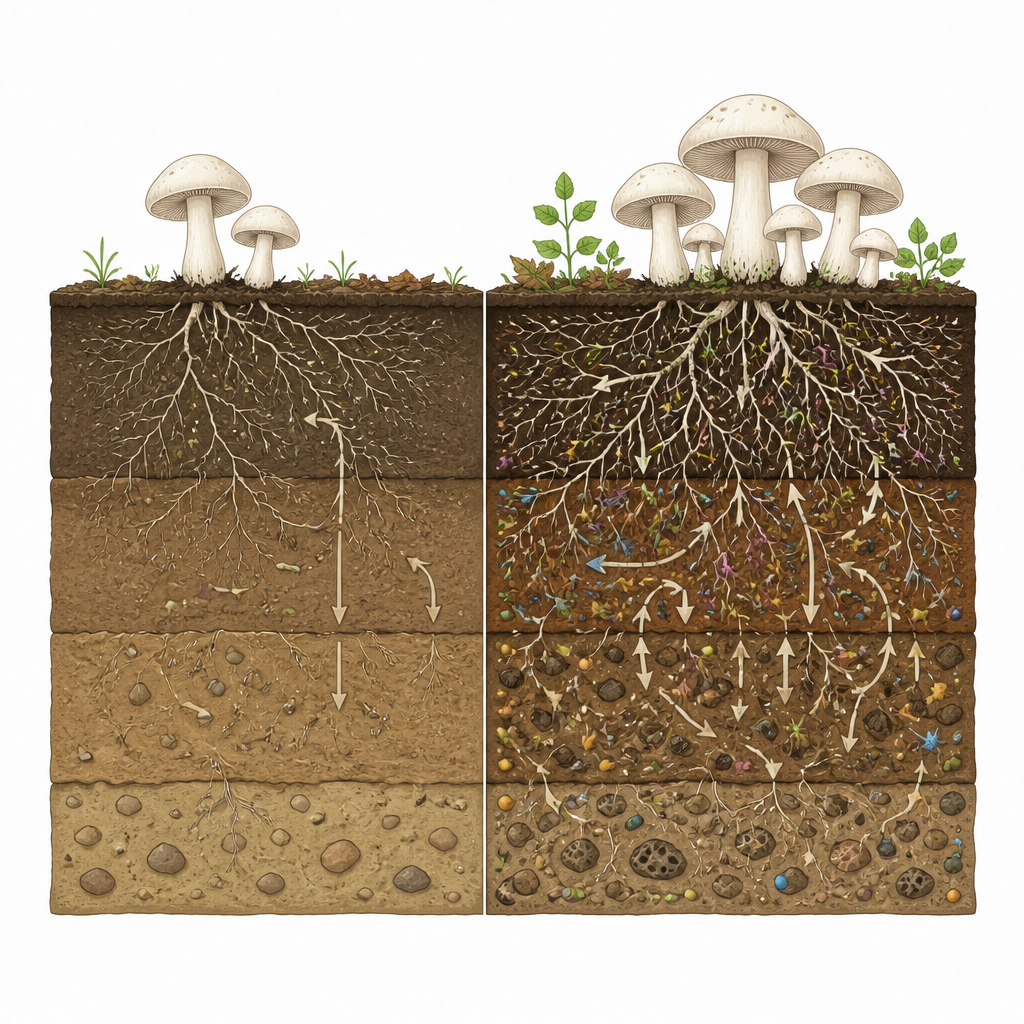
When the team compared the soil microbes, they found that the overall kinds of organisms present were similar across all soils, but their relative numbers differed sharply. Wild and high yielding soils were richer in several groups of bacteria known from other studies to support plant and fungal growth, including Pseudomonadota, Gemmatimonadota, and Myxococcota, and the genera Bradyrhizobium, Sphingomonas, Candidatus Angelobacter, Pseudolabrys, and Rhodoplanes. These microbes can help break down organic matter, cycle nitrogen, release bound phosphorus, and even produce hormone like compounds that stimulate growth. Diversity measures showed that wild and high yielding soils also had more even and varied microbial communities than the medium and no yield soils.
Links between nutrients and microbes
To test how soil chemistry and microbes were related, the researchers mapped statistical correlations between microbial groups and chemical properties in the wild and high yielding soils. Several beneficial bacterial genera were strongly linked with higher levels of phosphorus and potassium, while others tracked changes in pH or nitrogen forms. These patterns suggest that certain microbes thrive in, and may help create, soil conditions that are especially suitable for P. dongsun. Wild soil, in particular, hosted the largest number of distinctive microbial groups associated with nutrient cycling and enzyme activity, reinforcing its role as a natural model for productive cultivation.
Using wild wisdom to guide farming
Overall, the study shows that soils supporting wild P. dongsun and soils that deliver high farm yields share very similar chemical and microbial traits. Slightly higher pH, greater phosphorus and potassium, and a diverse community of helpful bacteria appear to go hand in hand with better mushroom harvests. For growers, this means that mimicking wild soil conditions, and perhaps managing fields to encourage these key microbes, could be a practical path toward stable, high yield cultivation of this valuable mushroom.
Citation: Cao, L., Xiao, Q., Yao, Y. et al. Comparative analysis of soil microbial diversity and chemical properties in different Phallus dongsun habitats. Sci Rep 16, 15547 (2026). https://doi.org/10.1038/s41598-026-45668-x
Keywords: Phallus dongsun, soil microbes, edible mushrooms, soil nutrients, microbial diversity