Clear Sky Science · en
Chaos quasi-opposition arithmetic algorithm-based Robust improved frequency regulation for restructured hybrid power system integrating renewable energy sources
Keeping the Lights Steady in a Wind-and-Solar World
As more electricity comes from wind turbines and solar panels, keeping the power grid steady becomes surprisingly hard. Tiny imbalances between supply and demand show up as shifts in grid frequency, which can damage equipment or even trigger blackouts. This paper explores a new way to keep frequency under control in a future grid packed with renewables and operating under competitive electricity markets, aiming to make our power supply both cleaner and more reliable.
Why Grid Frequency Matters to Everyday Life
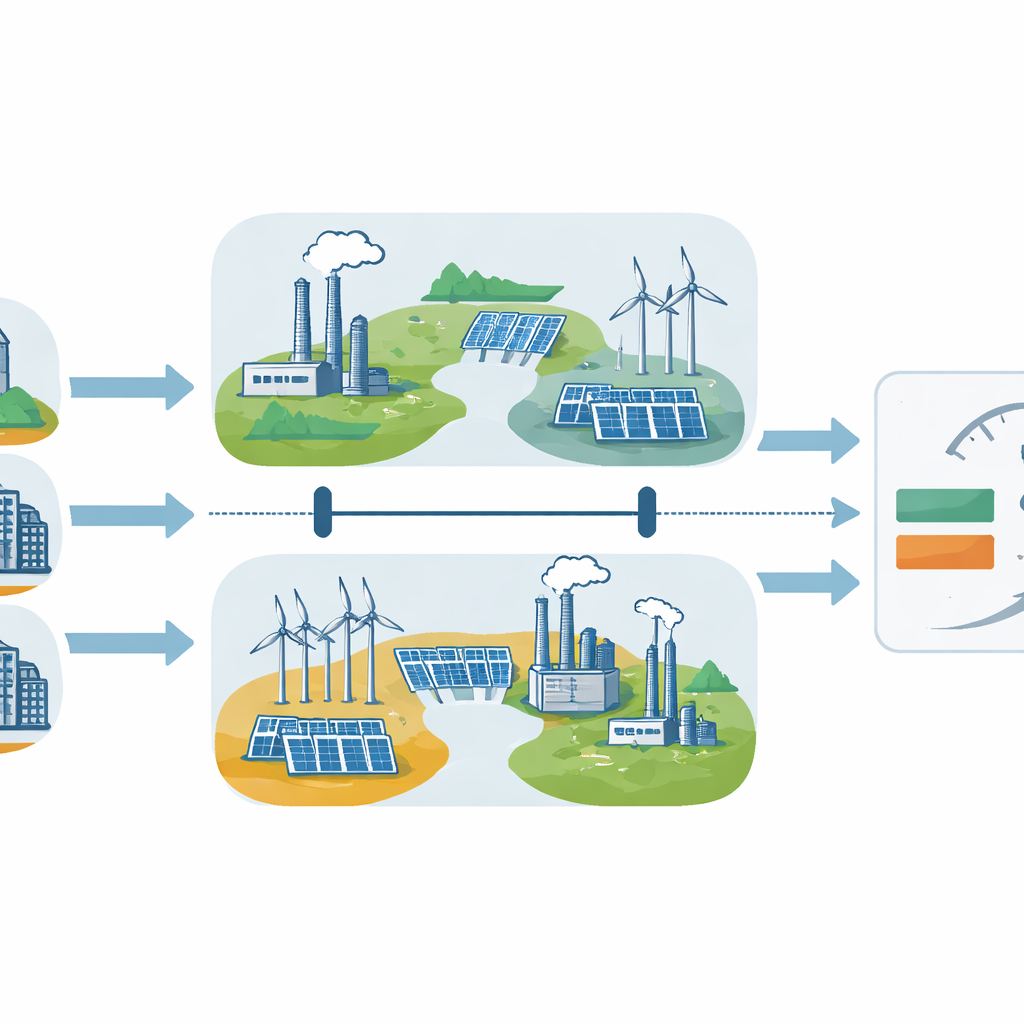
In large power networks, countless generators must move in lockstep, all synchronized at nearly the same frequency. When people suddenly switch on air conditioners, electric ovens, or factory machines, the demand for power jumps. If generation does not instantly follow, the grid frequency sags; if there is too much generation, it rises. Traditionally, power plants equipped with automatic generation control adjust their output to keep things in balance. But the rise of wind and solar—whose output changes with clouds and breezes—makes these swings faster and less predictable, while deregulated markets add more complex power trades between regions.
New Control Brains for a Complex Power Mix
The authors focus on a "hybrid" power system where each region includes a mix of thermal, hydro, and gas plants, plus wind farms and solar arrays, all linked by tie-lines that allow power to flow between regions. Standard controllers, such as the familiar PID family, struggle in this setting: they can be slow to settle after a disturbance and may allow large overshoots in frequency. To address this, the paper introduces a more flexible controller called a two-degree-of-freedom tilted fractional controller. In simple terms, it separates how the system responds to sudden disturbances from how it follows planned targets, and it uses a richer mathematical description of memory and damping to better smooth out oscillations.
Smarter Tuning Through Nature-Inspired Search
Designing such an advanced controller is only half the battle; choosing its many tuning knobs is just as important. Instead of relying on trial-and-error or designer intuition, the authors use an artificial intelligence style search method inspired by arithmetic operations, chaos, and the idea of checking not only an option but also its "opposite". Their Chaotic Quasi-Opposition Arithmetic Optimization Algorithm explores many candidate settings in parallel and homes in on those that minimize a measure of how long and how far frequency and tie-line power deviate from desired values. By blending random-like chaotic sequences with structured opposition-based guesses, the method improves the chances of escaping poor local solutions and converging faster.
Testing Under Realistic Disturbances
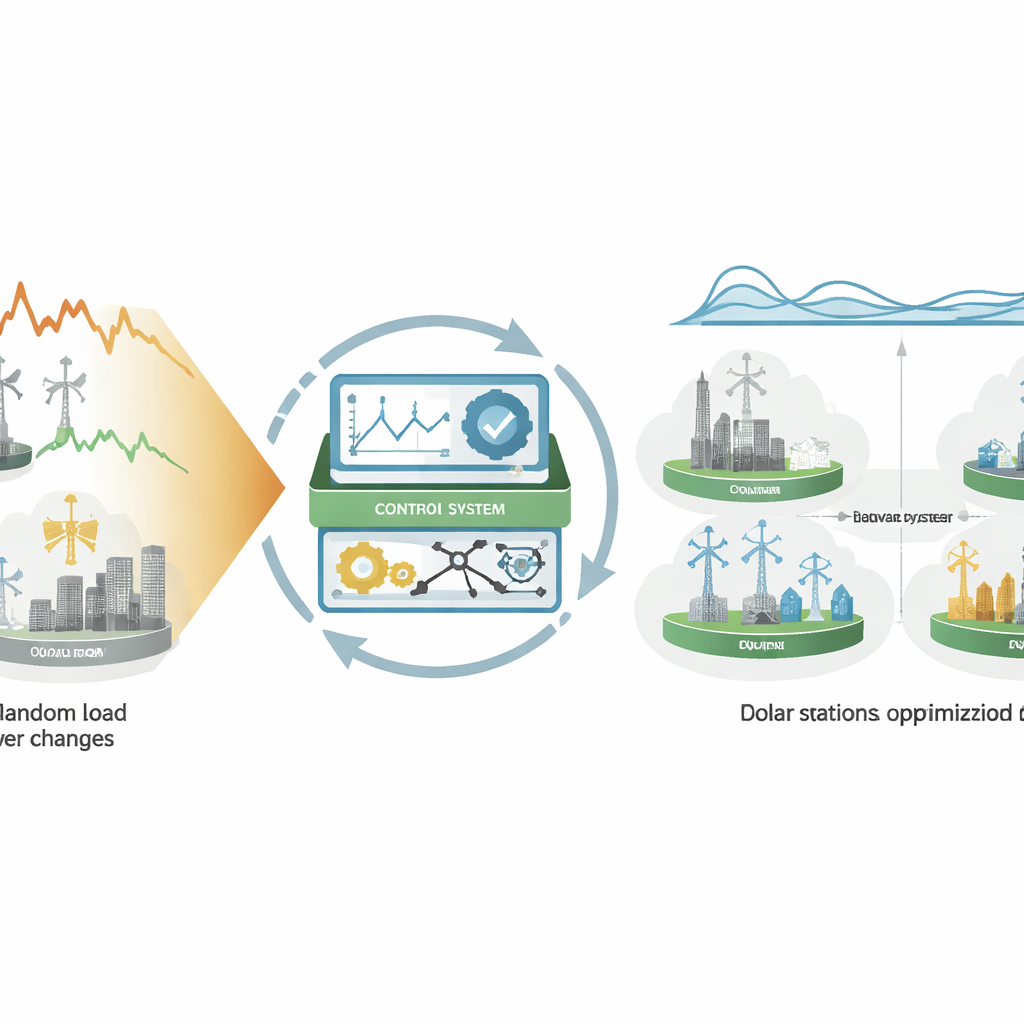
To see how well the new controller works, the researchers test it on a widely used benchmark model of a 118-bus power system, including realistic non-ideal features such as turbine rate limits and dead bands in governors. They examine several challenging situations: single sudden load changes, multiple step changes over time, and fully random variations that mimic industrial loads and renewable fluctuations. They also model variable wind speeds and changing solar irradiance, letting wind and solar outputs wander naturally. Across all these tests, the proposed controller—tuned by the new optimization algorithm—reduces settling time by more than two-thirds and cuts overshoot and an overall error measure by roughly two-thirds to four-fifths compared with an already advanced earlier design.
From Simulation to Hardware Bench
Reliability is crucial for grid control, so the authors probe how robust their design is to uncertainties. They deliberately vary key power-system parameters by up to plus or minus 50 percent and show that the controller still keeps frequency deviations small and well-damped. To move beyond pure simulation, they implement the strategy in real time on an OPAL-RT hardware-in-the-loop platform, where a digital model of the grid runs fast enough to interact with actual control hardware. The observed behavior closely matches the simulations, reinforcing confidence that the scheme could function in practice.
What This Means for a Renewable Future
In plain terms, this work shows that smarter, more adaptable control strategies can keep a renewable-heavy, market-driven grid stable without sacrificing responsiveness. By combining a flexible controller design with a powerful search method for tuning it, the authors manage to tame the frequency swings caused by sudden load changes and fluctuating wind and solar power. If adopted in real networks, such approaches could help ensure that as we add more clean energy and restructure our electricity markets, the grid remains as dependable as the flick of a light switch.
Citation: Kumar, S., Shankar, R. Chaos quasi-opposition arithmetic algorithm-based Robust improved frequency regulation for restructured hybrid power system integrating renewable energy sources. Sci Rep 16, 10558 (2026). https://doi.org/10.1038/s41598-026-45650-7
Keywords: grid frequency control, renewable energy integration, automatic generation control, metaheuristic optimization, power system stability