Clear Sky Science · en
Liquid digestate treatment potential of five green microalgae in non-axenic cultures
Turning Waste into a Resource
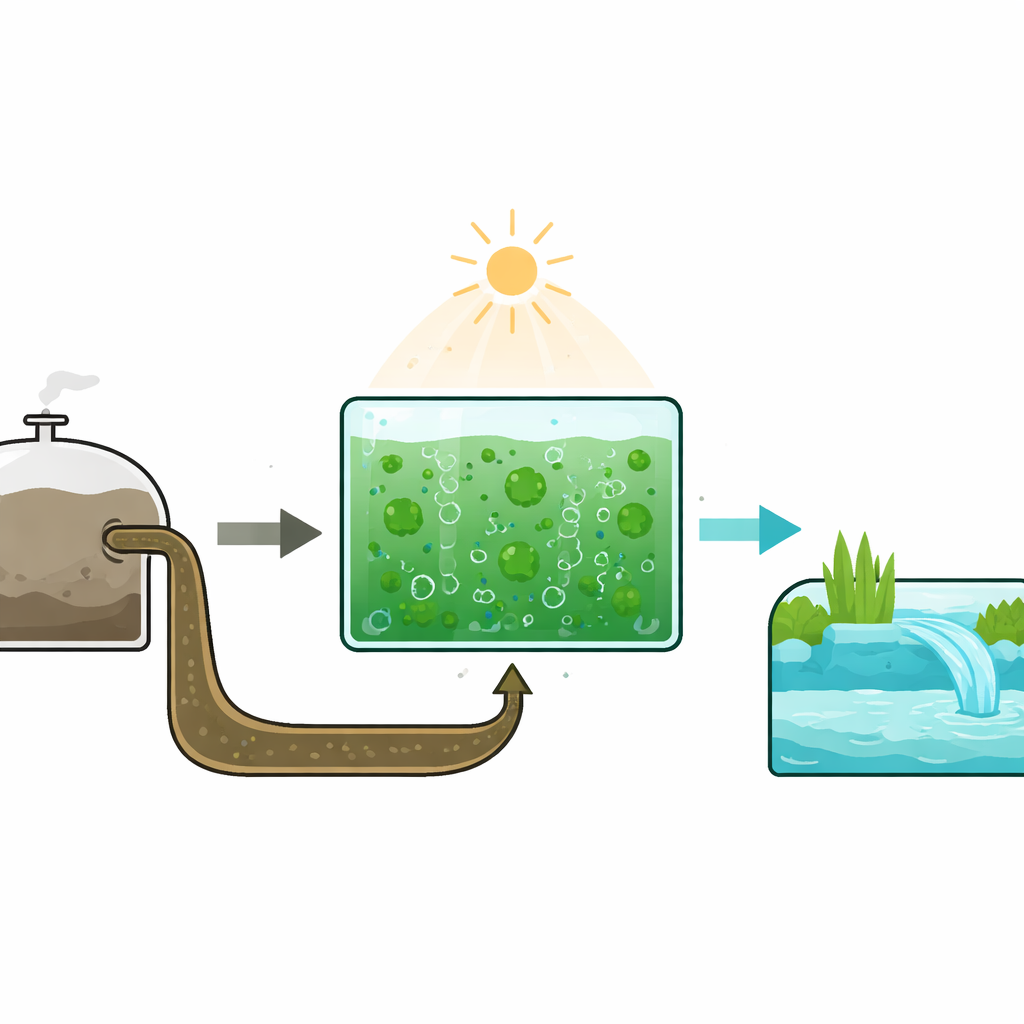
Anaerobic digestion plants turn food and farm waste into biogas, a renewable fuel. But they also leave behind a watery residue called liquid digestate, loaded with nitrogen and phosphorus. If this by-product is not handled well, it can pollute rivers and soils. This study explores whether naturally occurring green microalgae, growing together with bacteria, can clean this challenging liquid while turning its nutrients into useful biomass.
Why the Leftovers Are a Problem
As biogas production expands worldwide, so does the volume of digestate. The liquid portion, which makes up most of the volume, is rich in plant nutrients but also in organic residues and sometimes heavy metals and pathogens. Spreading it on farmland can be helpful as fertilizer, but too much causes water pollution and soil overload. Conventional treatment methods are often costly and not very efficient, especially for small or stand-alone biogas plants. A more elegant solution is to use the liquid as a growth medium for microalgae, which can capture nutrients, clean the water, and generate biomass for products such as animal feed or biofuels.
Putting Wild Microalgae to the Test
The researchers collected liquid digestate from a pilot plant processing vegetable waste like corn, peas, and beans. They diluted it only fivefold with water and did not sterilize it, deliberately keeping it close to real-world conditions. Five strains of green microalgae, isolated from natural water bodies rather than bought from culture collections, were grown in small illuminated reactors for four months. These cultures were “non-axenic,” meaning the algae lived together with their naturally associated bacteria. The team monitored key pollution indicators—forms of nitrogen, phosphate, and organic matter—as well as algal growth and shifts in the bacterial community.
How pH Control Changed the Game
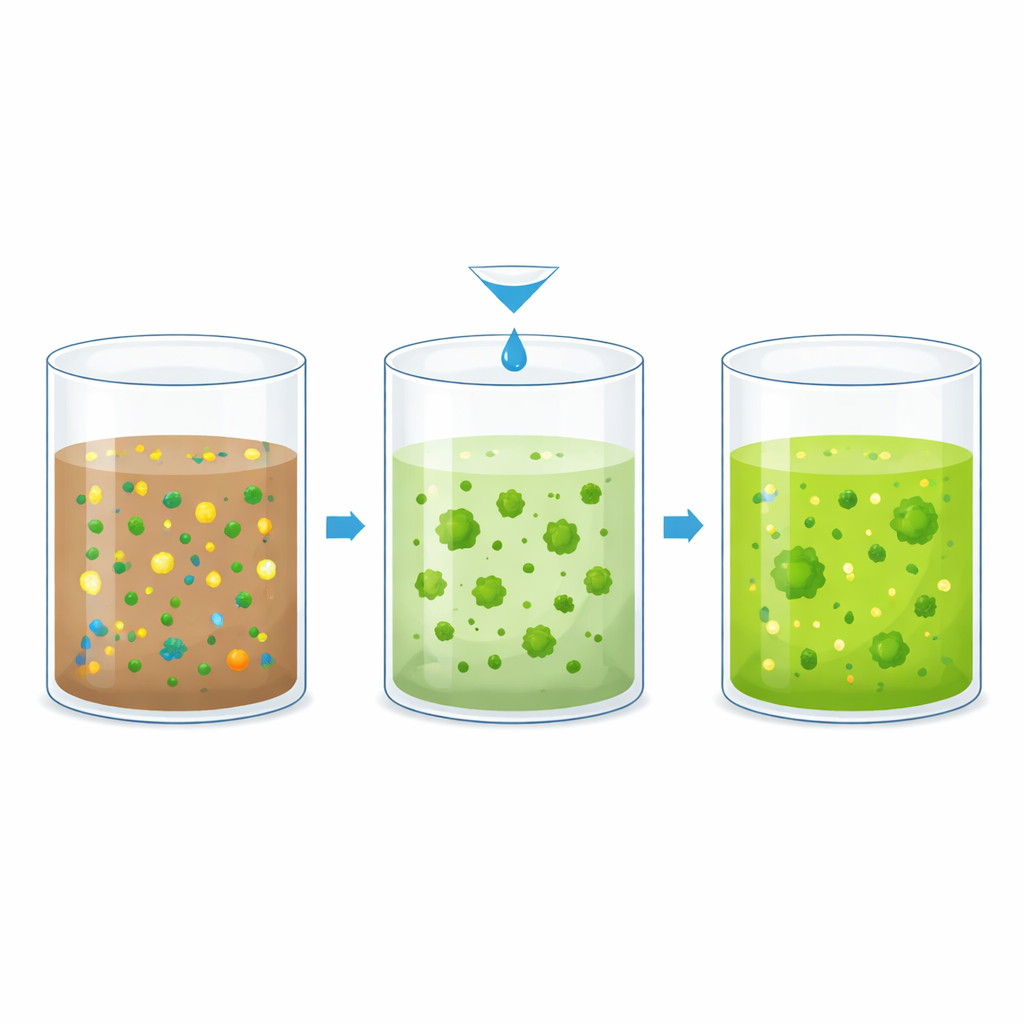
The experiment had two main stages. In the first 60-day phase, the digestate was fed to the reactors without controlling acidity (pH). The microalgae grew at first, but as the mixed community released carbon dioxide and transformed nitrogen, the pH gradually dropped to mildly acidic values. This slowdown in growth limited how much pollution was removed: total nitrogen fell by roughly 55–70%, and phosphate removal stayed below about 50%. In the second 60-day phase, the team carefully raised and held the pH above neutral using small additions of sodium hydroxide. Under these more alkaline conditions, the algae flourished, chlorophyll levels rose, and the reactors removed substantially more nitrogen and phosphate, although the removal of some organic compounds became less effective.
Algae, Bacteria, and a Balancing Act
Among the five species tested, cultures dominated by Desmodesmus communis stood out. They removed nearly 90% of total nitrogen and over 90% of phosphate in the pH-controlled phase, even though this alga did not reach the highest cell counts. Its advantage appears linked to its larger, multi-cell structures and to the way it interacts with partner bacteria. Genetic analysis showed that when the pH was adjusted upward, the balance of bacterial groups shifted: some declined, while others that thrive in alkaline, nutrient-rich environments became more common. Certain bacteria seemed to specialize in breaking down complex organic matter, while others helped remove nitrogen and phosphorus or made these nutrients more accessible to algae. The overall performance came from this mixed, cooperative community rather than from algae alone.
From Polluted Effluent to Cleaner Cycles
In plain terms, the study shows that letting the algae–bacteria mix “do its thing” is not enough: careful pH control is crucial to unlock their full cleaning power. With the right conditions, wild green microalgae living with bacteria can strip most of the excess nitrogen and phosphorus from liquid digestate using only modest dilution and no sterilization. This makes the treated liquid safer for reuse in biogas plants or potential return to the environment, while the resulting algal biomass can become a secondary product. Such systems could help close nutrient loops, reduce waste, and make biogas production more sustainable.
Citation: Sobolewska, E., Borowski, S. & Nowicka-Krawczyk, P. Liquid digestate treatment potential of five green microalgae in non-axenic cultures. Sci Rep 16, 14589 (2026). https://doi.org/10.1038/s41598-026-45636-5
Keywords: microalgae, anaerobic digestate, nutrient removal, biogas, wastewater treatment