Clear Sky Science · en
Dual-output hybrid converter based on the modular universal dc-ac/dc converter
Power for homes and communities
As more homes, buildings, and neighborhoods add solar panels, batteries, and electric vehicles, they need smart hardware that can move electricity around efficiently. Many future microgrids will have both traditional alternating current (ac) wiring and newer direct current (dc) lines side by side. This study presents a new type of power converter that can feed both ac and dc circuits from one compact box, helping local energy systems become simpler, safer, and more affordable.
Why both ac and dc matter
Most of today’s appliances and the public grid use ac, but many renewable sources and electronic devices naturally work with dc. In a house or community microgrid, this often means using several separate converters in a chain to adapt voltages and change between ac and dc. Every extra stage adds cost, energy loss, and complexity. At the same time, Europe and other regions are pushing hard to cut carbon emissions and encourage local “energy communities,” where people share clean power. These trends are driving interest in hybrid networks that carry both ac and dc, and in modular electronics that can be reused and scaled as needs grow.
A single box instead of two
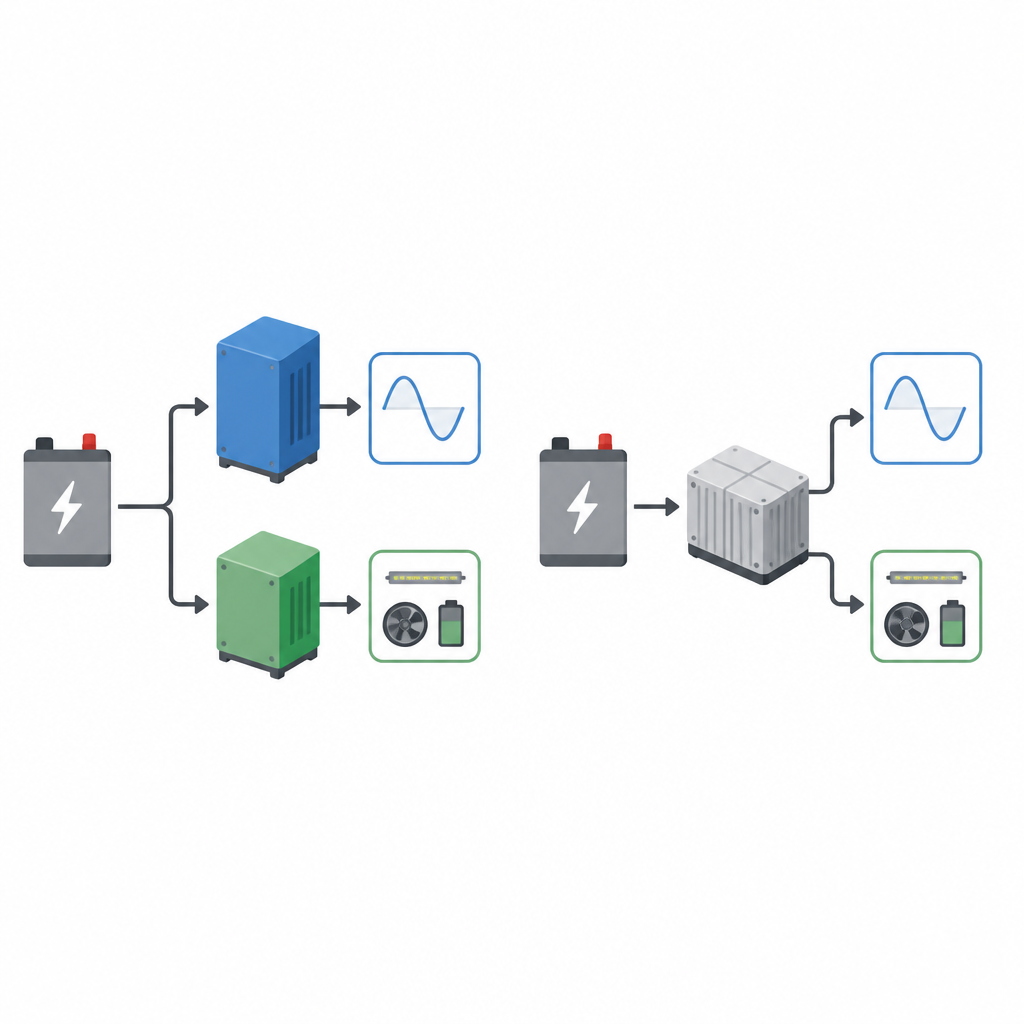
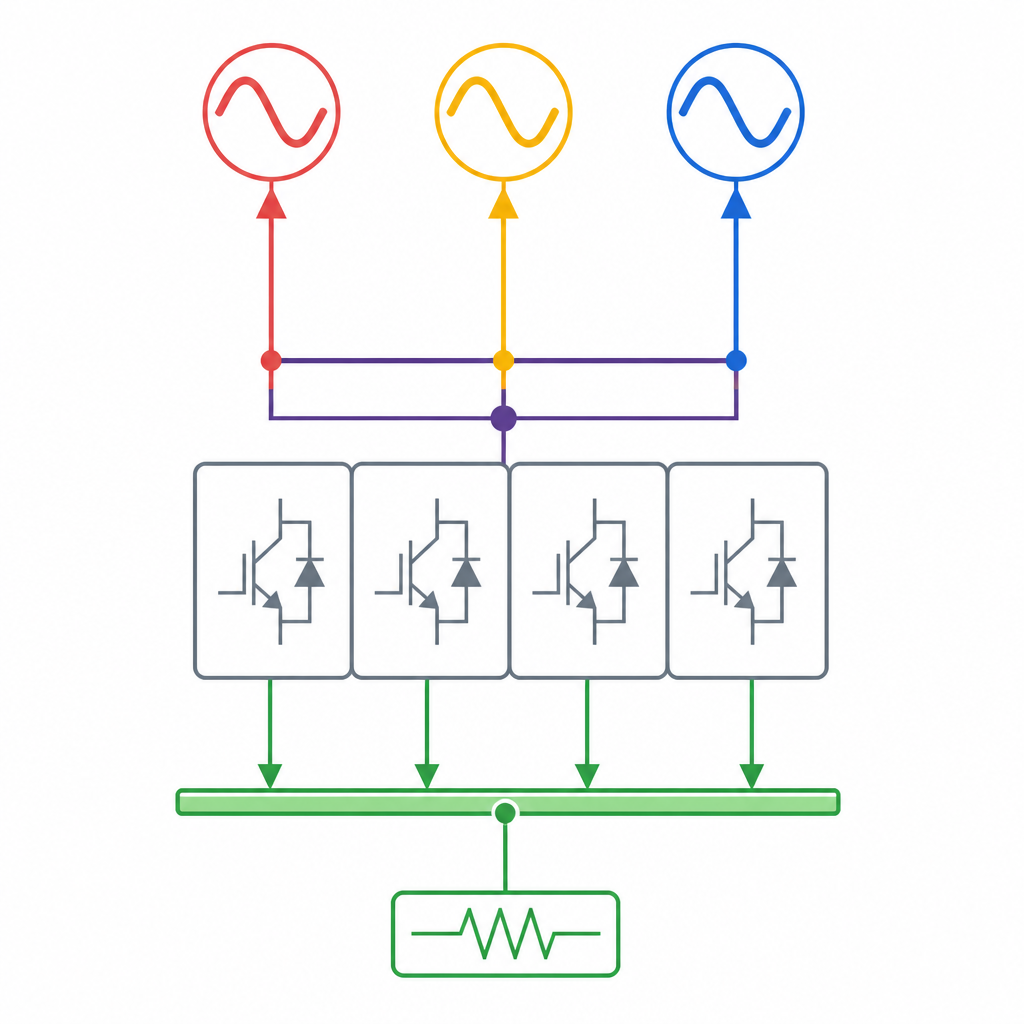
Traditionally, supplying both ac and dc from a solar array or battery requires two blocks: one converter to raise or lower the dc voltage, and another to turn dc into ac. The authors build on an earlier “universal” converter idea and redesign it so that one power stage can do both jobs at once. Their device is made from four identical building blocks called buck boost cells. Three cells create the three ac phases that a building or small grid might use, while the fourth cell keeps the dc output at a set level. Cleverly, the neutral wire of the ac system is tied directly to the positive side of the dc output, so both ac and dc share the same electrical reference without needing a bulky isolation transformer.
How the new converter behaves
Inside each cell, fast electronic switches and small coils and capacitors shape the current, either stepping the voltage up or down as needed. The three “ac” cells generate smooth sinusoidal waveforms that ride on top of a dc offset, while the fourth cell holds the dc level steady. Because of the shared neutral point, the ac loads only see the ripple part of the wave, while the dc loads see the steady value. The researchers simulate the converter under realistic conditions and then build a laboratory prototype. In tests, a single dc source feeds 1 kilowatt of three phase ac power and 800 watts of dc power at the same time. The ac voltages remain balanced and nearly sinusoidal, and the dc output stays close to its target level even when ac or dc loads are suddenly switched on or off.
Safety, grounding, and reliability
Grounding choices are crucial for safety in mixed ac and dc systems. With conventional non isolated dual converters, tying the ac neutral and one dc pole to earth can unintentionally create a loop that lets large fault currents circulate, so designers usually add galvanic isolation. In the new design, the ac neutral and the positive dc pole are physically the same point, so there is only one internal node tied to earth and no hidden loop. This removes the need for extra isolation hardware and can also reduce long term corrosion problems linked to stray dc currents. Thermal imaging of the prototype shows that the hottest parts are the power switches, as expected, but their temperatures remain within safe limits and could be lowered further with improved cooling.
What this means for future grids
The study shows that a modular single stage converter can reliably supply both ac and dc networks from one dc source while keeping waveforms clean and voltages well controlled. For a non specialist, the key message is that the same small set of electronic “bricks” can be repeated and reused to power different types of loads in a microgrid or energy community. This cuts down on hardware, simplifies grounding and protection, and may improve overall efficiency by avoiding extra conversion steps. With the addition of closed loop control and grid synchronization, such converters could become central building blocks in future low carbon local energy systems.
Citation: Gutiérrez-Escalona, J., González-Antúnez, J.J., Roncero-Clemente, C. et al. Dual-output hybrid converter based on the modular universal dc-ac/dc converter. Sci Rep 16, 15203 (2026). https://doi.org/10.1038/s41598-026-45619-6
Keywords: hybrid microgrid, power converter, AC DC distribution, modular electronics, renewable energy systems