Clear Sky Science · en
A novel nowcasting (estimation) model based on an adaptive network neutrosophic hesitant fuzzy inference system (ANNHFIS): a case study of Istanbul
Why this study matters for city air
Biomass power plants turn household rubbish and organic waste into electricity, which sounds like a win for clean energy. Yet these facilities still release nitrogen dioxide, a gas that can irritate lungs and worsen asthma. In crowded cities such as Istanbul, knowing today’s nitrogen dioxide level near such plants can help authorities warn residents and manage air quality. This study introduces a new kind of smart prediction system designed to give more reliable same day estimates of nitrogen dioxide around a major waste to energy plant.
How waste to energy affects nearby air
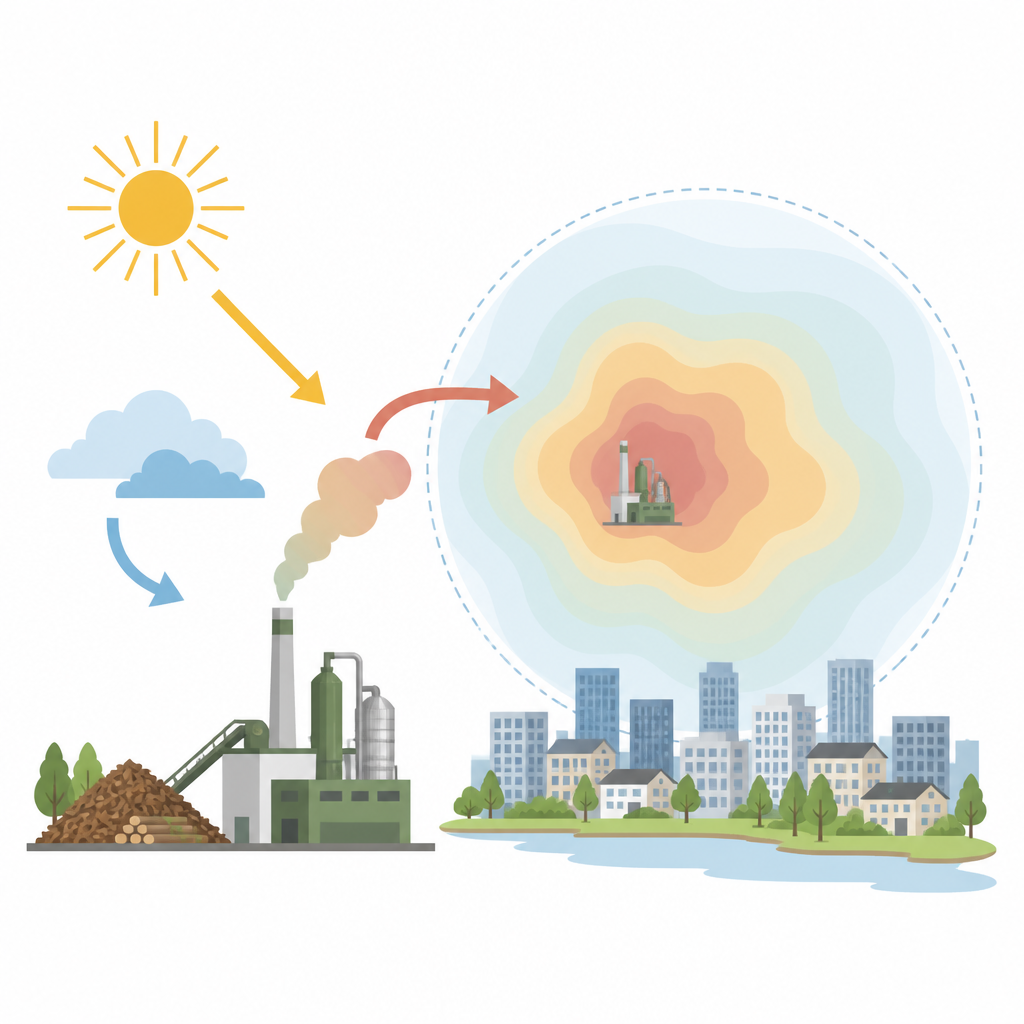
Biomass plants burn or process huge amounts of waste to keep the lights on. Depending on how they are run, they can emit particles and nitrogen oxides at levels similar to some fossil fuel plants. Nitrogen dioxide is especially important because it clouds the air, contributes to smog and acid formation, and harms the lungs. In Istanbul’s Eyup district, a large complex of waste to energy and biomethanization plants supplies power for millions of people, but it also releases gases such as nitrogen dioxide and tiny particles into the atmosphere. Understanding how local weather and co pollutants combine to shape daily nitrogen dioxide levels near this complex is therefore a key public health question.
What data went into the model
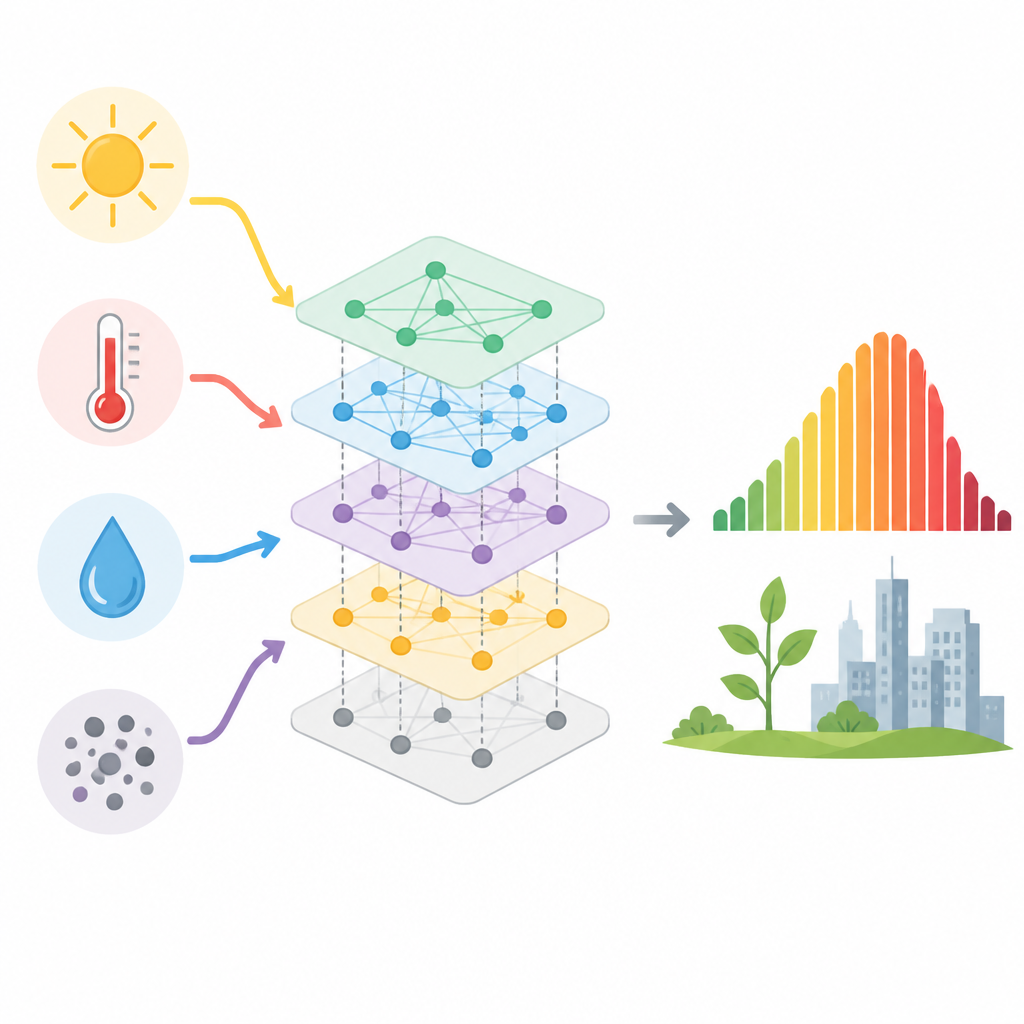
The researchers focused on daily conditions between 2019 and 2023 near the Eyup facilities. They used five pieces of information as inputs: sunlight, air temperature, humidity, nitrogen oxides, and coarse particles in the air. All were measured at a nearby monitoring station that tracks both weather and air quality. The goal was to estimate the same day average nitrogen dioxide level from these measurements. Before training any models, the team cleaned the data by removing days with missing readings and filtering out extreme sensor glitches. They then scaled all values to a common range and checked the records for sudden jumps or long term drifts that could confuse learning algorithms.
A new way to handle messy real world signals
Traditional statistical models treat relationships in the data as mostly straight line and can struggle when patterns are wavy, irregular, or change over time. Standard neural networks are more flexible but can overfit or give little insight into how they reach a decision. The authors built a hybrid system that mixes neural networks with fuzzy logic, a method that works with shades of gray rather than yes or no answers. Their twist was to let the system express not only how strongly an input belongs to a category like low or high, but also its uncertainty and hesitation. By using paired bell shaped curves and a special blending rule, the model can represent ambivalent cases where the data are noisy or conflicting, which is common in outdoor air measurements.
How the smart estimator learns
The new model relies on a set of if then style rules, such as low sunlight and high particle levels may suggest higher nitrogen dioxide. Behind the scenes, it combines hundreds of such rules, each with smoothly varying strengths rather than hard boundaries. To tune this complex rule base, the team used particle swarm optimization, a method that treats each candidate solution like a particle moving through space and nudges the swarm toward better performance. This search step adjusts how the fuzzy categories are placed and how important each rule is. A follow up fine tuning step based on gradient learning then polishes the fit. The model’s accuracy was checked with standard error measures and compared with several strong baselines, including classic neural networks, long short term memory networks, and earlier fuzzy systems.
What the researchers found
On unseen test data, the new system produced the lowest average error and the highest agreement with observed nitrogen dioxide levels among the models studied. It captured daily swings and pollution peaks better than other fuzzy approaches and a deep learning sequence model, and performed similarly to a well tuned standard neural network while remaining more transparent. Statistical tests showed that the improvements over most rivals were unlikely to be due to chance. The authors argue that the richer way their model handles uncertainty helps it cope with non smooth, changing patterns in the air quality records.
What this means for urban residents
For people living near waste based power plants, the study shows how smarter nowcasting tools can give a clearer picture of the air they breathe today. The proposed method does not eliminate pollution, but it may allow city agencies to spot risky days more reliably and to plan responses such as alerts or operational changes. Because the approach is flexible, it could be adapted to other districts, pollutants, or forecasting horizons in future work. In simple terms, the research offers a more nuanced air quality thermometer that acknowledges uncertainty yet still delivers practical guidance for managing nitrogen dioxide in busy urban settings.
Citation: Turgut, A., Seker, S. A novel nowcasting (estimation) model based on an adaptive network neutrosophic hesitant fuzzy inference system (ANNHFIS): a case study of Istanbul. Sci Rep 16, 14855 (2026). https://doi.org/10.1038/s41598-026-45618-7
Keywords: air pollution, nitrogen dioxide, biomass power plants, air quality modelling, machine learning