Clear Sky Science · en
Quasi-integrability from $$\mathcal{P}\mathcal{T}$$ -symmetry
Why waves that keep their shape matter
From ocean swells and atmospheric fronts to light pulses in optical fibers, many waves in nature behave in a surprisingly orderly way. They can travel long distances, collide, and emerge with their shapes almost unchanged. Mathematicians describe ideal versions of such behavior with perfectly balanced equations that have many built-in conservation rules. Real systems, however, are messy: they contain defects, losses and irregularities. This article explores how a subtle kind of mirror-and-time symmetry, called PT symmetry, can keep many of the good features of the ideal models even when those real-world imperfections are present.
Perfect order and its limits
Classic wave equations like the Korteweg–de Vries (KdV) equation for shallow water and the nonlinear Schrödinger equation for optical pulses are called integrable. They come with an infinite tower of conserved quantities, such as total height, energy and many more abstract measures, which together make solitons and kinks remarkably robust. In the real world, though, no medium is perfectly clean. Small changes in the governing rules, or extra physical effects, break exact integrability and spoil strict conservation. Yet experiments still show stable, localized waves. This puzzling coexistence of imperfection and order has led researchers to the idea of quasi-integrability: systems that are not perfectly integrable but still behave almost as if they were, especially far away in space and time.
A new role for mirror and time reversal
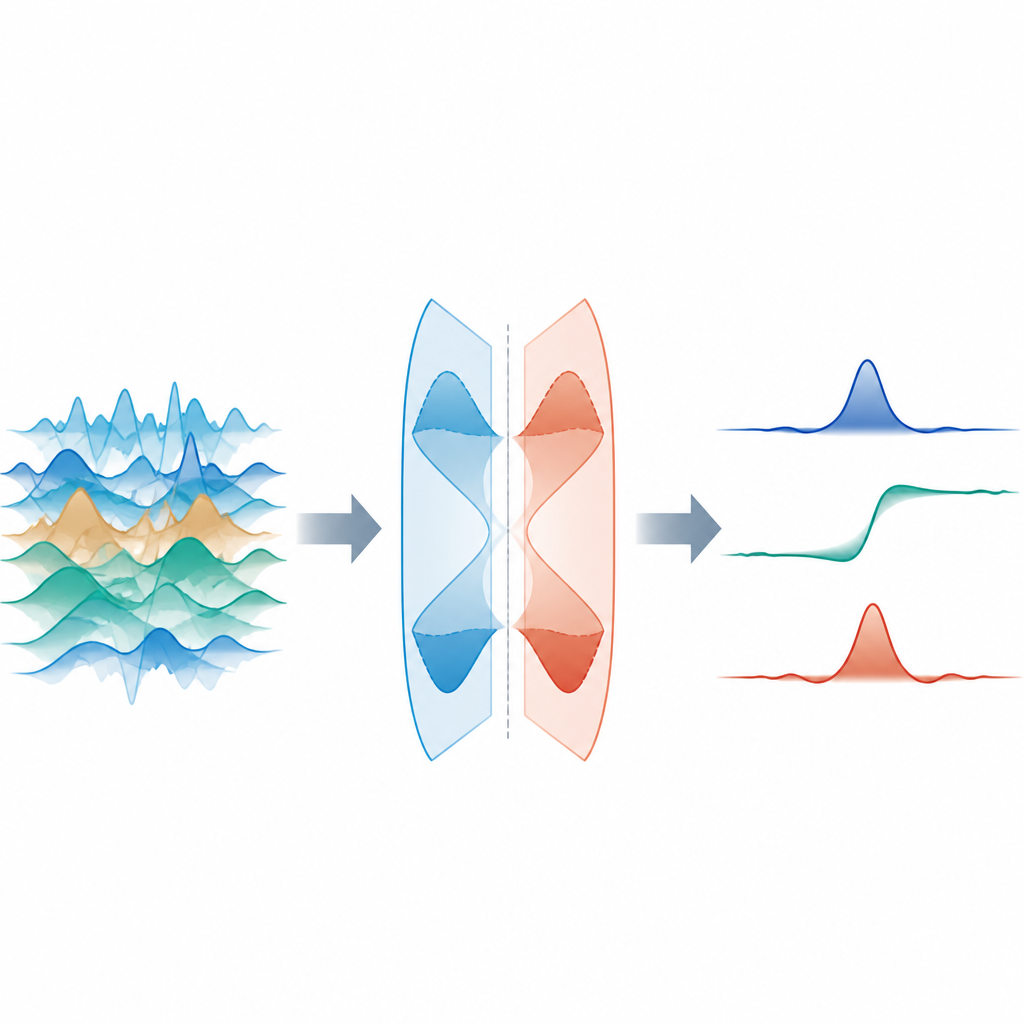
PT symmetry combines a flip of space (parity, turning left into right) with a reversal of time. It has become famous in quantum physics, where even non-standard, non-Hermitian systems can have real energy levels if they respect this combined symmetry. The authors argue that the same idea can explain why quasi-integrable wave models retain long-lived, soliton-like behavior. When a deformed wave equation remains PT symmetric, both the basic building blocks that encode its dynamics and the extra terms that represent imperfections acquire specific even-or-odd behaviors under the space-time flip. As a result, certain quantities that are not conserved at every point still return to the same values when measured at very early and very late times.
Nearly conserved quantities from symmetry
To make this connection precise, the authors work with the Lax pair description, a mathematical framework that packages a wave equation into two linked operators whose mutual compatibility reflects integrability. They show that in a PT-symmetric setting these operators transform in a controlled way: they are effectively odd under the combined space-time flip. When the equations are gently deformed to better reflect real physical conditions, this odd behavior is preserved, and the new terms that break perfect integrability obey matching symmetry rules. The resulting “anomalous” contributions to time changes of the would-be conserved charges then become odd under PT, so their net effect cancels when integrated over all space and very long times. In this sense the charges are not strictly conserved, but their beginning and end values match.
Examples from water waves and light pulses
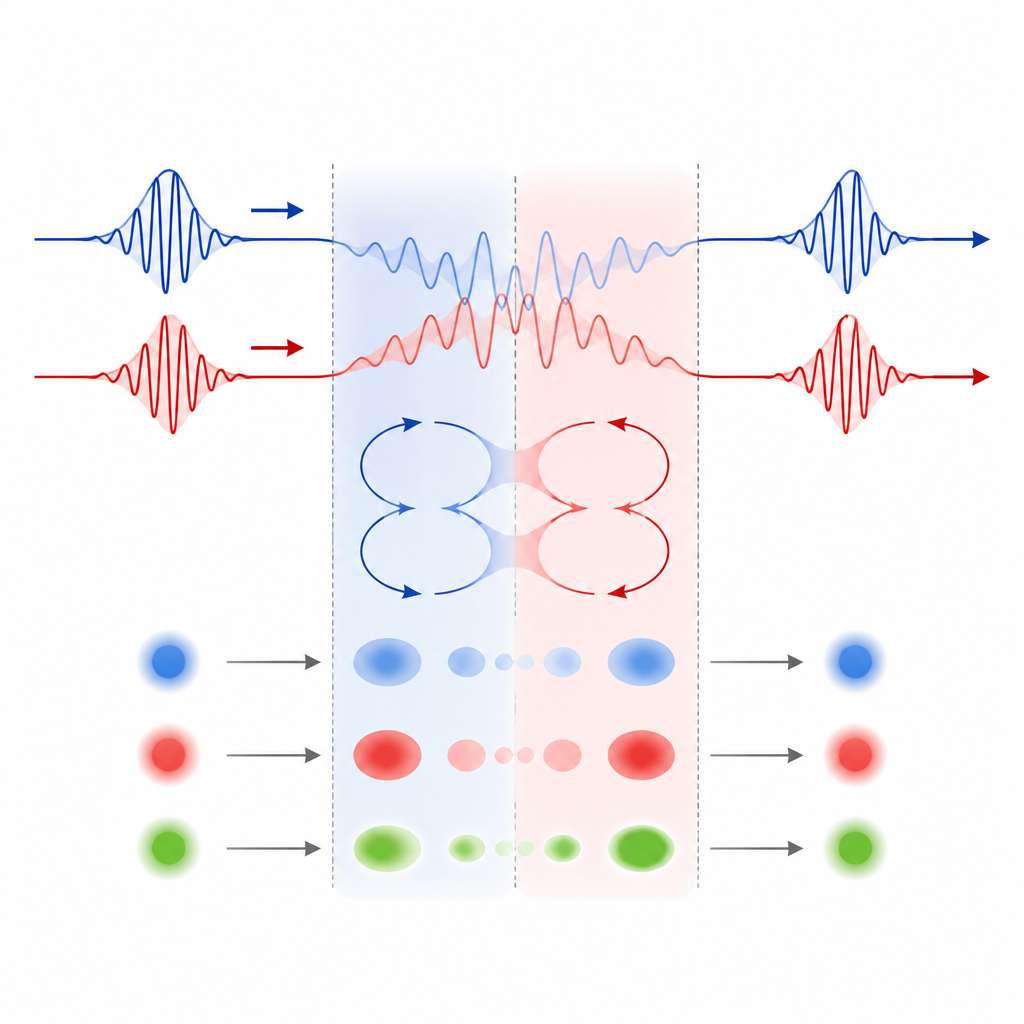
The paper illustrates this mechanism in detail for several important families of wave equations. For the KdV equation, which models shallow-water waves, the authors examine specific deformations and known one- and two-soliton solutions, showing that these wave shapes are PT symmetric and that the associated charges are quasi-conserved. They then turn to the nonlinear Schrödinger equation, central to the theory of light pulses in fibers, and to a non-local version where the wave at a point interacts with its mirror image. In each case, when the deformed system is built to remain PT symmetric, the same pattern appears: localized waves such as solitons survive, and a hierarchy of charges changes locally but settles back to fixed values at the distant past and future.
What this means for imperfect reality
Overall, the article shows that PT symmetry can naturally underwrite quasi-integrability: it provides a structural reason why nearly conserved quantities and robust solitary waves persist in imperfect media. While exact integrability does not require PT symmetry, once one allows realistic deformations it is precisely this combined mirror-and-time property that can keep long-term behavior well ordered. The authors suggest that many PT-symmetric nonlinear systems, including optical devices with gain and loss, may owe their stable localized excitations to this mechanism. In simple terms, if the rules of a wave system look the same when space and time are flipped together, then certain hidden balances can survive disorder, allowing waves to act almost as if they lived in a perfectly ideal world.
Citation: Abhinav, K., Guha, P. & Mukherjee, I. Quasi-integrability from \(\mathcal{P}\mathcal{T}\)-symmetry. Sci Rep 16, 15078 (2026). https://doi.org/10.1038/s41598-026-45617-8
Keywords: PT symmetry, quasi-integrability, solitons, nonlinear waves, KdV and NLS equations